Do You Know Where Your Energy Facilities Are?

by Bob Shively, Enerdynamics President and Lead Facilitator

Ever read about a gas leak and wondered if there is a gas storage field near you? Or where the closest power plant is? Or maybe you heard about a major storm on the news and wondered what energy facilities lay in its path? There’s a great free tool on the Energy Information Administration website that allows you to quickly and easily answer such questions.

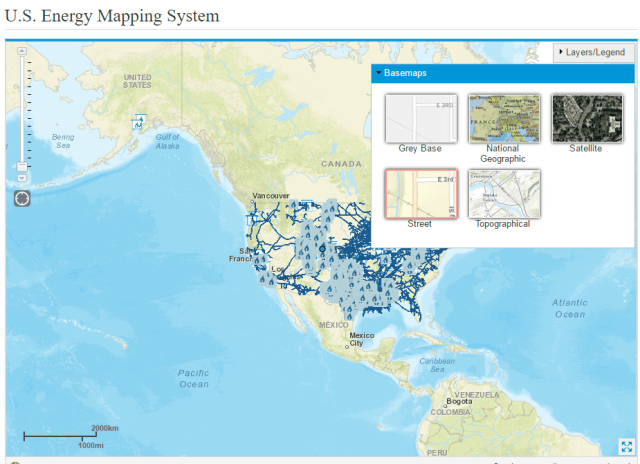
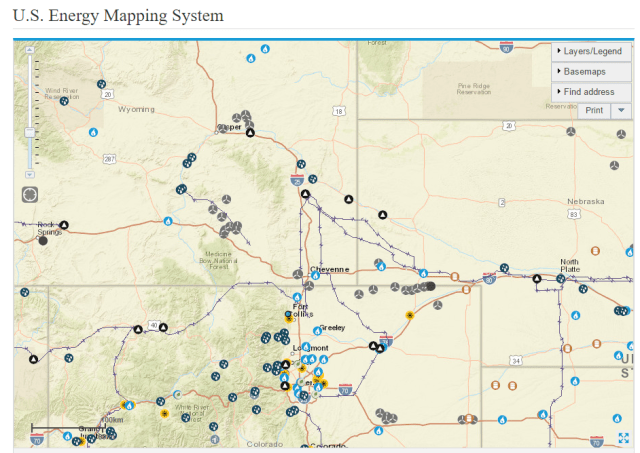
To access this tool, go to http://www.eia.gov/state/maps.cfm. You will see something that looks like this:mapping graphic 1

Let’s say I wanted to see what energy facilities are located near Enerdynamics’ offices in Laporte, Colorado. I can use the interactive menu in the upper right and corner and start exploring what facilities are nearby.

First let’s take a look at natural gas facilities. I know there are lots of gas pipeline and processing facilities in our region, but I want to see specifically where they are located. Finding out is simple.

I use the menu to select only the gas facilities I am interested in. To do so, I open the Layers/Legend section, and click the red X that says Remove All to clear the menu. Then I click the boxes next to Natural Gas Processing Plant, Natural Gas Inter/Intrastate Pipeline, and Natural Gas Underground Storage. Now the map shows all processing plants, all high-pressure pipelines, and all underground storage facilities.mapping graphic 2

Also, I want to see this down to the street level, so I use the Basemaps menu section to select Street.

mapping graphic 3

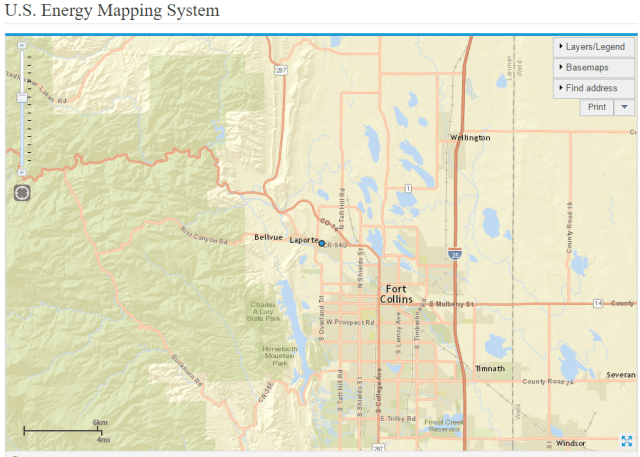
Then I enter our address into the Find Address menu, and here I see a map that makes me think there is nothing in my area:

mapping graphic 4

But this isn’t true, because the mapping system only shows certain facilities if the map is above the scale of 1:1,000,000. So I zoom out a little and find that while there are not facilities right in Laporte, there are numerous gas pipelines to the north and east, gas processing facilities around Greeley, and underground storage in the area of Fort Morgan.

mapping graphic 5


An important SAFETY WARNING: This map only shows high-pressure pipelines and is not showing distribution facilities. So don’t think you can go digging in Laporte without worrying about hitting a gas line!


Now suppose I wanted to find out more about the closest processing plant north of Greeley. I simply click on the icon on the map and see detailed plant information:

mapping graphic 6

Similarly, if I am interested in electric facilities, I can see all the power plants and transmission lines above 345 kV:

mapping graphic 7

And I can get plant-specific information:

mapping graphic 8

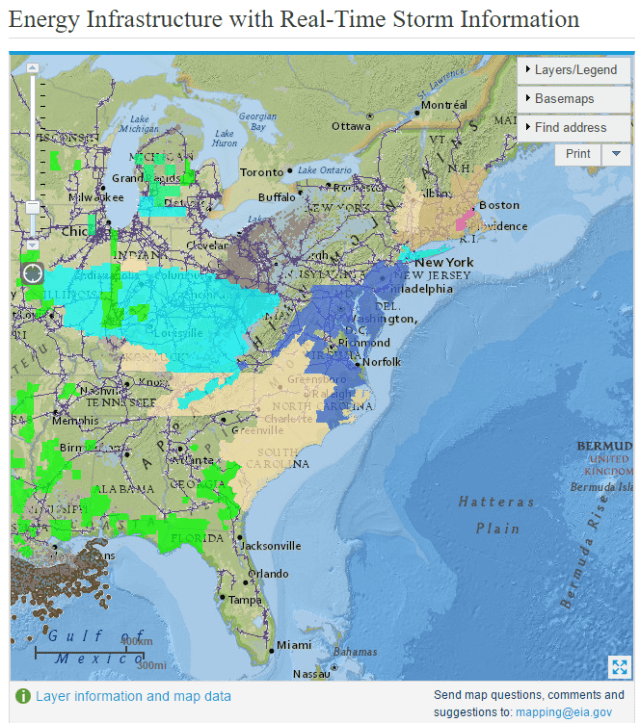
Although we won’t discuss it in detail here, a similar tool located at http://www.eia.gov/special/disruptions/ allows you to see what facilities are in the path of coming weather events:

mapping graphic 9


Posted in Electricity, Energy Training, Natural Gas | Tagged , , , | Leave a comment

Will Federal Government Enable Large Transmission Projects?

by Bob Shively, Enerdynamics President and Lead Facilitator

As our nation’s generation mix continues to evolve from one based on thermal fossil fuel baseload units to one based more on variable renewable generation and natural gas turbines, the role of transmission must also evolve. To the extent that the mix includes increasing distributed resources, then the role of transmission may not be a critical issue.

Distributed PV chart                     Source: NERC 2015 Long-Term Reliability Assessment, p. 20


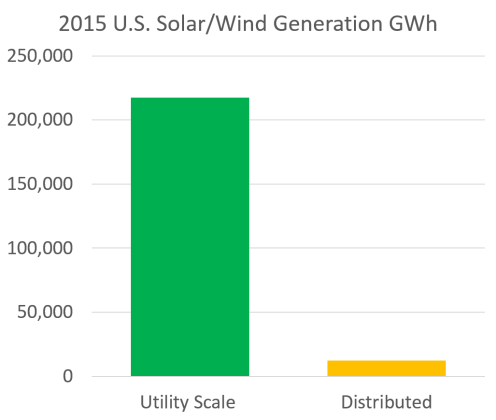
But at least to date, the majority of renewable generation has taken the form of utility-scale projects.

Utility scale vs distributed

Since renewable projects are located where renewable resources are most plentiful, new projects are often built in regions without much existing transmission and therefore require significant upgrades to deliver the power to load centers. A perfect example of this is the proposed 3,800 MW Power Company of Wyoming wind project that, if built as planned, will be the largest wind farm in North America. To make the project feasible, construction of the $3 billion, 725-mile TransWest Express transmission line connecting the farm to the grid in southern Nevada via Colorado and Utah will be required.

Wind resources and transmission lines.pngSource: NREL.gov[1]

Additionally, system operators are increasing depending on interregional power flows to manage the variable output provided by wind and solar resources. This is perhaps best demonstrated by the ongoing growth of the Energy Imbalance Market in the western United States, but is also demonstrated by the ability of MISO to absorb growing renewable generation across its footprint.

Market areas maps.png

The difficulty with needing more transmission is that transmission projects are difficult to build because, unlike natural gas pipelines, siting approval for electric transmission has traditionally been the legal purview of the states. This means that a line like TransWest must individually obtain approval from multiple states. This can be difficult because while a project may benefit numerous states, it may provide little to no benefits to one state that the line must pass through. The opposition of just one state has frequently been sufficient to sink proposed transmission projects.

To address difficulties in building transmission projects, the federal government has taken steps to move beyond sole state decision making. Congress in the 2005 Energy Policy Act authorized FERC to issue permits in certain situations where the states refused, but subsequent court decisions prevented this provision from being used. In 2011 FERC issued Order 1000, which required transmission planning to be done on a regional basis, but FERC does not have the ability to compel states to allow transmission to be built.

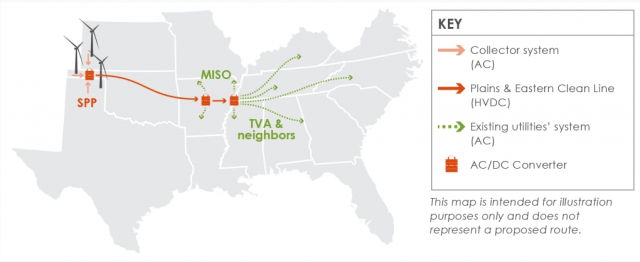
Finally, project developers working on the Plains and Eastern Clean Line, a $2 billion, 705-mile transmission project designed to bring wind power to the southeast figured out another angle. The project received approval from the states of Texas, Oklahoma, and Tennessee, but was stymied by the Arkansas Public Service Commission that stated that state law in Arkansas only allowed it to approve utility-owned transmission, not lines owned by independent transmission companies.

Plains and Eastern Clean LineSource: Cleanlineenergy.com

The project developers then turned to a separate provision of the 2005 Energy Policy Act that allows the Southwest Area Power Administration and/or the Western Area Power Administration to participate in transmission projects in states in which the agencies operate. With the participation of the federal agencies, state approval is no longer required[2] .

Of course, the state of Arkansas is not happy with the federal government stepping in, and it is attempting to change federal legislation. But, at least for now, there is an example of federal jurisdiction being used to construct multi-state transmission. More such federal efforts may be required if the U.S. is to build out the transmission “super-highway” envisioned by some renewable proponents. The fight over who has rights to approve transmission projects will significantly impact how our nation’s electric infrastructure develops going forward.


Footnotes:

[1] http://www.nrel.gov/electricity/transmission/transmission_planning.html

[2] See http://energy.gov/sites/prod/files/2016/03/f30/Summary%20of%20Findings%20Plains%20%20Eastern%20Clean%20Line%20Project%203-25-2016%20FINAL.pdf, p. 2 for further explanation


Posted in Electricity | Tagged , , , | Leave a comment

New Website Promotes Ease of Use, Free Training Tools


Enerdynamics recently launched a completely redesigned and much-improved enerdynamics.com. The new website is a significant upgrade from the previous site as it boasts a responsive design (meaning it is now mobile- and tablet-friendly), and it offers some helpful tools for training professionals. These include: 

  • All Products page: As the name suggests, the All Products webpage lists every product that Enerdynamics offers, with the exception of our Custom Training solutions that are built specifically for each client. From the All Products page users can use filters to narrow their product search based on industry (gas or electric), medium (online course, live seminar, or book), level (core or intermediate), and even topic (industry basics, physical systems, the utility business, and energy markets). You can also download a brochure with all of Enerdynamics’ products listed by medium and category. 
  • Resources section: Accessible from any page on the website via the Resources link in the site’s global header and footer, the Resources section features an array of useful tools that training managers can distribute to energy industry employees. Among these free resources are:  
    • Infographics — Enerdynamics continually creates visuals that help explain industry data and concepts in a clear and easy-to-understand graphical format. Examples include physical delivery systems, the grid of the future, and U.S. energy consumption by source and sector. View, download, and share these infographics at no cost. We just ask that you credit Enerdynamics Corp. as the source when using any of our inforgraphics in presentations or reference materials.
    • Industry glossaries and acronyms — Use these convenient links/downloads to keep employees current on the unique language and many acronyms widely used in the electric and gas industries. 
    • Video library — Access a variety of short videos that address various topics of interest and frequently asked questions relating to natural gas and electricity. This is a great opportunity for industry professionals to expand their understanding of the energy industry at no cost. 
    • Blog and newsletter access — Link to this blog, Energy Currents, to stay current on trends and topics of importance in the natural gas and electric industries. Access Energy Currents and archives of Energy Insider, our quarterly newsletter, from the resources page or the website’s global footer.

We hope you take some time to explore Enerdynamics’ new website and the easy-to-access information it offers on all of our products. If you have feedback or questions, email us or call us at 866-765-5432 ext. 700.

Posted in Energy Training, Uncategorized | Leave a comment

Where Do the Presidential Candidates Stand on Energy Issues? Part II

ELECTIONby Bob Shively, Enerdynamics President and Lead Facilitator 

Well, the field of presidential candidates shrunk a bit since we posted Part I of this article. With Ted Cruz and John Kasich dropping out of the race, there are three candidates left. Last week we looked at the stance each candidate (Cruz and Kasich included) has taken on four energy issues: overall policy, renewables, ethanol mandates, and fossil fuels.

Continuing our discussion but focusing on the three remaining candidates, here’s a brief overview of how Bernie Sanders, Hillary Clinton, and Donald Trump each view nuclear energy, energy efficiency, and climate change regulation.

Issue 5: Nuclear 

  • Sanders — Wants to progressively halt nuclear license renewals to ultimately phase out nuclear power
  • Clinton — Says she is agnostic (neither supports nor opposes)
  • Trump — Believes nuclear is an underutilized resource; strong supporter of further development of nuclear resources

 Issue 6: Energy efficiency 

  • Sanders — Strongly supports as a key part of energy policy
  • Clinton — Favors cutting energy waste by 30%; wants to bring efficiency to low-income citizens
  • Trump — Position unknown

 Issue 7: Climate change regulation 

  • Sanders — Favors the Clean Power Plan (CPP); wants to implement a national carbon tax
  • Clinton — Favors the CPP; plans to create $60 billion Clean Energy Challenge; supports a North American Climate compact with Canada and Mexico
  • Trump — Does not believe in man-made climate change; opposes any regulation on carbon emissions including the CPP

From these positions, the point is clear. If you want to make your voting decision based on a candidates’ energy views, you have a very distinct choice to make.

 Want to do your own research on candidates’ stances on energy? Here are some online resources that may help:

Posted in Electricity, Energy Training, Renewables | Tagged , , , , | Leave a comment

Where Do the Presidential Candidates Stand on Energy Issues?

by Bob Shively, Enerdynamics President and Lead Facilitator democrats x republicans

As we get deeper into the presidential election season, the current candidates offer very clear and differing views on what is the right energy path for America. There are two extreme ends of the spectrum:

  • One extreme, represented by Bernie Sanders, is that the U.S. needs to rapidly move away from fossil fuels and nuclear power, move to 100% renewables, and take strong action on climate change.

  • The polar opposite, represented by Donald Trump, is that America can only become strong again by focusing on fossil fuels and nuclear power and recognizing that the concept of man-made climate change is a “hoax.”

Here is where the candidates sit on the spectrum:  

To get a better understanding of each candidate’s views, let’s look at the stance each candidate has taken on specific energy issues as cited in their campaign websites, public statements, voting records, and debate responses.

Issue 1: Overall Policy

  • Sanders — Supports 100% renewables including phase out of nuclear power
  • Clinton — Strongly favors clean energy development, but also supports ongoing use of traditional sources with appropriate regulation
  • Kasich — Believes in mix of fossil fuels and clean energy
  • Cruz — Welcomes all energy sources, but opposes regulation and subsidies; wants government policy to encourage fossil fuel production
  • Trump — Believes in expanding fossil fuel production and nuclear power

Issue 2: Renewables

  • Sanders — States goal is to drive America to 100% clean energy; supports the Production Tax Credit (PTC)
  • Clinton — Strongly supports; policy calls for 50 million solar panels in first term (seven-fold increase over existing) and within 10 years enough renewable energy to power every home in America; supports PTC
  • Kasich — OK with renewables subsidies; supported Ohio’s current renewable portfolio standard (RPS), but he doesn’t make renewables a big piece of his platform
  • Cruz — Says we should pursue but only when it makes economic sense without any subsidy
  • Trump — Believes clean energy initiatives endanger lower- and middle-class jobs by increasing the cost of energy; at times says he’s OK with subsidies; sued to block offshore wind projects near one of his golf courses in Scotland; often belittles renewables in speeches

Issue 3: Ethanol mandate

  • Sanders — Supports
  • Clinton — Supports
  • Kasich — Supports
  • Cruz — Proposes five-year phase out
  • Trump — Supports

Issue 4: Fossil fuels (coal, natural gas, oil) 

  • Sanders — Opposes hydraulic fracturing and supports end of fossil fuel leases on public land
  • Clinton — Has stated support for natural gas and said hydraulic fracturing is acceptable if appropriately regulated; recently stated, however, that once hydraulic fracturing is regulated, there may be very few places left for drilling; wants to update infrastructure such as gas pipelines; wants to increase fees and royalties on fossil fuel production
  • Kasich — Strong supporter of hydraulic fracturing but as governor did propose additional taxes on gas and oil
  • Cruz — Wants to foster a “Great American Energy Renaissance” by removing federal obstacles to energy development and removing regulations on fossil fuels; wants to eliminate regulations that adversely impact the coal industry
  • Trump — Supports increased use of fossil fuels and hydraulic fracturing; hopes to resuscitate the coal industry by removing barriers to mining

Next week we’ll look at each candidate’s stance on three more issues: nuclear power, energy efficiency, and climate change regulation.

Posted in Electricity, Energy Training, Natural Gas, Renewables | Tagged , , , | 1 Comment

New York’s REV: A New Model for the Electric Business Worldwide?

By Matthew Rose, Enerdynamics Facilitator and Director at EMI Consulting

Queensboro bridge and Ravenswood station

There’s a lot of talk — and many opinions — among electric industry insiders about New York’s Reforming the Energy Vision (REV) model. Some view it as a visionary promise, while others feel it’s a perilous and overly ambitious process, too many details of which must still be determined.

Initiated in 2014, REV is an ongoing proceeding initiated by the New York Public Service Commission (PSC) designed to transform the retail electricity market in New York. REV is structured to move the electric industry away from a monopoly-regulated, cost-plus driven system to one based on the market with emphasis on customer-owned distributed energy assets. The REV initiative focuses on distributed system solutions that lead to greater resiliency and reliability while finding ways to upgrade system infrastructure. REV also empowers customers to take greater control over energy usage and find ways to engage as prosumers (energy producers).

The REV proceeding is a work in progress, which is not surprising given the complexities and scope of the state’s legacy electric utility regulatory framework. The proceeding includes hundreds of stakeholders, academics, and industry experts trying to anticipate, plan, and ultimately revise New York’s electric regulation and markets. It is acknowledged that it will take New York years to fully embed REV into policy, rules, and operations while moving from “philosophy to practice.”

To realize their expansive vision, New York regulators separated the REV docket into two tracks:

  • Track One focuses on developing distributed resource markets with the utility serving as the distribution system platform (DSP) provider. As a DSP provider, the utilities serve as orchestrators of the distribution grid responsible for enabling dynamic load management. This will help reduce energy usage, balance loads, and integrate distributed energy resources without the utility assuming ownership of assets behind the customer meter.
  • Track Two focuses on aligning utility interests with policy objectives by reforming utility ratemaking practices and revenue stream strategies. The intent leads to rewarding utilities for positive market performance rather than capital investment. Specific issues include rate and tariff design, market-based earnings, alternate regulatory schemes, and performance-based regulation.

Efforts associated with both tracks are underway as decision makers debate system policies and operations.

The current focus of the REV proceeding aims at using demonstration programs to test various aspects of distributed energy resources (DER) integration, customer data sharing, and third-party partnerships. Later this year the NY utilities are required to file initial five-year plans to begin delivering distributed energy resources from third-party providers. The demonstration projects are intended as blueprints for the new utility initiatives called distributed system implementation plans, or DSIPs.

The New York PSC has approved a series of demonstration projects across the state. Examples of approved projects include:

  • targeting offers to customers who use non-wire alternatives to offset distribution system investment
  • using community solar to help low- to moderate-income customers access clean energy while reducing outages
  • offering residential customers a resiliency service bundling solar with batteries and energy storage to extend customer value
  • developing alternative solutions for renewable grid interconnection

A complete listing of approved projects is available on the NY PSC website.

The REV initiative still faces many challenges and areas of contention, especially as the traditional electric market undergoes change that impacts how companies transact with customers and make money. The proceeding is beneficially forcing a discussion of the state’s electricity future while raising key questions that eventually everyone will need to answer. But if implemented as envisioned, New York’s REV model may become the model for utility and electric retail market reform across the U.S. and around the world.  

Posted in Electricity | Tagged , , | 1 Comment

Continental U.S. Begins Exporting LNG Despite Uncertain Global Market, part II

by Christina Nagy-McKenna, Enerdynamics Facilitator

In last week’s post I delved into how the United States’ lower 48 is, for the first time ever, iStock_000067246787_Mediumexporting liquefied natural gas (LNG) to overseas markets. On February 24, 2016, the first LNG tanker filled with U.S.-produced, non-Alaskan natural gas left Sabine Pass LNG terminal in Texas and headed for Brazil.

Many factors are at play that will ultimately determine LNG’s impact on U.S. gas markets. Last week we asked:

  • Can U.S. LNG erode Russia’s European market share?
  • Will Australian LNG supply further erode market opportunities?


Continuing our discussion, let’s briefly look at the natural gas supply-versus-demand situation in the U.S. and globally.

Will U.S. demand remain weak relative to supply?

Henry Hub prices and those across the U.S. are at a surprisingly low point, especially since the winter season has yet to end. However, a mild winter and record gas production has led to what is perhaps the lower end, if not the bottom of the market, and this is taking a toll on producers.

Steve Mueller, former CEO of Southwestern Energy, stated last year that higher drilling rig efficiencies have led to lower costs and huge time-savings. The company can now drill twice as far in less than half the time due to technological advancements in the drilling process. However, the darker side of very low prices and robust supplies has reared its head for the company as it announced in January a workforce reduction of more than 40% of its employees. The company had no active drilling rigs at the time, and this was the second workforce reduction since the third quarter of 2015.

In the meantime:  

  • Residential and commercial U.S. consumption is down this winter, according to the EIA.
  • Storage working gas stocks may end the winter season with close to 2,336 Bcf, above the five-year average and close to the record of 2,473 Bcf set in 2012.[2]
  • Low U.S. prices make overseas market more desirable, but they also may be the undoing of the production boom if prices continue to decline.

Will world demand also remain weak? 

The U.S. market is not the only one in which demand is weak: 

  • Platts’ Eclipse Energy Group reports that global demand growth in 2015 was only 700 MMcf/d, while 2.2 Bcf/d of new export capacity was added to the market.[1]
  • Chinese manufacturing has declined for the 11th straight month as of the end of January, and it may be slow to recover as the government moves away from a strategy of increased exports and large capital projects to one of increased domestic demand.
  • Japan has restarted two of its 43 nuclear power plant units that have been off-line since September 2013 following the implementation of stricter safety rules due to the Fukushima nuclear disaster. Twenty-five units have applied for safety inspections that would allow them to restart in the near future. This would reduce Japan’s demand for natural gas as a fuel for electric generation.

To say that the U.S. natural gas market is in an uncertain position is like saying “situation normal” for this volatile commodity. The greater change is the geographic reach of implications as the U.S. enters the global LNG market as an active seller. Just a decade ago such a scenario seemed ludicrous as the U.S. looked to the LNG market as a means of garnering additional supply. Now, in 2016, the U.S. is officially in the export business, and those in the industry will watch intently to see how market competitors like Russia, Australia, and Qatar respond.


Footnotes:

[1] “The U.S. Enters a Brave New World as It Begins LNG Exports,” The Barrel Blog, Platts.com, February 10, 2016

Posted in Natural Gas | Tagged , , , , , | Leave a comment

Continental U.S. Begins Exporting LNG Despite Uncertain Global Market, part I

by Christina Nagy-McKenna, Enerdynamics Facilitator

The natural gas market, like all commodity markets, is a moving target that once again is shifting. But for U.S. gas production there is a new factor: global price exposure due to U.S. liquefied natural gas (LNG) export capability.

On February 24, 2016, the first LNG tanker filled with U.S.-produced, non-Alaskan natural gas set sail for an overseas market. The Asia Vision left Sabine Pass LNG terminal in Texas and headed for Brazil.

The road to the export market began in 2011 for Cheniere Energy, the company that owns the Sabine Pass facility and the first company to apply for an export license with the U.S. Department of Energy. During the subsequent five years several things occurred:

  • Russia made it no secret that it was unhappy with the prospect of competing with the U.S. for natural gas sales to Europe;
  • natural gas prices fell to $1.85/MMBtu at Henry Hub;[1]
  • global market demand no longer could keep up with expanding supply;
  • and Australia roared into the LNG export market.

Two years ago Russian President Vladimir Putin expressed his doubt that U.S. exports of LNG would impact his country’s substantial market share of natural gas in Europe. Asian markets, in Putin’s opinion, were more lucrative for the U.S. However, the economic slowdown in China, the drop in global oil prices, and the return of nuclear-generated electricity in Japan, have put downward pressure on natural gas prices in Asia, thus making it a less lucrative market for LNG exports.

As the U.S. enters the LNG export market, some key questions surrounding the global market situation remain to be answered:

  • Can U.S. LNG erode Russia’s European market share?
  • Will Australian LNG supply further erode market opportunities?
  • Will U.S. demand remain weak relative to supply?
  • Will world demand also remain weak?

Ultimately the answers to these questions will determine LNG’s impact on U.S. gas markets. We’ll look at the first two questions in this post and discuss the questions relating to U.S. and global demand in next week’s post.

Can U.S. LNG erode Russia’s European market share?

While the European Union may be cautious about doing business with Russia because of recent geo-political events, European utilities do not share the EU’s concern. This means that whoever wins the European market will have to do so with competitive prices.

Whether the Russians, with a weak ruble and falling oil and gas prices, can compete long term in a slash-and-burn economic fight is up for debate. Some analysts forecast that Russia will take a page out of the Saudi playbook and simply crank up the volume on production, flood the market, and absorb the impact from lower prices. Others believe Russia has no room to cut prices based on their analyses of Gazprom’s production and transportation costs. The mild winter weather in Europe this year is not fueling the issue. It will be one to watch during the winter of 2016-2017.

Will Australian LNG supply further erode market opportunities?

Australia is ready to make its presence felt in the global LNG market. Gorgon LNG in Western Australia is a mega project operated by Chevron and owned jointly by Exxon Mobile, Shell, Osaka Gas, Tokyo Gas, and Chubu Electric Power, presumably giving it the inside track on portions of the Japanese market. Chevron announced this week that it expects its first shipment of LNG to depart Barrow Island later this week. Two more liquefaction trains will come on line in the next year. In addition, three other LNG projects are under construction in Australia and three additional projects have been commissioned since 2014. The EIA estimates that Australia will have a capacity of 11.5 Bcf/day by 2019 and will overtake Qatar as the world’s largest global liquefaction capacity holder. Some of the LNG will stay in Australia, but the majority is earmarked for Asia.

Next week we’ll  explore the status of gas demand in the U.S. and around the world and how demand may impact the U.S.’s success as an LNG exporter.

Posted in Natural Gas | Tagged , , , | Leave a comment

Is the U.S. Losing Its Lead in the Business of Battling Climate Change?

by Bob Shively, Enerdynamics President and Lead Facilitator

“Private firms have the primary responsibility for the development and adoption of technology in this country, but federal and state governments play an important role in enhancing civilian technology development and adoption through their economic, regulatory, and trade policies, their support for research and development, and their own procurement of technology.” National Academy of Sciences[1]

“We are driven to the conclusion that activist and aggressive policy choices are necessary to drive reductions in the consumption of fossil fuels and greenhouse gas emissions.”

Covert, Greenstone, and Knittel[2]

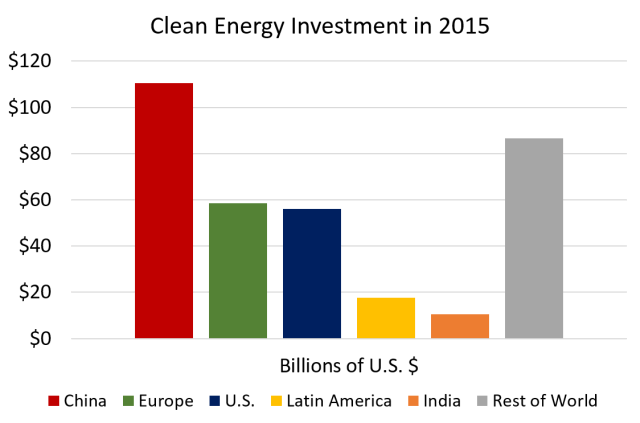
clean energy investment 2015 by country

Climate change concerns have driven a significant technological evolution in the energy industry including development of wind energy, solar energy, energy storage, and advanced electric distribution systems often called the smart grid. Another recent key technological development — hydraulic fracturing that allows for the economic development of shale gas— also has received generally favorable support from both the Bush and Obama administrations, at least in part for gas’ ability to quickly reduce greenhouse gas emissions by replacing coal generation. 

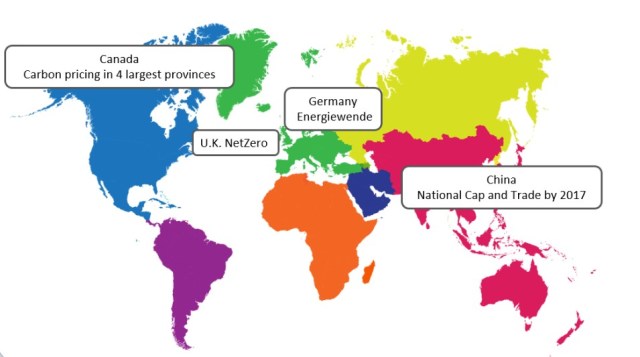
In the U.S., such developments have been assisted by favorable government policies including federal R&D investment, tax credits, state-level renewable portfolio standards, and federal support for natural gas development. No doubt about it, there is serious business opportunity in battling climate change. But now that federal-level climate change action seems stalled in the U.S. with the Supreme Court’s stay of the Clean Power Plan, it is possible that other countries will overtake the U.S. in developing technologies that will ultimately create wealth from combating climate change. Here are some key developments in some other countries around the globe:

climate change map

Canada

  • The four largest provinces have implemented either carbon taxes or cap-and-trade programs, and the federal government is developing federal-level policy.
  • Any new coal unit must incorporate carbon capture and storage or keep carbon emissions limits at the level of a new natural gas combined-cycle unit.
  • In 2014, Saskatchewan opened the world’s first commercial-scale carbon capture and storage power plant.

China

  • China is implementing national carbon cap-and-trade by 2017 and government policy designed to reduce coal consumption.
  • A five-year plan with a focus on the environment is in the implementation stage.
  • Extensive government support exists for development of energy efficiency, new nuclear including SMR (small nuclear reactor), renewables, and carbon capture and storage.
  • China has become the world’s largest manufacturer of solar photovoltaic technology and is the largest market for clean energy investment.

Germany

  • Almost 33% of the country’s generation in 2015 was from renewable.
  • There are significant subsidies for renewable energy and currently strong government support for off-shore wind.
  • Germany is moving forward with plans for construction of high-voltage direct current transmission lines to move renewable energy.
  • It is closing all nuclear units but still struggling with use of lignite coal.

United Kingdom

  • Current law is for the U.K. to reduce carbon emissions by 80% by 2050.
  • Government has stated it will pass a new law in 2016 mandating net zero carbon emissions by a currently unspecified future date.
  • Government subsidies for renewables (although renewable subsidies have recently been cut), nuclear, carbon capture and storage. The government also strongly supports new natural gas infrastructure.

It is indeed possible that state-level actions, initiatives by U.S.-based corporations, and federal tax policy extending production tax credits will keep the U.S. in the forefront of technology development[3] in response to climate change. However, as evidenced by recent developments overseas, the reality exists that another country or countries may take the lead while the U.S. stalls due to political stagnation in Washington.


Footnotes:

[1] The National Academy of Sciences, Preparing for the 21st Century: Technology and the Nations Future available at http://www.nas.edu/21st/technology/technology.html

[2] The Journal of Economic Perspectives, Winter 2016, Will We Ever Stop Using Fossil Fuels?, Thomas Covert, Michael Greenstone, and Christopher R. Knittel

[3] See for instance: Rocky Mountain Institute: Ten Things More Important Than the Clean Power Plan in Limiting Carbon Emissions in the U.S., at http://blog.rmi.org/blog_2016_02_11_10_things_more_important_than_the_clean_power_plan


Posted in Energy Training, Renewables | Tagged , , , | Leave a comment

Can a Hawaiian Island Run Its Grid on 100% Renewables?

by Bob Shively, Enerdynamics President and Lead Facilitator

wailua falls kauai hawaii

Wailua Falls in Kauai, Hawaii

The state of Hawaii has made it law that by 2030 40% of electricity used by utilities mustbe generated by renewable sources and that 100% will come from renewables by 2045.  Many wonder how this will be possible, especially in a state with separate unconnected electrical grids on each of the six main islands. For a vision of how this is possible, let’s look at the island of Kauai, which is already moving down the path to 100% renewables[1]:

  • Kauai generated 38% of its power from renewables in 2015.
  • For short periods in the month of January 2106, Kauai ran its system on over 90% renewables.
  • The Kauai Island Utility Cooperative (KIUC) that serves the island plans to generate more than 50% from renewables by 2023.

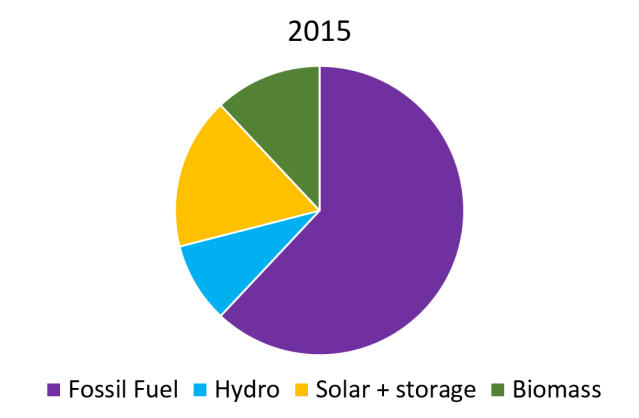
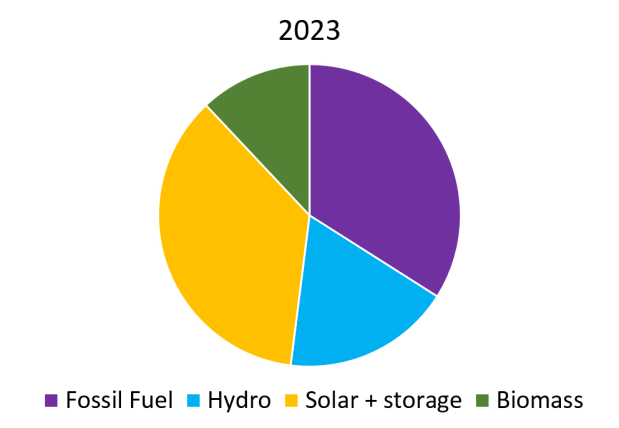
The following charts demonstrate Kauai’s shift from fossil fuels to renewables:

Kauai 2009

Kauai 2015

Kauai 2023

According to the Regulatory Assistance Project (RAP)[1], there are 10 key strategies for running an electric grid with high penetrations of renewables:

  1. Targeted efficiency that reduces demand in key hours
  2. Peak-oriented renewables that provide output during high-demand hours
  3. Managing water pumping to reduce pumping loads during ramping hours or times when renewables output is low
  4. Controlling electric water heaters to heat water during night and mid-day hours
  5. Converting commercial air-conditioning to utilize ice or chilled water storage
  6. Adapting rate design to focus on time-of-use that charges high prices during crucial hours and avoids high fixed charges
  7. Deploying electric storage for targeted purposes
  8. Deploying demand response programs to reduce loads during critical hours
  9. Developing programs for inter-regional power exchange to allow import/export to regions with different peaking period or different renewables output
  10. Replacing inflexible generating plants with flexible resources

To understand how a tiny island like Kauai can turn these strategies into a successful high-penetration renewables plan, it’s important to have some background on its exclusive utility, KIUC[3]:

  • KIUC, a customer-owned cooperative, is the exclusive provider of electricity on the island of Kauai.
  • There is no interconnection to other islands.
  • KIUC traditionally served the island with 121.3 MW of fossil fuel generation and 1.3 MW of hydro capacity.
  • The current system peak demand is approximately 73 MW.
  • System load typically varies from a low of about 30 MW to a peak of 70 MW. Peaks occur in the early evening, and day-time loads average between 60 to 65 MW.
  • Given the load shape, a key challenge for KIUC as solar penetration grows is to “move” solar generation from mid-day to the evening peak.
  • Annual energy sales are over 425,000 MWh.

Now let’s take a look at how KIUC has applied the RAP principles:

Targeted efficiency — KIUC has an active Energy Wise conservation program that includes services around efficient lighting, heat pump water heaters, efficient appliance replacement including ceiling fans and window air-conditioners, appliance meter testing, and a commercial retrofit program.

Peak renewables — KIUC has encouraged development of both utility and customer-owned solar photovoltaic (PV) resources. KIUC has installed 24 MW of utility PV generation while customer-owned had exceeded 20 MW with installations at over 3,000 customer locations (10% of its customer base).

Managed water pumping — Water pumping is not a big load on Kauai, so KIUC has not found this to be a key area to pursue.

Controlled water heaters — KIUC has concentrated on reducing hot water demand through a solar hot water heater that offers $1,000 rebates plus low- or no-interest loans and rebates on heat pump water heaters that significantly increase the efficiency of water heating. This is important because water heating is often the largest use of energy in customers’ homes.

Controlled air conditioning — As mentioned above, ceiling fans and air conditioners are a key component of KIUC’s energy efficiency programs. Especially important is cooling in the commercial sector, which can make up 30% of commercial loads. KIUC’s commercial retrofit program offers incentives that can cover 50 to 100% of the cost of retrofitting commercial premises.

Focused rate design — KIUC started a pilot program with 300 customers to shift demand to the high solar hours. The program offers customers a 25% rate discount for all power used during the hours of 9 a.m. and 3 p.m. This is of note because most time-of-use rate structures encourage customers to use energy in night-time hours, not during the solar peak.

Energy storage — KIUC is working to develop pumped hydro projects that are planned to provide 25 MW of storage by 2019. These projects are designed to pump water during the mid-day solar peak and use the water to generate power during the evening hours. KIUC currently has 10.5 MW of battery storage. This includes 4.5 MW of grid storage and 6MW of storage at the Anahola solar array to handle short-term fluctuations in solar output. KIUC also signed a power supply agreement with SolarCity for a future solar project that includes 13 MW of batteries allowing solar output to be shifted to later in the day.

Demand side management — Current demand response programs are included in the Energy Wise program discussed above.

Inter-regional exchange — While inter-island cables have been discussed for some of the Hawaiian Islands (most notably Oahu and Maui), Kauai’s smaller size and location make it less likely to be able to share integration efforts with other islands, at least in the near-term.

Flexible resources — KIUC recently added a 7 MW baseload biomass power plant. This is meaningful because it frees up fossil fuel generation that used to be baseload to now be used as load-following resources. Existing diesel gensets have been upgraded to provide more flexibility including the ability to run below 50% loading and to ramp quickly.


In addition to the efforts described above, KIUC has made changes to its generation interconnection requirements and its distribution grid. These include inverter requirements, installation of advanced metering, and redesign of relay protection and load shed schemes.

As of early 2016, KIUC feels confident in its ability to reliably and economically achieve over 50% renewables by 2023. The next question will be how to squeeze out the last 35% of fossil fuel generation.  This will likely require advancements in biofuels and electric storage, which is a topic worthy of its own discussion in a future post.


Footnotes:

[1] For a scenic view of many of KIUC’s renewable generation, watch the short video at: https://vimeo.com/153464892

[2] Lazar, J. (2016). Teaching the “Duck” to Fly, Second Edition, Montpelier, VT: The Regulatory Assistance Project. Available at: http://www.raponline.org/document/download/id/7956 

[3] For more details, see the KIUC website at http://kiuc.coopwebbuilder2.com/content/about-us and the Case Study Kauai Island Utility Cooperative: The Impact of Extensive PV Penetration, Tom Lovas, July 2015 at http://www.nreca.coop/wp-content/uploads/2014/09/ts_kiuc_pv_case_study_july_2015.pdf

 

Posted in Electricity, Renewables | Tagged , | 2 Comments