Are Zero Marginal Costs Transforming the Energy Industry?

by Bob Shively, Enerdynamics President and Lead Facilitator

In his 2014 book The Zero Marginal Cost Society, futurist Jeremy Rifkin states his view that  “the emerging Internet of Things is speeding us to an era of nearly free goods and services.”[1]

Specifically, Rifkin describes how once initial capital costs are spent, more and more goods and services have almost no marginal cost[2] to produce. An example is the music industry where digital versions of songs, once recorded, have virtually zero marginal cost to provide copies to consumers. In a recent talk in Chicago, Rifkin described his views on how this applies to the energy industry. These were summarized as follows by the Energy Times[3]:

“The Third Industrial Revolution will see a decline in massive vertical power structures in favor of a horizontal, distributed model. Economies will move from a seller-buyer model to a provider-user model. More and more industries – just like the music and entertainment industries have already experienced – will make the shift to operating off of very low margins of very high traffic.

The same will hold true for energy companies. In this highly distributed model almost every community, no matter the size, will be generating it’s [sic] own power off of solar and wind. Energy will become amazingly cheap, and energy companies will make their money through partnerships with their customers and clients to manage those distributed networks.”

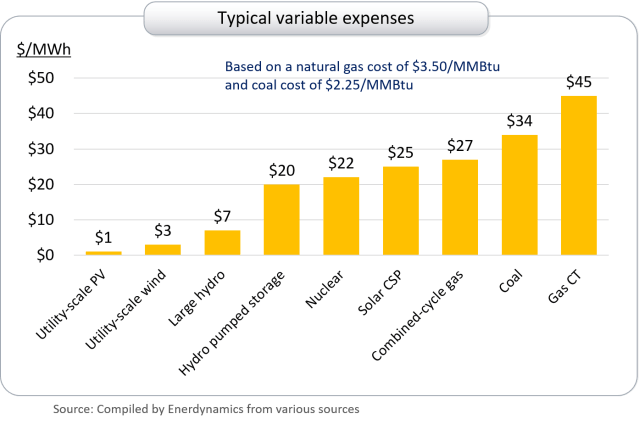
Certainly, the energy world is becoming familiar with the concept of low marginal costs.  Advances in the natural gas industry including horizontal drilling and hydraulic fracturing have resulted in a natural gas resource with very low marginal cost that has driven prices to sustained lows not seen since the early 2000s. And in both the generation and the utility distribution side of the business almost zero marginal cost renewable generation is roiling business practices built on the concept that both capital costs and variable costs could be spread across all customers in a “fair” manner determined by long-standing regulatory principles.

variable-expenses-by-resource

Rifkin suggests that utilities must be preparing for the Third Industrial Revolution by running two parallel business models. One focused on continuing to provide reliable service in today’s energy world primarily driven by fossil fuels, and one focused on transitioning the company to the future.  He suggests that utilities prepare for the future by setting “up partnerships with thousands and thousands of enterprises. You have to manage their energy flow on an on [sic] internet platform, helping them to mine the analytics of their big data and their energy flows.”[4]

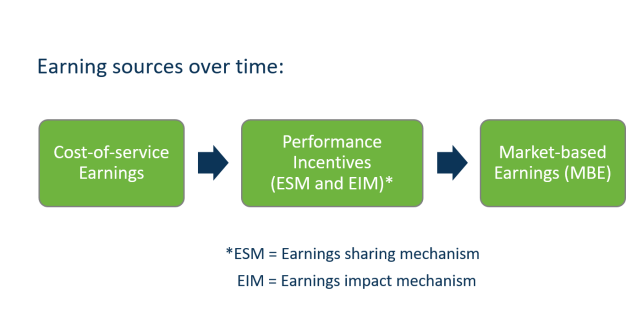
Interestingly, this echoes the direction the State of New York is taking in the ongoing Reforming the Energy Visions (REV) proceeding where regulation will be reformed to move electric utilities to become distribution systems platforms[5]. Over time, New York envisions that utility revenues will become more and more driven by market-based earnings associated with network services. Below illustrates NY PSC’s vision for future utility earning sources.earning-sources-over-time

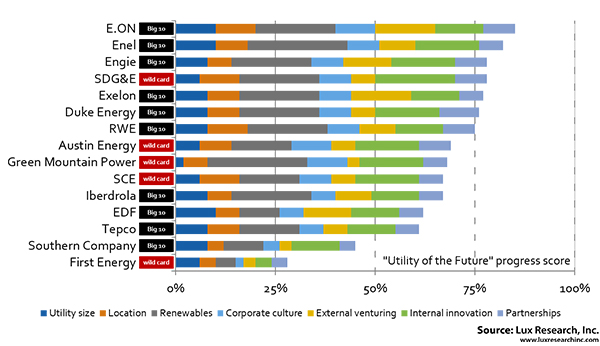
Transforming a company while also keeping the lights on in today’s world is not an easy task. Certainly some utilities will do better than others. A recent study by Lux Research[6] suggested that some of the utilities leading the way include the European utilities E.ON, Enel, Engie, and RWE plus the U.S. utilities SDG&E, Exelon, and Duke.

hr_7_3_16_1-0

Of course, who wins and who loses in the coming new world remains to be seen. But what appears certain is that future energy companies will be as dramatically different from our traditional utilities as today’s mobile carriers are different from the Bell telephone companies of yesteryear.


Footnotes:

[1] If you have 10 minutes, we recommend Rifkin’s video at https://www.youtube.com/watch?v=3xOK2aJ-0Js

[2] For an explanation of marginal costs, see http://www.investopedia.com/terms/m/marginalcostofproduction.asp?lgl=no-infinite

[3] Bold New Power Vision at Empowering Customers & Cities 2016, Steve Spaulding, The Energy Times, November 3, 2016, http://tdworld.com/energy-times/bold-new-power-vision-empowering-customers-cities-2016

[4] Utilities Must Partner with Thousands, the Energy Times, October 6, 2016, http://tdworld.com/news/utilities-must-partner-thousands-0?utm_rid=CPG04000000071983&utm_campaign=10742&utm_medium=email&elq2=60f97daa7c6f478e8e6af8489d0077d7

[5] See Enerdynamics blog, New York’s REV a New Model for the Electric Business Worldwide?  https://blog.enerdynamics.com/2016/04/21/new-yorks-rev-a-new-model-for-the-electric-business-worldwide/

[6] http://blog.luxresearchinc.com/blog/2016/07/leaders-and-laggards-in-the-race-to-create-the-utility-of-the-future/


Posted in Electricity, Energy Training | Tagged , , | Leave a comment

LNG Goes Off the Grid

by Christina Nagy-McKenna, Enerdynamics Instructor

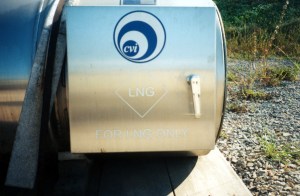
Liquefied natural gas fueling station

This liquefied natural gas fueling station at INEEL was built by MVE, Inc. and provided to INEEL by Amoco LNG. As part of its liquefied natural gas R&D program, INEEL uses this skid-mounted LNG fueling station that can be moved to various locations to service its natural gas vehicles. (Photo credit: NREL)

Liquefied natural gas (LNG) may soon be available to customers who, due to infrastructure restraints, do not have the option to choose natural gas as a fuel source. ISO (International Organization of Standardization) containers that fit on rail cars, truck trailers, and container ships and can hold 10,000 gallons of LNG are the lynchpin to opening these new markets. The 40-foot by 8-foot containers hold the equivalent of 830 Mcf of natural gas, enough to meet the annual consumption of 13 American households[1], and they offer an alternative delivery system to the large tanker ships that have been used for many years.

Mainland, remote U.S. markets are the target for one project that utilizes ISO containers, while another company is focused on more distant markets in Alaska, Puerto Rico, the Bahamas, and the Caribbean. Each will offer new choices to customers as they manage their environmental and business goals.

In Port Allen, La., NuBlu Energy recently began construction on a small-scale LNG plant that will ship containerized LNG to U.S. markets that do not have access to natural gas pipeline infrastructure. While the company is currently focused on high-use, industrial, and power generation end-use customers, shipping LNG in ISO containers also could be useful to smaller companies that cannot afford the high cost of traditional gas pipeline infrastructure expansions. The first phase of NuBlu’s project will produce up to 30,000 gallons of LNG per day. The company plans to expand to 90,000 gallons per day with 120,000 gallons of on-site storage capacity.

William H. Martin, Inc., a USA waste services company, Waste Management of PA, fueling station

photo credit: NREL

Crowely Maritime entered the LNG market by purchasing Carib Energy LLP in 2013. Among its energy services, Carib LLP, now a Crowley subsidiary, offers containerized transportation of LNG to markets in Alaska, Puerto Rico, the Bahamas, and the Caribbean. Small-scale LNG deliveries in ISO containers has helped the company reach end users such as Molinos de Puerto Rico, the largest supplier of flour to Puerto Rico.  Using ISO containers, Crowley will transport LNG that it will purchase from Pivotal LNG to its shipping facility in Jacksonville, Fla. From there the containers will be loaded onto a ship and delivered to Puerto Rico where Crowley will oversee the delivery of the containers to the Molinas plant.

These are but two examples of the possible markets that containerized LNG will reach in future years. If the ISO distribution and LNG fuel technologies continue with their early joint success, remote end-use customers will eventually have more fuel choices like the many customers who are connected directly to the gas pipeline grid.


Footnotes and references

[1] 2009 Residential Consumption Survey, Table CE3.1, Household Site End-Use Consumption in the U.S., Totals and Averages, 2009, U.S. Energy Information Administration, January 11, 2013.

Containerized LNG Broadens Reach of Natural Gas to Off-grid Customers,” October 26, 2016, U.S. Energy Information Administration.

 “Crowley to Supply LNG to Alaskan Power Plant,” LNG World News, October 16, 2016.

Pivotal LNG, Crowley’s Carib Energy Reach Multi-Year Supply Agreement for Puerto Rico,” News and Media, August 31, 2016, Crowley Maritime Corporation website.

2009 Residential Consumption Survey, U.S. Energy Information Administration.


Posted in Natural Gas | Tagged | Leave a comment

Are E-Bay Style Transactions and Blockchains Ready to Transform Electricity Markets?

by Bob Shively, Enerdynamics President and Lead Instructor

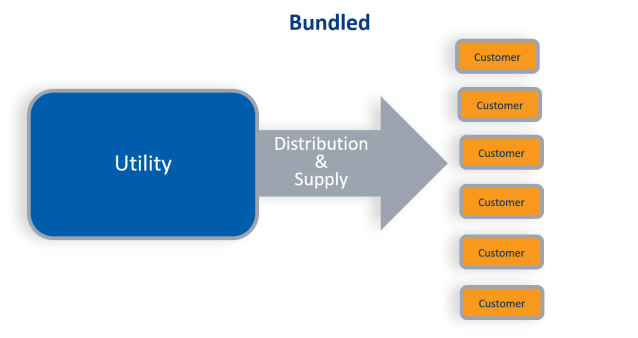
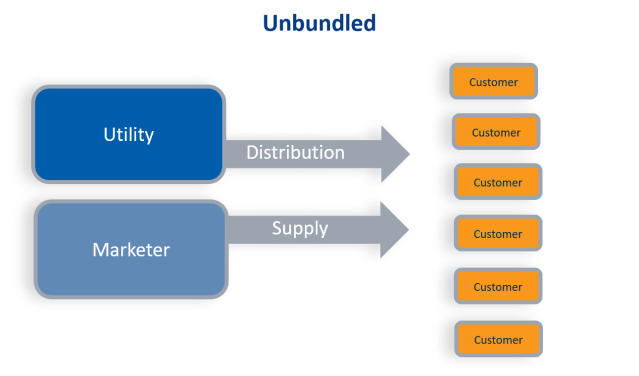
Over the last 20 years, the electric industry has gradually transitioned how its consumers purchase electric services. Prior to the 1990s, all consumers bought bundled service from their monopoly local utility. Beginning with deregulation in the 90s, some regions unbundled supply from distribution to allow consumers to purchase electricity from third-party retail marketers; transmission and distribution remained the role of the monopoly utility.

bundled-service

unbundled-service

Approximately 24% of U.S. consumer electric usage currently is acquired from retail marketers instead of the distribution utility. This figure has increased steadily and is likely to continue its growth given interest in Community Choice Aggregation in California and a successful ballot proposition in Nevada where voters supported implementation of customer choice. In other countries, this percentage ranges from 0% to 100% depending on regulatory and business models.

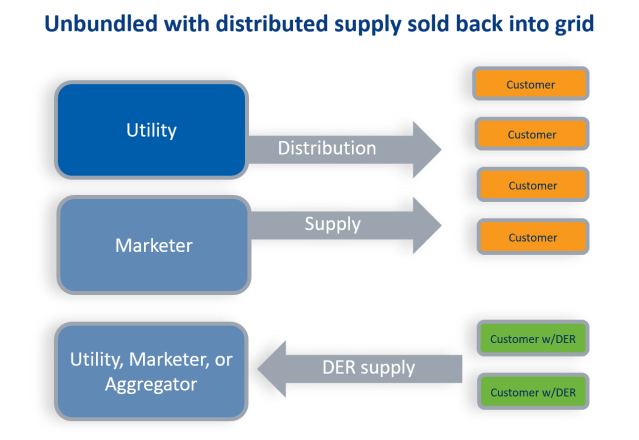
Both models assume that large central generators produce the bulk of supply that is then purchased by a central entity (either a utility or a retail marketer) for resale to end users. Retail electricity markets have continued transforming in some regions with the growth of distributed energy including combined heat and power (CHP), rooftop solar, and active economic demand response. But markets are still structured with the assumption that any distributed energy not used internally by a customer is sold back to a centralized entity.

unbundled-with-dist-supply-sold-back

Are Markets Ready for a New Paradigm of Peer-to-Peer Transactions?

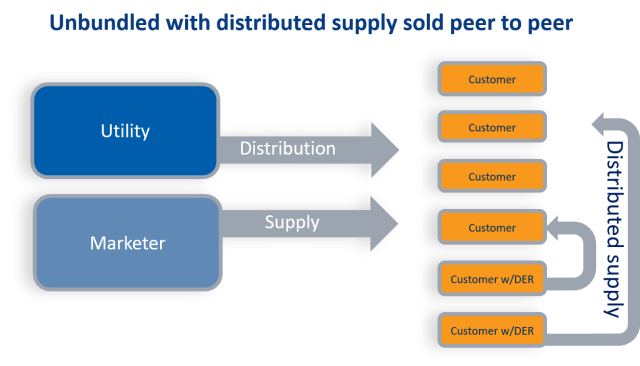
From time to time, energy insiders have discussed whether an E-Bay model allowing customers with DER — sometimes called prosumers since they can both produce and consume electricity — could interact among themselves and bypass centralized market players. It’s comparable to how people sell unneeded used items on E-Bay or via Craigslist. Until now, technologies, markets, and regulatory rules have not allowed for such transactions. Even if one can figure out how to physically sell power to a neighbor (run a wire over the fence?) it’s likely they’ll receive a letter from the local utility instructing them to cease and desist from violating their monopoly franchise service territory.

But with regulators looking at new business models fostered by the growth of DER, pilot projects are now testing the possibility of enabling peer-to-peer transactions.

Unbundled peer2peer.png

Imagine that you install solar on your roof, but you and your other family members typically work during the day so no one is home. Rather than selling back to your utility, you might instead sell the supply directly to another consumer so they can avoid high time-of-use or demand charges and simply use the utility as an enabling network.

Enabling Technology is Here, We Just Need to Develop Regulatory and Business Models

The enabling technology is already available to make this happen including the PowerMatcher platform developed in Europe by the Flexipower Alliance Network and the Transactive Grid platform developed by the U.S. company LO3 energy. As the State of New York explores new business models in the NYREV process, Siemens AG and LO3 have announced that the Brooklyn Microgrid project will test local energy trading based on blockchain technology that is now being used to facilitate secure financial trading, but that has yet to be applied to retail energy.  Pilot projects such as the Brooklyn Microgrid and other efforts in Europe will begin to address the desirability of moving forward with new transactive business models. It will then be up to the regulators and industry participants to modify current structures to allow a new way of doing business to grow.

Posted in Electricity | Tagged , , | Leave a comment

Surviving the Winter Without Aliso Canyon: A Look at California’s Short- and Long-term Natural Gas Storage Future

by Christina Nagy-McKenna, Enerdynamics Instructor

California’s transition to a carbon-free resource mix for electricity generation may have just gotten a momentum boost from a most unlikely source: clean-burning natural gas.

Long at the forefront of the movement to use resources such as solar, wind, and hydro for electricity production, California – the state which as of 2025 will have no large-scale nuclear power plants and doesn’t use oil or coal – may sever its dependence on natural gas as a power generation fuel. This decision comes after last year’s leak at the Aliso Canyon gas storage field in Southern California. In place of traditional gas-fired electric generation, the state will focus on developing renewable energy projects, demand reduction, distributed generation, and energy storage.

On Oct. 23, 2015, employees of Southern California Gas Company discovered a leak at Aliso Canyon, the largest natural gas storage facility in California. Before the leak was finally plugged on Feb.18, 2016, it displaced thousands of nearby residents and became the largest methane leak in U.S. history[1]. The short-term implications of the leak may include curtailments, higher gas prices, and tighter balancing rules as California nears the winter heating season with Aliso Canyon still closed to storage injections. The long-term implications may be profound, and they may change the storage and energy production industries. Safety regulations will be strengthened and natural gas as a fuel for generation may be more quickly supplanted by renewables and energy storage.

Aliso Canyon SS 25 wellhead, December 17, 2015.
Note subsidence craters at center, apparently from the attempts to plug the leaking well [2].

Aliso Canyon plays an important role in ensuring that there is adequate natural gas available to Southern California customers during the peak winter season. It also serves many gas-fired power plants year round by providing an accessible source of gas for quick power plant dispatch. On a daily basis power plants belonging to Southern California Edison (SCE), Los Angeles Department of Water & Power (LADWP), San Diego Gas and Electric (SDG&E), and numerous smaller municipalities including the cities of Glendale, Burbank, Pasadena, Anaheim, and Vernon, all rely on Aliso Canyon to help balance their natural gas needs.

These power plants have no backup fuel as burning oil is rarely allowed in California. When combined, the inability to burn oil and coal, limited hydroelectricity due to four years of drought, and the closure of the San Onofre Nuclear Power Plant in 2012 that wiped 2,200 MW off the grid in Southern California left the region substantially dependent on natural gas. When Aliso Canyon sprang a leak that could not be plugged for four months, natural gas suddenly looked less safe and reliable.

Under order of Governor Jerry Brown, the California Energy Commission, the California Public Utility Commission (CPUC), LADWP, and the California Independent System Operator (CAISO) formulated a plan to shepherd Southern California through Summer 2016 with the intent to minimize gas and electric interruptions to all customers. The plan worked well with results including:

  • tighter balancing rules for non-core through stricter operational flow orders;
  • demand reduction;
  • closer coordination between the ISO and SoCalGas;
  • LADWP operated its system differently as it halted excess energy sales, economic dispatch, and physical hedging;
  • LADWP acquired a waiver to burn diesel if its gas was curtailed; and
  • Aliso Canyon was limited to 15 Bcf of inventory to be used only for system reliability issues per order of the CPUC.

For the winter, a recently released plan from the same regulatory agencies added additional measures to deal with the possibility that Aliso Canyon will remain unavailable this winter for anything other than system reliability issues. These measures include:

  • a gas demand response program;
  • extending the tighter balancing rules;
  • new balancing rules for core customers;
  • reducing down time on pipelines due to maintenance;
  • preparations to buy liquefied natural gas (LNG);
  • identification and solicitation of additional gas supplies;
  • monitoring gas usage of oil refineries; and
  • modifying the use of Aliso Canyon as appropriate if regulators change the restrictions currently in place.

In concurrence with this plan, the CPUC last week ordered SoCalGas to submit a proposal for a demand response program for natural gas that would be implemented on December 1, 2016.

What Else Can Be Expected This Winter?

The utility’s own hydraulic modeling shows that under normal weather conditions, without withdrawing gas from Aliso Canyon, it can meet customers’ daily demands by withdrawing gas from its remaining gas storage facilities. Under cold weather conditions, it appears that as long as all facilities remain operational, the utility will just barely meet customers’ delivery needs with very little cushion for contingencies. However, the utility will be unable to meet peak day demands without curtailing customers by approximately 0.3 Bcf.

The worst-case scenario would be an abnormally cold winter, no ability to use Aliso Canyon, and equipment malfunctions on either SoCalGas’ pipeline system or those of the interstate pipeline companies that serve Southern California that would limit supply deliveries. If there is not enough supply for the region, then natural gas and electricity prices are expected to rise. Higher natural gas prices will increase rates to customers for gas and electricity if electric generators use the spot market to round out their supplies.

In the longer term, the impact of the Aliso Canyon leak will be codified through more operational and safety regulations that are expected from California’s Division of Oil, Gas, and Geothermal Resources (DOGGR), which regulates gas wells, the CPUC, and also the California Legislature. SB 887, which calls for increased testing and reporting for storage owners, is already sitting on Governor Brown’s desk awaiting his signature.

Some of these new rules will impact storage owners’ operations this winter, but it is unknown at this time if and when the Governor will sign the bill into law. Natural gas will continue to play an important role as a heating fuel for most customers and as feedstock for large industrial end users. However, its role as a popular fuel for electricity generation in California seems to be coming to an end.


Source: Energy Information Administration

The colossal nature of the Aliso Canyon leak will continue to accelerate California’s development of renewable power generation, distributed generation, energy storage, energy conservation, and the move away from electricity generated from natural gas. The scale of the accident, including the thousands of people temporarily displaced from their homes, the record amount of methane released into the atmosphere, and the inability of the utility to plug the leak for four months was simply unprecedented and unsettling. In Northern California PG&E has announced it will shut down the Diablo Canyon Nuclear Power Plant in 2025. However none of the steps it will take to replace the 2,200-MW gap in capacity involves natural gas. Instead, the utility plans to work with customers to reduce energy usage and to use renewables, distributed generation, and other forms of energy storage.

Predicting the future is an inexact practice, but given the recent accident at Aliso Canyon, regulators and legislators seem determined to steer power generation in California away from natural gas and toward a cleaner, carbon-free future. While the short-term focus will be on regulations that make gas storage safer and strategies that ensure natural gas supplies and deliveries are adequate to serve customers in the coming winter, the long-term emphasis will be to develop energy projects that do not rely upon fossil fuels, to incent customers to use less resources, and to ramp up the usage of energy storage. Natural gas as a heating fuel will have its place, but natural gas-fired power plants will have a much more limited role in California’s future resource mix.


Footnotes and references:

[1] For an explanation of how the leak occurred, see our blog Gas Storage Safety, What is Next After Aliso Canyon?, https://blog.enerdynamics.com/2016/02/23/gas-storage-safety-what-is-next-after-aliso-canyon/

[2] Image By EARTHWORKS (Aliso Canyon leak well pad 4 Credit: Earthworks), [CC BY 2.0 (http://creativecommons.org/licenses/by/2.0)%5D, via Wikimedia Commons

Aliso Canyon Gas and Electricity Reliability Winter Action Plan, California Public Utilities Commission, California Energy Commission, California Independent System Operator and the Los Angeles Department of Water and Power, August 22, 2016.

Bade, Gavin, “After Diablo Canyon: PG&E CEO Tony Early on Renewables, DERs and California’s Energy Future,” Utility Dive, June 30, 2016.

Manzagol, Nilay, “California is Using More Renewables and Less Natural Gas in its Summer Electricity Mix,” September 6, 2016, US Energy Information Administration

Natural Gas Weekly Update, September 14, 2016, US Energy Information Administration

Southern California Daily Energy Report, September 21, 2016, US Energy Information Administration

Walton, Robert, “Facing Stricter Climate Goals, California Passes 4 Bills to Boost Energy Storage,” Utility Dive, September 2, 2016.

 

Posted in Natural Gas | Tagged , | Leave a comment

Is the End of Baseload Generation a Reality?

by Bob Shively, Enerdynamics President and Lead Instructor

Since the mid-20th century, it’s been widely accepted wisdom: For electric utilities to economically serve customers they must build generating systems rooted in large baseload plants. But with the recent growth of renewables in various global markets, the need for large baseload plants is in question. Developments in markets such as Southern Australia and Northern California suggest that the concept of baseload generation may soon be considered a thing of the past.

Adding significant amounts of wind and solar to the electric grid results in a paradigm shift from traditional baseload generation. Now a significant amount of electric supply is not controllable and is variable in nature. The new resources share some interesting characteristics with typical baseload units and in other ways are the exact opposite.

From a cost standpoint, renewables share the baseload characteristic of low operating costs but higher upfront capital costs. This means that utilities prefer to take the output of renewable units whenever it is available. And given the operating restrictions on baseload units, system operators do not like to ramp the units much meaning that controllability of baseload units is low. This is similar to renewables (at least from the standpoint of the ability to ramp up, renewables can usually be ramped down by simply curtailing their power although this is not a popular alternative). But the key difference is variability. Traditional baseload units are expected to have similar output every hour (except during planned or forced maintenance outages), whereas renewables are a variable resource whose output depends on weather.

As renewables grow, system operators shift the focus on operating traditional units to serve all loads to operating them to serve the “net load’ – that portion of load not served by renewable resources. Forecasts for some scenarios suggest that eventually solar power may push net loads in some regions to below zero. To maintain system balance, operators in this case would either need to export power to another grid, have available storage options, have flexible loads willing to use more power, or curtail solar output.

So will renewables be the death of baseload? In 2015, Australian professor Mark Diesendorf raised eyebrows in the utility industry with his paper titled “Do We Need Base-load Power Stations?” The paper suggested that “base-load power stations are unnecessary to meet standard reliability criteria for the whole supply-demand system, such as loss-of-load probability or annual energy shortfall.” Diesendorf suggested that future dispatch curves may look like this:

Source: Energyscience.org [1]

In the last few months, it has become clear that Diesendorf’s thoughts are not just idle speculation. In May, the state of South Australia closed its last baseload unit, the 520 MW Northern coal unit. Now, the dispatch curve in the state shows large amounts of renewables supplemented with flexible gas generation:


Source: RenewEconomy [2]

In June the major utility in Northern California, Pacific Gas and Electric (PG&E), announced a settlement that will result in closing their 2,240 MW Diablo Canyon nuclear unit by 2025[3]. The settlement outlined PG&E’s plan to replace Diablo’s power with a mix of reduced loads through energy efficiency, flexible loads, storage, and renewable power. Once this occurs, one of the largest utilities in the U.S. will be operating without any traditional baseload units.

In most cases, major infrastructure such as electric grids take many decades to transition once new technologies are introduced[4]. Many regions will continue to use baseload units for years to come. But markets such as Southern Australia and Northern California show us that, in some cases, transitions happen more quickly than we expect. And yes, it is possible to run an electric system without baseload units.


Footnotes:

[1] Available at: http://www.energyscience.org.au/BP16%20BaseLoad.pdf

[2] Giles Parkinson, Wind and solar power become the new “base load” power for South Australia, May 16, 2016, available at http://reneweconomy.com.au/2016/wind-and-solar-become-new-base-load-power-for-south-australia-99364

[3] See Joint Proposal for the Orderly Replacement of Diablo Canyon Power Plant with Energy Efficiency and Renewables, available at http://www.pge.com/includes/docs/pdfs/safety/dcpp/MJBA_Report.pdf

[4] See for instance this blog by Vaclav Smil: http://blogs.scientificamerican.com/the-curious-wavefunction/vaclav-smil-e2809cthe-great-hope-for-a-quick-and-sweeping-transition-to-renewable-energy-is-wishful-thinkinge2809d/

Posted in Electricity, Renewables | Tagged , , , | Leave a comment

Utility Business Acumen Series Helps Companies Navigate Changing Workforce

by John Ferrare, Enerdynamics CEO

Earlier this month Enerdynamics President Bob Shively wrote about the changing workforce that change-000058098154_mediumwill drive the energy industry’s future. Perhaps the most notable statistic: As much as 50% of utility employees will reach retirement age in the next five to 10 years.
Over the past several years, I’ve noticed increasing requests for business acumen curriculum. In fact, many clients have done extensive needs analyses for their companies and found utility business acumen training to be a primary training concern among employees.

In response to this phenomenon, Enerdynamics recently launched its “Utility Business Acumen Series,” which assists companies in meeting their evolving training needs. On our website at www.enerdynamics.com/utility you will find options for both utilities and companies providing services to utilities, since each sector must have a thorough understanding of the utility business.

Once you choose the appropriate sector, you are a click away from a variety of appropriate training options. First you’ll see examples of programs we’ve put together for other clients. And below that you will find the various products (online courses, live seminars, and books) that may be useful in providing quality business acumen training to your employees.

Remember that much of what we do can be customized for your company. Contact me at 866-765-5432 ext. 700 or jferrare@enerdynamics.com if you’d like to discuss your specific needs, learn how we’ve worked with other companies with similar needs, and get details on the customized training program we can build to meet such needs.

Posted in Energy Training | Tagged , , , | Leave a comment

A Look at Japan’s Post-disaster Grid Resilience

Introduction by Bob Shively, Enerdynamics President and Lead Facilitator
Presentation by Dan Bihn, Enerdynamics Facilitator

Sure everyone wants a more resilient electric grid. Especially after a recent natural disaster that caused long outages. But few consumers want to pay the increased rates that go along with utility-financed grid “hardening.” For example, when JCP&L proposed a 4.5 % rate increase following Hurricane Irene and Superstorm Sandy, a city councilman from Vernon, N.J., gave a typical response in public comments: “I don’t think the customers, who are supposed to be served, should be paying for what was essentially their [the utility’s] lack of management and poor planning.”[1]

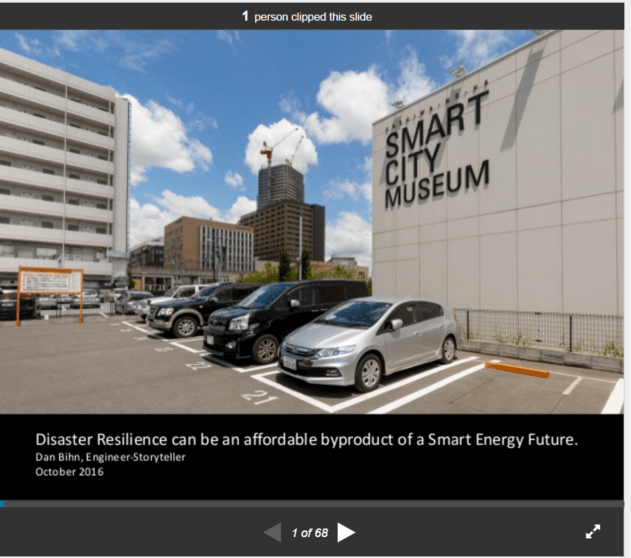
As we develop new technologies and as utilities and regulators consider new business models, it is fair to ask if there’s a better way than utility spending to improve grid resiliency. Enerdynamics’ facilitator Dan Bihn recently visited Japan, which has a long history of natural disasters and is currently undergoing implementation of retail electricity deregulation. Bihn discovered that grid-connected electric vehicles (EVs), smart homes, meaningful electric pricing driven by competitive electric retail companies, and business opportunities may be resulting in a new model for how to create and pay for grid resiliency. Based on his findings, following is a SlideShare presentation by Bihn titled Japan’s Disaster Resilient Smart Energy Economy.

dan-bihn-presentation_japan-disaster-resilience


Footnotes:
[1] Vernon councilman Dan Kadish quoted in the New Jersey Herald: http://www.njherald.com/story/21311355/jcpl-cites-sandy-in-seeking-rate-increase#
Posted in Electricity | Tagged , , , , | Leave a comment

A New Workforce Will Drive Energy’s Future

by Bob Shively, Enerdynamics President and Lead Facilitator

Not too long ago, utility workers were overwhelmingly male and white, and they tended to stay at theportrait-of-confident-multiracial-business-team same utility for decades of employment. Now studies show that in most utilities, as much as 50% of the workforce will reach retirement age in the next five to 10 years. 

UtilityDive’s ‘The State of the Electric Utility 2016 Survey‘ asked over 500 utility executives what the three most pressing challenges are for their utility. The most prevalent response, at 43% of respondents, was “aging workforce.” The expected turnover in employees will come at the same time that the utility industry is grappling with a likely transition to new technologies, new expectations from customers and regulators, competition from technology giants like Google and Apple, and a need to develop new business models. 

The composition of the workforce is also changing when it comes to gender and race:


I recently observed this while teaching a seminar of new engineers at a utility in the Southwest. Out of 20 new employees, only two were white males, and over half the attendees were female. 

Secondly, expectations for how workers will work are significantly changing. In a recent paper titled ‘Transitioning to Workforce 2020‘ tech company Cisco outlined changing employee expectations:

Cisco went on to suggest that traditional organizations will need to reform significantly by “letting go of some immediate control in order to keep the globalizing organization in better balance over the long run.” According to Cisco, necessary activities will include some or all of the following:

  • Synthesizing diverse viewpoints – more dialogue and compromise
  • Recalibrating timing and processes – allowing workgroups to work at their own pace with their own tools
  • Reforming existing policies – restructuring and disruption of current policies
  • Integrating new values – valuing creativity and innovation as much as efficiency and productivity
  • Shifting key relationships – lateral relationships replacing vertical with cross-functional groups
  • Concentrating attention on opportunities – maintaining focus through unforeseen conditions and market complexity
  • Engaging new and different stakeholders – reaching out to more partners, customers, governments, and communities
  • Allocating resources – flexible approaches to deal with fast-changing, hard-to-predict business conditions

Clearly the needed changes will be doubly hard for utilities given the imperative to maintain careful processes to ensure safety and reliability, and given the overwhelming influence of regulation in the industry. Utility leaders and managers must prepare themselves for what may be the biggest challenge of their careers.

One way Enerdynamics is helping current and prospective clients navigate a changing workforce is through its “Utility Business Acumen Series,” which assists companies in meeting their evolving training needs. On our website at www.enerdynamics.com/utility you will find options for both utilities and companies providing services to utilities, since each sector must have a thorough understanding of the utility business.

Once you choose the appropriate sector, you are a click away from a variety of appropriate training options. First you’ll see examples of programs we’ve put together for other clients. And below that you will find the various products (online courses, live seminars, and books) that may be useful in providing quality business acumen training to your employees. Much of what we do can be customized for your company. Contact us at 866-765-5432 ext. 700 or by email if you’d like to discuss your specific needs, learn how we’ve worked with other companies with similar needs, and get details on the customized training program we can build to meet such needs.


Posted in Energy Training | Tagged , , , | Leave a comment

Mexico’s Electricity Market Reforms Create New Opportunities

by Bob Shively, Enerdynamics President and Lead Facilitator

In a recent blog post we compared the current deregulation of Mexico’s gas market to the 1990s in the United States. But unlike the U.S., which phased gas and electricity restructuring, Mexico is restructuring its gas and electricity markets at the same time.  Mexico finalized laws for comprehensive electricity market reform with the Electric Industry Act in 2014, and at the beginning of this year the competitive wholesale market kicked off.

Prior to regulatory reforms, Mexico’s electricity was provided by the vertically integrated monopoly Comisión Federal de Electricidad (CFE) under limited oversight from the federal Secretaría de Energía de México (SENER).  In 2002, Independent Power Producers (IPPs) were allowed to build generation but could only sell to CFE.  Also in this time frame, industrial customers were allowed to acquire supply through self-supply from closely related generation entities.

Market Structure Prior to Reform

market structure prior to reform.png

Source: Regional Address to the CAISO Stakeholder Symposium, Electricity Reform in Mexico, presented by Jeff Pavlovic, SENER, October 22, 2015

The structure resulted in multiple concerns including:

  • Average rates 25% higher than in the U.S.
  • Extensive use of government subsidies to keep rates low; without subsidies rates would have been over 70% higher than in the U.S.
  • Lack of incentive for investment in clean power or in new transmission projects
  • Limited transparency in setting pricing and making investment decisions

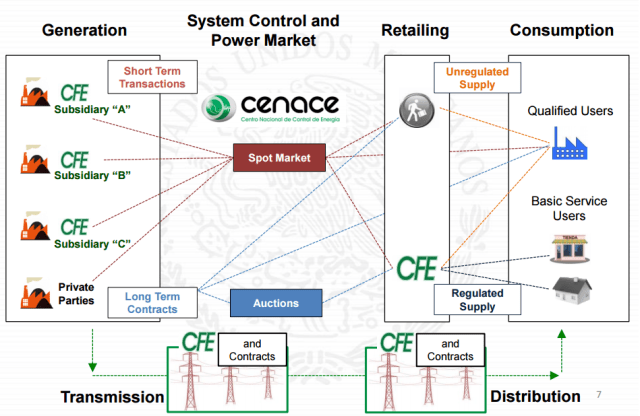
With the objectives of reducing costs and rates, fostering more clean energy, and spreading benefits among multiple stakeholders, a new market structure has emerged. Policy makers believe it will provide incentives for value creation and efficient operation, result in decision-making through competitive processes, provide open-access and non-discriminatory use of the electric system, and offer transparency.

The New Market Structure

new-market-structure

Source: Regional Address to the CAISO Stakeholder Symposium, Electricity Reform in Mexico, presented by Jeff Pavlovic, SENER, October 22, 2015

The new electric market reforms have ushered in new market players and a new market structure.

Market Players

  • Existing CFE generation will be split into multiple subsidiary companies.
  • Existing and new IPPs will be allowed to participate directly in the market.
  • Clean energy power producers will be incented to develop projects by new clean portfolio requirements and the trading of Clean Energy Certificates.
  • A new Independent System Operator (ISO) named Centro Nacional de Control de Energía has been created to run day-ahead and real-time markets, operate the electric system, provide open access to the electric system, and to ensure interconnection requests are fulfilled.
  • A new regulatory agency Comisión Reguladora de Energía (CRE) has been created to set transmission and distribution rates and tariff rules, grant generation permits, and oversee regulatory aspects of the new market.

New Market Structure Overview

  • Long- and medium-term bilateral transactions will be facilitated by power auctions run by CENACE.
  • CENACE will run centralized day-ahead and real-time markets using price offers and optimized energy/ancillary services processes similar to U.S. ISO markets with nodal pricing (with the difference that all price offers must be cost-based).
  • CENACE will administer a yearly capacity market.
  • CENACE will facilitate a yearly and monthly Financial Transmission Rights market.
  • CENACE will administer a yearly Clean Energy Certificates market for retailers to fulfill clean energy portfolio requirements set by CRE.
  • CFE will continue to own the transmission and distribution system.
  • Small commercial and residential customers will continue to buy their supply from CFE under cost-of-service-based tariffs.
  • Larger consumers can choose to buy regulated supply from CFE or can purchase unregulated supply from marketers or generators.

The Market Has Begun

The market has kicked off.  CENACE has been running the spot markets since January 1.  The following graphic from the U.S. Energy Information Administration shows results for the first six months of 2016:

mexico-average-wholesale-electricity-prices
Source: EIA Today in Energy, July 5, 2016

The initial long-term auction for energy, capacity, and Clean Energy Certificates was held in March with CFE as the only buyer. A second auction is planned for this fall with multiple buyers. Other aspects such as FTR auctions, the CENACE-administered capacity auction, medium-term auctions for energy, and the CENACE-administered clean energy market will be implemented over the next two years. And Mexico has ambitious plans to become a key international player in electricity markets with connections to the U.S. and Central America. Indeed, Mexico has indicated an interest in direct participation in the California ISO (CAISO) real-time Energy Imbalance Market (EIM). There certainly will be numerous interesting developments to discuss in future blog posts as Mexico’s new electric market evolves.


Posted in Electricity | Tagged , , | 1 Comment

Can Wyoming Reinvigorate the Coal Industry?

by Bob Shively, Enerdynamics President and Lead Facilitator

Open Pit Coal Mine

Texas and Wyoming are perhaps the two states most associated with fossil
fuels production – Texas with its oil and natural gas, and Wyoming with its coal. Concerns about global warming, evolution of new low-cost natural gas and renewable electric generation, and growth of electric vehicles are putting pressure on economies dependent on fossil fuels.

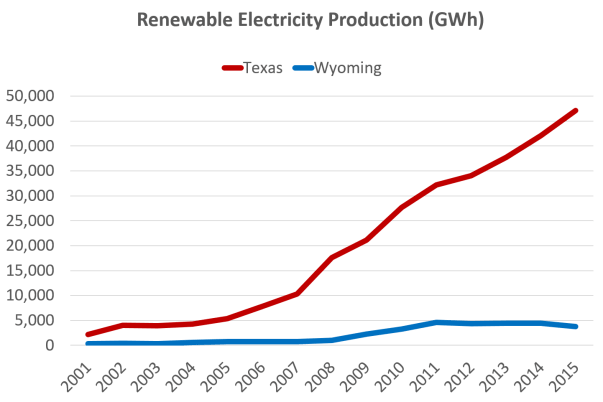
Texas has been able to hedge its energy bets by developing a robust renewables industry, leading the Wall Street Journal to recently pen a front-page article titled “Texas’ Latest Gusher: Wind and Sun”[1]. Meanwhile in Wyoming, numerous renewable projects are in development stages including a 3,000-MW wind project by the Power Company of America. However, Wyoming has struggled to rapidly grow renewable energy production. Barriers include Wyoming’s remote location, lack of transmission to carry power to loads in other states, and, in some cases, lukewarm political support by a state where the coal economy is estimated to make up 14% of state GDP and 11% of state government revenues[2]. 

texas-vs-wyoming-renewables-production

Source: EIA

Opportunities to Market Coal in the U.S. Appear to be Declining

Since its peak in 2008, Wyoming coal production has fallen by almost 20%. 

wyoming-coal-production

Source: EIA

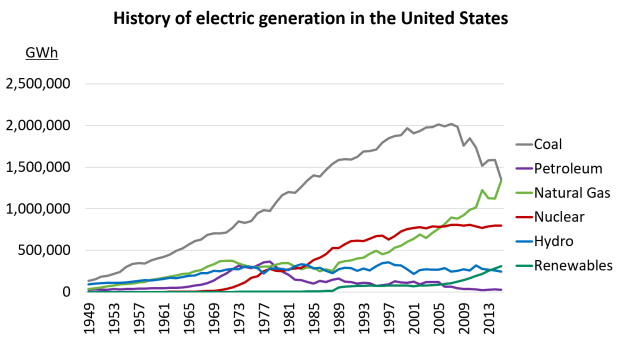
The fall in production is not due to lack of supply in Wyoming, because reserves and productive capability remain robust. Instead it is driven by lack of demand as the U.S. generation fleet transitions from a dominance of coal to rapid growth in natural gas and renewable capacity.

history-of-generation


Wyoming Attempts to Buoy Coal’s Future

Given the importance of coal production to Wyoming’s economy, the trends are not promising. Coal producers in Wyoming have attempted to develop export markets to sell coal to Asia but have been hampered by environmentalists’ opposition to developing West Coast ports to allow more exports as well as the costs of shipping coal far distances[3]. Wyoming Governor Matt Mead is focused on the issue and realizes that without addressing coal’s environmental barriers, the future will continue to look bleak. 

In April of this year, Gov. Mead, state officials, and utility executives broke ground on a new $21 million research center in Gillette, Wyo., next to the Dry Fork coal power station. The center will provide a real-life laboratory for scientists to design and test technologies that remove carbon emissions for the plant’s emission stream.  Participating scientists will be buoyed by the opportunity to win a $10 million prize offered by the XPrize Foundation and awarded to the team that can best achieve two goals: 1) remove the greatest amount of carbon from the stream; and 2) turn the carbon into a product with the largest commercial value[4]. The governor also recently signed a cooperation agreement with the Japan Coal Energy Center, a consortium of 120 companies, for research associated with clean-coal technologies[5].

According to the governor, the hope is to find a game-changing technological breakthrough that will again make coal a favored fuel. It won’t be easy, as other research associated with removing carbon emissions has resulted in technologies that work in laboratories but have yet to prove economic in power plant applications. Time will tell whether coal can continue to support Wyoming’s economy or whether Wyoming should look to Texas’ example of finding new ways to grow a more prosperous energy future.  


Footnotes

[1] Wall Street Journal, August 29, 2016

[2] See: The Impact of the Coal Economy on Wyoming, available at  http://www.uwyo.edu/cee/_files/docs/wia_coal_full-report.pdf

[3] See for example: Think Progress,The Plan to Revive Big Coals Fortunes Isn’t Panning Out,   https://thinkprogress.org/the-plan-to-revive-big-coals-fortunes-isn-t-panning-out-cc6300b1e715#.r2wbuq62r

[4] For more details, see: The Casper Star Tribune, Wyoming, hoping to save coal, breaks ground on a new test center,  http://trib.com/business/energy/wyoming-hoping-to-save-coal-breaks-ground-on-new-test/article_53e3cadb-502e-5429-9c7f-5cc7c1fa15f4.html

[5] See:  The Seattle Times, Wyoming Partners with Japanese Companies seeking coal, http://www.seattletimes.com/business/wyoming-partners-with-japanese-companies-seeking-coal/

Posted in Electricity, Renewables | Tagged , , , | Leave a comment