Will Low Natural Gas Prices Continue?

by Bob Shively, Enerdynamics President and Lead Facilitator 

In 2016, annual average natural gas prices in the U.S. were the lowest since 1999.

Ave annual HHub natural gas spot price.png

Source: EIA website


Interestingly, this occurred even with a slight drop in production and slight increases in both demand and exports.
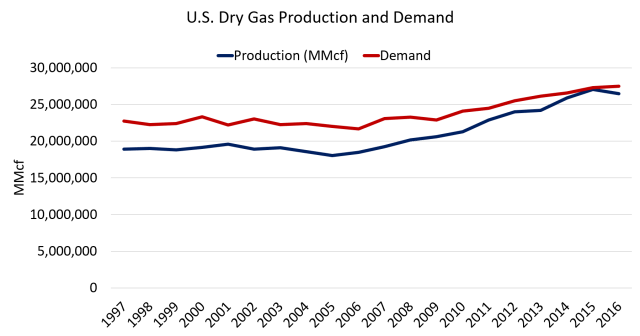
US dry gas production and demand.png

Source: EIA website

While prices rose a good bit in December due to cool weather, warmer temperatures have pushed prices right back down in recent weeks:
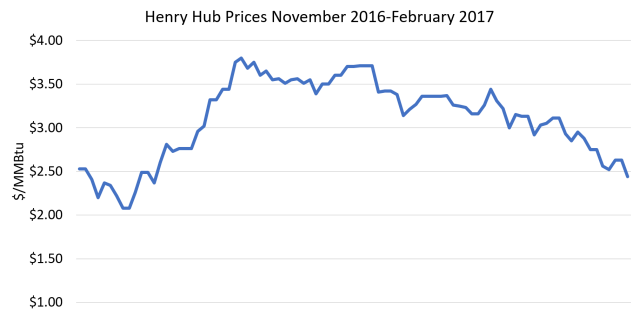
hhub-prices-nov-2016-feb-2017

Source: EIA website

Low natural gas prices have had significant impacts on the energy marketplace:

  • For the first time ever, electricity generation by natural gas power plants in 2016 was the largest source of generation in the U.S. surpassing coal which has been the leader since the mid-1900s.
  • The cost of power generation by gas has fallen to unprecedented low levels. Combined with growing low-cost renewable and solar power in some markets, numerous coal units and even some nuclear units have closed or been scheduled for closure.
  • Many independent power products (IPPs) are now questioning whether they can attain enough market revenues to stay in business
  • Exports of LNG are now economic as cargos priced at an index to Henry Hub are competitive in world markets.
  • Industrial gas demand in the U.S. is at the highest level since the year 2000.
  • And both natural gas and electricity consumers have benefited by low utility bills.

Given these factors can we expect that gas prices will continue to stay low, or will prices creep back up? A quick Google search of the phrase ‘2017 gas price forecast’ leads to sites with titles like “Outlook ’17: U.S. natural gas prices could soar” and “Will natural gas go on another run in 2017?”

Natural gas prices are set by the market based on the forces of supply and demand, plus market expectations for the future. So what are the expectations?

  • Demand plus exports is forecast to be flat: According to the EIA February 2017 Short-term Energy Outlook, the level of demand plus exports in 2017 is expected to grow about 1% compared to 2016.
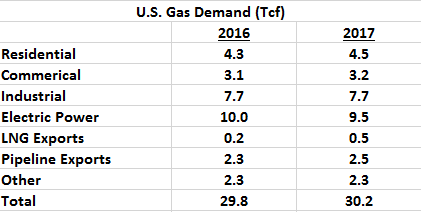
    us-gas-demand

It should be noted that this assumes that electric power generation will fall a bit, primarily because the EIA has forecast a significant gas price increase to $3.54, which makes gas generation less competitive with coal.

  • Supply is forecast to increase slightly: According to the EIA Short-term Energy Outlook, supply is forecast to increase by about 2% due to increasing U.S. gas production.
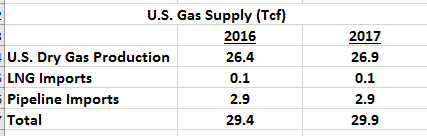
US Gas Supply.png

And indeed, we have seen natural gas rigs actively drilling for gas increase by 50% compared to this time last year, which would indicate that more supply is on the way.  Meanwhile, natural gas in storage is about 4% above the 5-year average.

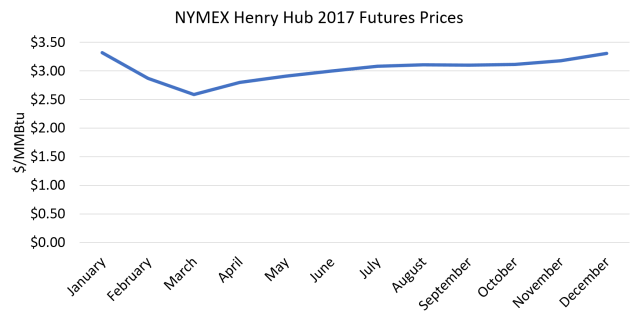
  • The natural gas futures market is less optimistic on price than the EIA.
    NYMEX HH 2017 Futures Prices.png

The natural gas futures market, which indicates the current price available today to lock in a purchase or sale of supply in future months, suggests an average 2017 price of $3.03.  This is more in line with forecasts from the IMF and the World Bank, which forecasts U.S. gas prices of $3.00/MMBtu for 2017.

  • Weather doesn’t look promising to help gas prices in the near term: According to weather forecast maps from NOAA, winter may already be close to over with forecasts for both the next month and the next three months showing temperatures higher than normal for most of the country.
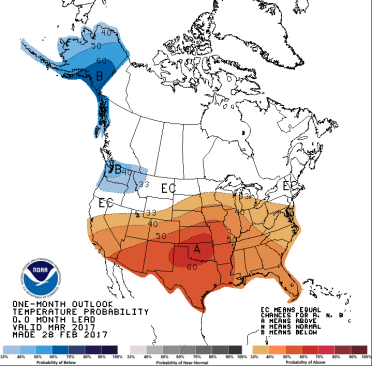
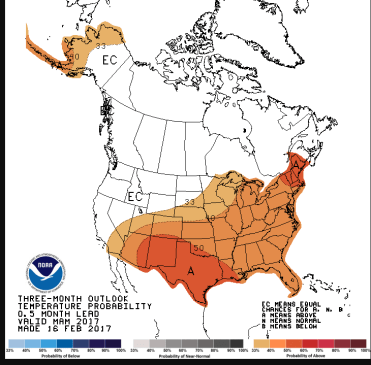
weather-map-1weather-map-3-months


So what can we expect for gas prices in 2017?

With production still strong, heating demand looking low for the rest of this winter, and gas in storage above the five-year average, it doesn’t look optimistic for significant gas price spikes. Much will depend on power plant demand for natural gas, and producers are hoping for a hot summer. Absent that, we would expect gas prices to remain at historic lows. Others disagree and think there is potential for a price run-up. That is the fun of the gas markets — no one knows what will happen until it does!

Posted in Natural Gas | Tagged , | Leave a comment

Electrification May Be Key to Saving Utilities and the Environment

by Bob Shively, Enerdynamics President and Lead Instructor

These are uncertain times for electric utilities. With flat load growth, increasing Straight open road to upcoming 2017 at idyllic sunsetdistributed energy, shrinking value for many large centralized power plants, and discussion around changing business models, electric utility shareholders are left wondering from where future earnings growth will come. Meanwhile, despite the current administration in Washington, utilities in many regions are feeling increasing pressure to reduce environmental impacts.
Historically, utilities have grown earnings by investing in capital facilities as loads grew. Large fossil fuel power plants were a favored source of investment. Customers were generally on board since growing loads meant costs were spread over more sales and rates did not go up much.  However, load growth now appears uncertain. As recently stated by Jim Rogers, the former CEO of Duke Energy:

“I think the demand for electricity is going to be anemic, at best. Perhaps more likely than not, the demand for electricity will actually decline.”

Without demand growth, the path for utility investment seems restricted to system upgrades.  Unfortunately, investment without load growth inevitably leads to rate increases. But, there may be a new path to load growth that will help utilities find a new wave of growth while also benefiting the environment. 

Jim Avery, Chief Development Officer at San Diego Gas & Electric, believes electric vehicles (EVs) are the solution. Says Avery: “Think I’m worried about growth? I’m worried about how the hell do I serve all of that.” 

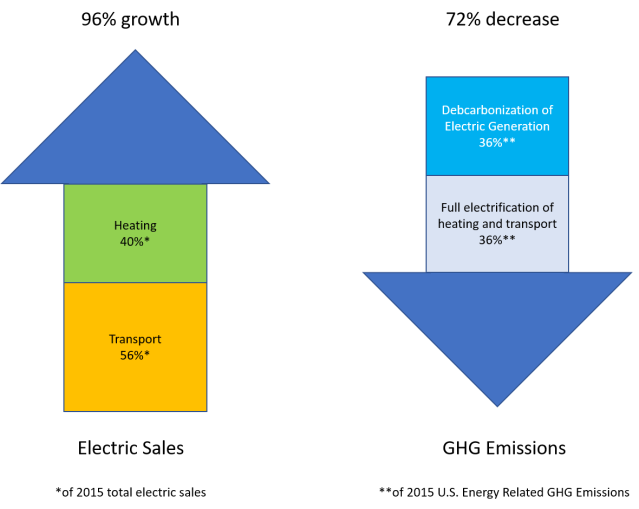
The potential for load growth and environmental benefits was covered in a recent whitepaper from the Brattle Group, titled Electrification – Emerging Opportunities for Utility Growth. In the executive summary, the authors write that under the current prevailing paradigm, utilities struggle with weak sales and growing distributed generation (DG) while projections show that emissions of greenhouse gases (GHG) will continue to exceed what is needed to meet long-term GHG reduction goals. But the authors suggest that with electrification of the transportation and heating sectors coupled with a significant reduction in GHG outputs from electric generation, a different paradigm can be achieved that offers a strong future to electric utilities. Under this scenario, electric utility sales could nearly double by 2050 while energy sector GHG emissions would decrease by 70%. 

To make this happen, the authors suggest that electric utilities could strive to shift loads to electricity from fossil fuels. The benefits could be achieved by addressing two key sectors:

  1. Transport
  • Light duty vehicles including passenger vehicles such as the cars we all drive
  • Commercial light trucks
  • Freight trucks

For this sector, current liquid fossil fuels would be replaced with battery electric vehicles.

  1. Residential and commercial loads:
  • Water heating
  • Space heating
  • Cooking

Here, current demand fueled by natural gas, propane, and fuel oil would gradually be replaced by heat pumps, electric water heaters, and electric ranges. 

The result according to the Brattle Group could be a 96% growth in electric load coupled with a 72% decrease in U.S. energy-related GHG emissions.

electrification-chart

How can utilities move toward this more positive future? Brattle Group suggests the following:

  • Regulatory outreach to communicate the potential benefits and to overcome barriers
  • Infrastructure deployment to build vehicle charging facilities
  • Rate reform to remove barriers to electricification and to account for the characteristics of the new end-use technologies
  • Program development including pilot projects and financial incentives to promote adoption
  • Resource planning including enhanced load shape forecasting and analysis of cost trajectories and adoption rates

While utilities currently struggle with the risks of slow load growth and potential competition from distributed resources, the Brattle Group presents a vision of an alternate future that could prove lucrative for utility investors. 

Posted in Electricity | Tagged , , , , | Leave a comment

Can Carbon Capture and Storage Do for Coal What President Trump Can’t?

by Bob Shively, Enerdynamics President and Lead Instructor

A key promise of Trump’s presidential campaign was revitalization of the coal industry to Smoking power plantmaintain coal-related jobs in the U.S. But as we pointed out in our Energy Insider article  “The Election Is Over: What’s In Store for the Energy Industry Under the Next Administration?”, it is unlikely that administration policies will do much to help a coal industry reeling from low natural gas prices combined with local and international energy policies designed to reduce greenhouse gas (GHG) emissions.

Indeed, since the inauguration, U.S. utilities have announced planned closures of the largest coal unit in the West and two large coal units in the Midwest[1]. And China, with its current fleet of more than 50% of the world’s coal capacity and more under construction, seems to be serious about reducing coal emissions[2].

But perhaps for the longer term, the coal industry saw a hint of light at the beginning of 2017 with the completion of the Petra Nova carbon capture plant southwest of Houston, Texas. Unlike other recent carbon capture generation units, the Petra Nova plant was completed essentially on time and on budget. The unit will capture 90% of the carbon dioxide (CO2, which is a key GHG) emitted from 240 MW of generation and will then pump the carbon through a pipeline for injection into a nearby oil field. The injection of the carbon will help producers capture more oil by stimulating flows, and the producers will pay Petra Nova for the CO2, thus creating a revenue stream for the power plant owners.

What is carbon capture and storage?

Carbon capture and storage (CCS) is the process of removing carbon from a fossil fuel stream, either pre- or post-combustion, and then storing the carbon in a location where it cannot leak into the atmosphere. If CCS can become feasible and economic, it can greatly prolong the use of fossil fuels in power generation since their GHG emissions would be significantly reduced. While CCS works in laboratories and demonstration projects, it has yet to be demonstrated in wide-scale commercial operation. Initial projects have struggled to get the technology to work well and to get projects built and running without wildly exceeding estimated costs.

So, the coal industry is celebrating as the new Petra Nova project comes online on time and on budget. This project is jointly owned by NRG and JX Nippon Oil and Gas, and it was installed on NRG’s existing WA Parrish generation station. In the new CCS plant, the exhaust waste from the electric generating station is run through a vessel containing a solvent called amine. Amine captures the CO2. The amine/CO2 mixture is then removed from the stream, the CO2 is separated by heating, and then pumped into a pipeline. The pipeline delivers the CO2 to a nearby oil field for use in a common process called enhanced oil recovery, which stimulates oil production. Since the process will result in oil production that was otherwise not possible, NRG estimates that at an oil price of at least $50/barrel, the process will prove economic[3].

Here’s a visual representation of how the process works as reported by U.S. News and illustrated by NRG:

source: http://www.usnews.com/news/articles/2014/09/17/carbon-captures-moment-in-the-sun

Does CCS have the opportunity to significantly reduce GHG emissions?

The role CCS plays as a widespread tool in reducing GHG emissions will depend on proving that the technology will work well in the field and in bringing down costs. Initial installations of any technology are always expensive. NRG estimates they can bring down costs for the next installation by 15%, but this likely isn’t enough to lead to many installations; costs will have to come down more substantially.

A recent study by the International Energy Agency, however, suggested that about a third of China’s existing 900 MW fleet of coal units could meet basic criteria for being suitable for a retrofit[4].  So although applications for CCS must still be proven, there is the possibility that use of CCS could become widespread through retrofits on existing coal plants.  In addition many in the industry believe that CCS may be a solution for reducing GHG emissions from natural gas units that provide needed flexibility to grids with large amounts of renewable power. Given these factors, there is strong industry interest in developing the technology, and initial projects will be closely watched to help determine whether CCS can become a part of our future.


Footnotes:

[1] See ‘Utilities vote to close 2,250 MW Navajo plant, largest coal generator in western US’ at http://www.utilitydive.com/news/utilities-vote-to-close-2250-mw-navajo-plant-largest-coal-generator-in-we/436222/ and ‘DPL settlement to close two power plants, shift to green energy’ at http://www.bizjournals.com/dayton/news/2017/01/31/dpl-settlement-to-close-two-power-plants-shift-to.html

[2] See ‘China’s war on coal continues – the country just cancelled 104 new coal plants’ at  http://www.vox.com/energy-and-environment/2017/1/17/14294906/china-cancels-coal-plants

[3] For more detail on how the process works, see the video available at https://www.youtube.com/watch?v=GGnGZ6pLzLU

[4] See ‘The potential for carbon capture and storage in China’ at https://www.iea.org/newsroom/news/2017/january/the-potential-for-carbon-capture-and-storage-in-china.html

Posted in Electricity | Tagged , , , , | Leave a comment

Renewable Natural Gas: A Viable Fuel for Power Generation and Transportation

by Christina Nagy-McKenna, Enerdynamics Instructor

Most of us think of natural gas as a reliable, plentiful fossil fuel. Less discussed is its renewable equivalent: biomethane, a biogas that is the result of the decomposition of organic matter. Once processed, this biogas can be a substitute for pipeline-quality gas and gas used for transportation fuel either as compressed natural gas (CNG) or liquefied natural gas (LNG). By reclaiming methane from landfills, livestock operations, and waste water treatment plants, renewable natural gas (RNG) is being used to produce electricity and to fuel large trash and recycling vehicles. Use of RNG in the clean transportation section has strong potential to help states meet their federal and state fuel standards for reduced petroleum product use.

There are three major sources of biogas in the United States:

  • Landfills: At landfill sites, methane is extracted, collected, and then processed until it is clean enough for use.  
  • Livestock operations: At livestock facilities like dairies and pig farms, farmers may collect manure and place it in an anaerobic digester that produces methane, or they may maintain a lagoon that contains manure, which they then cover to capture the methane.
  • Wastewater treatment plants: At these treatment plants, biogas is recovered during the digestion of solid materials that are removed from wastewater treatment. Once biogas is recovered at such facilities, it is processed until water, carbon dioxide, hydrogen sulfide, and other impurities are removed.

Depending on whether the gas goes directly to a power plant, a pipeline, or if it will be made into a transportation fuel, it is cleaned to the appropriate specifications.

While it is helpful that RNG can be used as a substitute for traditional natural gas, it is also valuable because it meets the requirements as an Advanced Biofuel under the U.S. Renewable Fuel Standard (RFS). The RFS was authorized by Congress as part of the Energy Policy Act of 2005 and then expanded under the Energy Independence and Security Act of 2007. Its goal is to reduce greenhouse gas emissions and create a more robust renewable fuel sector while reducing U.S. reliance on imported oil.

One of the most successful RNG projects in the U.S. can be found at the Waste Management Inc. Altamont Landfill in Livermore, Calif. A joint venture between WMI and Linde BOC, the project can consume more than 2,600 standard cubic feet per minute (scfm) of landfill gas and has an operational capacity of 13,000 LNG gallons per day. This LNG displaces more than 2.8 million gallons of diesel fuel per year.[1] According to Waste Management, the project achieved a capture rate of 93 percent; it produces enough LNG to fuel 300 of its 491 LNG vehicles, which collect waste and recycling.

The Altamont project gives us a glimpse into what is possible in recovering landfill gasses and processing them into RNG. As of March 2015, there were close to 645 operational projects at landfills around the country. Most, however, convert biogas into electricity rather than using it as transportation fuel. As of January 2015, there were also 247 anaerobic digesters operating at commercial livestock facilities nationwide. Lastly, there are approximately 1,500 anaerobic digesters being used in the U.S. at 16,000 wastewater treatment plants.[2]

 Thus, the potential for improvement and expansion is great. The time has come to acknowledge RNG as a viable form of natural gas and transportation fuel that may be well-suited to help reduce greenhouse gas emissions and meet renewable fuel standards goals.


Footnotes and references:

[1] Altamont Landfill Gas Purification, Testing, and Monitoring, Gas Technology Institute for the California Energy Commission, October 2013, page 2.

[2] Renewable Natural Gas (Biomethane) Production, U.S. Department of Energy – Energy Efficiency and Renewable Energy Alternatives Fuels Data Center, May 10, 2016, page 1.

Altamont Landfill Gas Purification, Testing and Monitoring, Final Project Report, Gas Technology Institute for the California Energy Commission, October 2013.

“Biogas/Biomethane for Use as a Transportation Fuel,” European Biofuel Technology Platform web site www.biofuelstp.eu, September 9, 2016.

“Biomass Explained,” U.S. Energy Information Administration, November 12, 2015.

Biomethane, NGV America web site www.ngvamerica.org., 2014 Inc., 2011.

“Case study: Altamont Landfill and Resource Recovery Facility,” Waste Management Inc. website,www.wm.com.

Jaffe, Amy Meyers, The Feasibility of Renewable Natural Gas as a Large Scale, Low Carbon Substitute, UC Davis Sustainable Transportation Energy Pathways, Institute of Transportation Studies for the California Air Resources Board and the California Environmental Protection Agency, June 2016.     

Renewable Natural Gas (Biomethane) Production, U.S. Department of Energy – Energy Efficiency and Renewable Energy Alternatives Fuels Data Center, May 10, 2016.

Resources – Education, The Coalition for Renewable Natural Gas website, www.rngcoalition.com.

Posted in Natural Gas, Renewables | Tagged , , , , | 1 Comment

From Where Will the Next Wave of Energy Research and Development Come?

by Bob Shively, Enerdynamics President and Lead Instructor

Energy is fundamental to modern life. Yet according to the International Energy Agency, more than 1.2 billion people live without access to electricity, and more than 2.7 billion are without clean cooking facilities. All desire to have access to ubiquitous and low-cost energy.

As Microsoft founder Bill Gates notes in the video Energy Innovation, modern lifestyles require huge amounts of energy. And given that “the energy miracle that has allowed modern civilization” is primarily based on fossil fuels, raising billions of people’s access to energy-consuming lifestyles will inevitably have severe environmental impacts unless we change our means of energy production.Teamwork and brainstorming concept

Many technologies that reduce environmental degradation already exist. In the power sector these include:

  • replacing coal generation with nuclear or gas-fired generation;
  • replacing coal and gas generation with renewable electricity;
  • and reducing end-use consumption through energy efficiency.

In the transport sector, these include replacing gasoline or diesel-powered vehicles with natural gas vehicles and replacing all fossil-fuel vehicles with electric vehicles (as long as the source of electricity is clean). But there is debate as to whether our current set of technologies is robust enough to provide ubiquitous, clean, low-cost, and reliable energy.

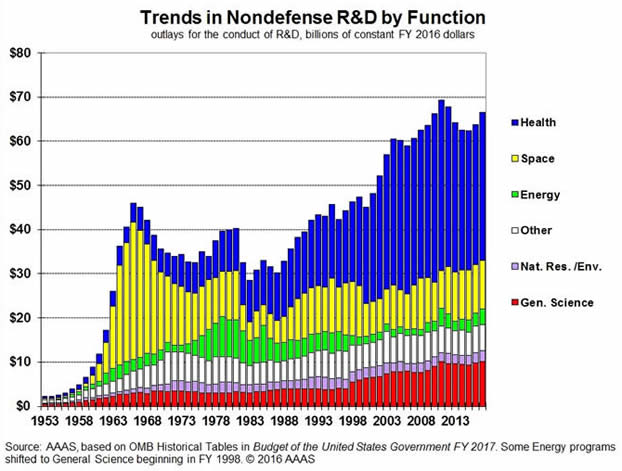
Gates and others believe that fundamental research is needed to create the next wave of transformational technology. Yet, the U.S. government currently provides surprisingly little budget support for energy:

rd_trends

So where will future research come from? The Breakthrough Energy Coalition is a partnership of business leaders “committed to broad investment in new energy technologies from public and private sources.”

Partners include familiar names such as Marc Benioff (Salesforce.com), Jeff Bezos (Amazon), Michael Bloomberg (Bloomberg LP), Richard Branson (Virgin Group), Reid Hoffman (LinkedIn), Jack Ma (Alibaba), Meg Whitman (HP), and Mark Zuckerberg (Facebook) among others. The coalition is working with a group of 20 countries worldwide (called Mission Innovation) to foster government/private partnerships with a goal of moving from basic research to breakthrough technologies in the marketplace.

To further their goals, some members of the coalition have formed Breakthrough Energy Ventures and have committed $1 billion to invest in early-stage companies committed to developing new energy technologies.

missioninnovationcountries

The vision is that initial government funding will support basic research that will ultimately lead to innovations in the marketplace. Key potential areas of investment include electricity generation, transmission, and storage; carbon capture and sequestration; and transportation, agriculture, manufacturing, and buildings.

Will this propel society to a new level of energy access? That remains to be seen. But in an era of shrinking government budgets and industry turmoil that discourages energy companies from spending money on R&D, it is encouraging to see some of the most successful and brilliant minds in the world working together on a solution.


Posted in Electricity, Energy Training, Renewables | Tagged , , , | Leave a comment

Do Your Employees Understand Wholesale Power Markets?

by Enerdynascreen_marketsmics Staff

Do your employees understand the electric services that are bought and sold in wholesale markets? Do they know which services are traded in bilateral, exchange, and centralized ISO markets? Can they explain to coworkers and customers how these markets work and how prices are determined? Are they able to analyze business opportunities and risks in the various wholesale markets? If not, Enerdynamics’ newest online course, Wholesale Power Markets, can help.

The course is actually a major update/upgrade to an existing course. Recently released, Wholesale Power Markets focuses on the electric services bought and sold in wholesale markets and replaces Electric Market Dynamics. Power markets have become increasingly important in recent years with the growth of gas-fired generation owned by independent power producers, the increase in renewables, and the expansion of ISO market areas. As a result, a clear understanding of how markets are organized as well as how services are traded is essential to many in the industry.

This updated course provides the most current information on power markets to keep your employees informed of what’s happening now in this fast-paced industry. Frequent updates also allow your employees to receive the benefits of technology evolution — Wholesale Power Markets is now available for viewing on all platforms including desktops, tablets, and even mobile phones.

Wholesale Power Markets comprises the following modules:

  • Introduction to Wholesale Power Markets
  • Power Market Structures and Participants
  • Electric Supply and Demand
  • Power Services and Markets
  • How Power Markets Work

As with all of Enerdynamics’ online courses, Wholesale Power Markets includes quality audio and graphics, interactive exercises and quizzes, and valuable material downloads. It can be viewed continuously or in small increments as an employee has time. View a short demo of Wholesale Power Markets or get more details on the course and its content.

The full-length course can be purchased or licensed on its own, or the modules are also available on a stand-alone basis. For more information and bulk pricing options, please contact John Ferrare at 866-765-5432 ext. 700 or info@enerdynamics.com.

Posted in Electricity, Energy Training | Tagged , , , , | Leave a comment

What Can the Energy Industry Expect Under the Trump Administration? Part II

by Bob Shively, Enerdynamics President and Lead Facilitator

Last week we looked at how the incoming Trump administration may or may not significantly impact What's next on the chalk board and US flagthe energy industry, particularly the natural gas and coal sectors. This week we continue the discussion but are examining how a Trump presidency may impact renewables, energy efficiency, and electric transmission/distribution sectors.

Renewables

Possible Trump policies impacting the renewable energy business:

  • Support for fossil fuel development
  • Reduced support by federal agencies for renewables and reduced funds for research and grants
  • Possible reversal of environmental regulations and international agreements that foster renewables development, especially the CPP and the Paris Agreement
  • Reduction in corporate tax rates
  • Support for infrastructure development

Possible impacts on markets:

  • For utility markets, the current development is driven by two factors: state level renewable portfolio standards (RPS) and economics (in cases where renewables are chosen for economic reasons in the Integrated Resource Planning). It does not appear that federal policies will impact existing state RPSs. As long as the Production Tax Credit stays in place, federal policies will not adversely affect the economic attractiveness of renewables.
  • Many renewable projects are being driven by corporate buyers (numerous big corporations now have significant goals to buy renewable power for economic or business policy reasons). It does not appear that federal policy will impact these goals.
  • Full implementation of the CPP could mean states that do not strongly support renewables must move to renewables to achieve CPP requirements. If the Trump administration fails to implement or enforce the CPP, we may see reduced growth in states implementing new RPS requirements.
  • Reduction in research, grants, and federal agency support for renewables may restrict future growth that otherwise may have occurred.
  • Reduction in tax rates improves the economics of large capital projects such as renewables development.
  • If Trump’s support for infrastructure includes federal policies to stimulate modernization of electric transmission and distribution this could further the capability of the grid to economically absorb more renewables.

Net impacts on renewables:

The negative impact on renewables may be less than it appears on the surface. Since initial growth in renewables has been stimulated by market developements, support by states, cost reductions, and Obama administration polices, future federal policy may not be a big factor. And paradoxically, some policies such as lower tax rates and infrastructure support may provide a boost to renewables. Also, it’s important to remember that much of Trump’s support came from Midwestern states that have been successful in profiting from development of wind power resources. So repeal of the Production Tax Credit appears unlikely.


Energy Efficiency

Possible Trump policies impacting energy efficiency:

  • Support for fossil fuel growth, reduction in regulations, and “getting government out of the way” would appear to foreshadow a lack of support for energy efficiency initiatives (though Trump has been very silent on the topic of energy efficiency).

Possible impacts on markets:

  • Reduced federal regulations such as appliance standards that foster energy efficiency may result in reduced growth in energy efficiency.
  • Reduced federal agency support could result in less government spending on energy efficiency.

Net impacts on energy efficiency:

Possible reduction in emphasis on and support for energy efficiency initiatives.


Electric Transmission and Distribution

Possible Trump policies impacting electric T&D:

  • Reduction in tax rates
  • Support for infrastructure development

Possible impacts on markets:

  • Reduction in tax rates would improve project economics.
  • If Trump includes the electric system in his apparent push for infrastructure development, policies could help stimulate growth and modernization of T&D systems.

Net impacts on electric T&D:

The potential impacts are uncertain, but we could see a boost in T&D modernization.

So, in conclusion, what can we say about a Trump administration’s impact on energy markets? In this case, it appears that markets trump (sorry for the pun) presidential politics. While the new administration may seem like an extreme departure from Obama’s policies, it appears that when actual market impacts are considered, the change may prove to be not much at all.

Posted in Electricity, Renewables | Tagged , , , , , | Leave a comment

What Can the Energy Industry Expect Under the Trump Administration?

by Bob Shively, Enerdynamics President and Lead Facilitator

President Obama took office eight years ago determined to address the United States’ emission of greenhouse gases (GHG). The President was unsuccessful in getting Congress to take much action other than extending renewable production tax credits. And when Obama attempted to use regulation instead of Congressional action to address greenhouse gases, the EPA’s Clean Power Plan (CPP) became tied up in court.

But interestingly, market forces aided by actions of federal agencies have surprisingly helped reduce greenhouse gas emissions. The U.S. Department of Energy (DOE) recently reported that U.S. energy-related greenhouse gases for the first six months of 2016 are the lowest since 1991. Federal policies fostered by the DOE, Defense Department, FERC, and other agencies helped stimulate growth of green technologies including renewables, storage, and smart grids. Increases in energy efficiency kept electric loads from growing even as the economy rebounded. The Obama administration also supported natural gas development — U.S. natural gas production grew by 33% since Obama took office, and U.S. exports of natural gas grew by 117%. So now as we transition to the Trump administration, what changes can we expect?

It’s hard to predict as there seems to be a significant gulf between Trump’s campaign statements and his statements as president-elect. But looking at what we know, it appears that while regulatory direction and other policies will change, the ultimate market direction will surprisingly be no different than under Obama. This means we can anticipate more growth of natural gas and renewables, ongoing decline in coal, and more reduction in U.S. greenhouse gas emissions.

This week, let’s look at how a new administration may impact the natural gas and coal industries. Next week we’ll conclude with a look at the renewables, energy efficiency, and electric transmission/distribution sectors.

Natural gas

Possible Trump policies impacting the gas business:

  • Ease in restrictions concerning drilling on federal lands
  • Reduction of federal environmental regulations of gas production
  • Strong federal support for hydraulic fracturing
  • Quickened approvals on new pipeline projects
  • Support for growth in gas exports
  • Support for growth of U.S.-based manufacturing
  • Support for coal

Possible impacts on market:

  • Costs of production may slightly decline due to cheaper land availability and less money spent on environmental protection.
  • But, given that we are already in a supply glut, this may not change dynamics much as producers don’t have the market for any new supplies they could theoretically access.
  • New pipeline projects could help move gas from regions with excess supply to markets, but currently the barriers to new pipeline development generally are either economic or due to local opposition, so this may not have much impact.
  • In theory, growth in gas exports and growth in U.S. manufacturing could boost demand for natural gas and thus help support price. Petrochemical development in the Northeast could help boost demand there. As for exports, there is already a global glut of LNG supply, so in the short term it appears that exports to Mexico are the primary growth engine. Trump has talked extensively about the negative aspects of trade with Mexico, which may impede this scenario.
  • If coal makes a comeback, it will primarily reduce gas-fired electric generation.  We don’t believe this will occur much (see coal section of this article), but if it does, it will offset any demand growth from manufacturing.

Net impacts on natural gas:

Not a significant change; perhaps lower overall natural gas prices and slightly more demand.


Coal

Possible Trump policies impacting the coal business:

  • Ease in restrictions on coal development on federal lands
  • Ease in environmental rules (or maybe ease in enforcement of current rules) on coal-fired generation
  • Maybe other federal policies concerning tax benefits or subsidies to try to maintain employment in coal industry
  • Desire to foster coal exports

Possible impacts on markets:

  • Trump policies may extend the life of some coal-fired power plants that are currently marginal since plant owners may not be required to install emissions technologies. But many of these units have been retired already or are uneconomic compared to alternatives.
  • And, given that it appears that Trump’s policies may reduce natural gas prices, coal will be less competitive vis-à-vis gas.
  • Paradoxically for units owned by utilities, older depreciated assets that do not require new capital investment become less attractive since capital investment is what generates utilities’ earnings. In some cases, this may reduce a utility’s interest in keeping older units open.
  • Possible ongoing growth in renewables mixed with low gas prices will reduce potential revenue for coal units in competitive markets.
  • Exports could grow, but federal policy is not likely the issue currently limiting exports. Most incremental global demand for coal is from Asia, whereas current U.S. export capability is on the East Coast. Recent attempts to expand port facilities in Washington and Northern California to foster coal shipping have met extreme local opposition that the federal government may be unable to overcome.

Net impacts on coal:

Not much impact, although the life of certain marginal electric generation units may be extended.


As mentioned, next week we’ll examine how renewables, energy efficiency, and electric transmission/distribution may be impacted.

Posted in Energy Training, Natural Gas, Uncategorized | Tagged , , , | 1 Comment

Natural Gas Companies Can Control Methane Emissions to Become More Environmentally Friendly

by Bob Shively, Enerdynamics President and Lead Facilitator

Greenhouse gas emissions by the electricity industry have declined significantly in recent years due mainly to natural gas generation displacing coal generation as well growth in renewables output and flat end-use load growth. But, there are concerns that with the shift to natural gas generation, we are not accurately accounting for the full emissions impact of using gas to generate electricity.

co2-emissions-by-source
Source: Today in Energy, October 12, 2016, Energy Information Administration (EIA)


As stated on the Environmental Defense Fund (EDF) website:

“There has been much debate about the climate implications of increased natural gas usage. While it is true natural gas burns cleaner than other fossil fuels, methane leaking during the production, delivery and use of natural gas has the potential to undo much of the greenhouse gas benefits we think we’re getting when natural gas is substituted for other fuels.”

Leakage of natural gas, which is primarily methane, is of significant concern because methane is 28 times more potent as a greenhouse gas than carbon dioxide (which is gas released when methane is combusted) measured over a 100-year time span. Methane is even more potent when measured over a shorter time span. So any releases of methane during production, processing, transport or distribution of natural gas negate some of the benefits of shifting generation from coal to gas.

But, the good thing is that we are learning how to reduce methane leakage. Over the last few years, EDF worked with universities, research organizations, and natural gas companies in 16 studies to learn more about methane emissions. Let’s explore some of the conclusions…

The Natural Gas Delivery System

NG delivery system.png

source: Enerdynamics

 
The EDF studies found the following key issues resulting in methane emissions:

Upstream

  • When measured, overall emissions of methane often prove to be much higher than previous estimates.
  • Emissions from equipment leaks and pneumatic devices are larger than previously thought.
  • Techniques to reduce emissions from well completions are 99% effective at capturing 99% of the methane previously vented.
  • Emissions from two sources, pneumatic controllers and liquids unloadings, are responsible for a significant portion of upstream methane emissions.
  • Unpredictable events such as malfunctions and maintenance have a strong influence on emissions rates.
  • Methane leakages from gathering systems are eight times larger than previous official estimates.
  • Concentrations of super emitters (sources responsible for a disproportionate amount of methane) are widespread and unpredictable, but they can be easily identified through monitoring.

Midstream

  • Compressors and equipment leaks are two primary sources of methane emissions in the midstream sector.

Downstream

  • Methane emissions from local natural gas distribution systems are significant especially in regions with older infrastructure.
  • Methane emissions often occur due to leaky pipelines that are not addressed because the level of leakage does not create a safety risk.
  • Natural gas emissions from gas meters and from customer-owned appliances such as furnaces, boilers, and hot water heaters are significant.

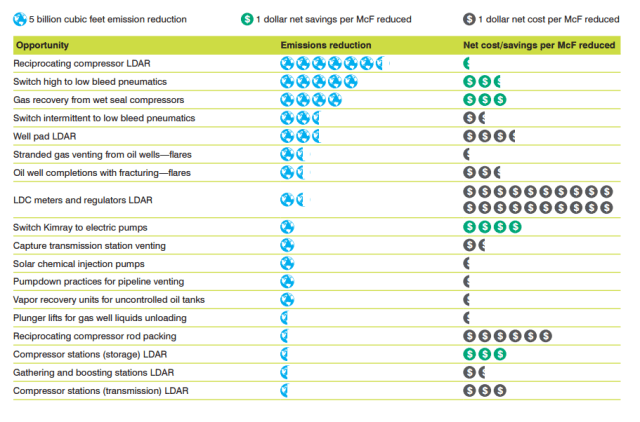
EDF then identified different techniques that, coupled with better and more frequent monitoring, can reduce methane emissions. In some cases the techniques have a net savings due to value of the captured methane. In other cases, costs are high.

EDF graphic.png   Source: EDF website

The advantage is now that it is more clear what causes methane emissions, the gas industry has the knowledge to become part of the solution in increasing environmental benefits of switching from other fossil fuels to natural gas.


Posted in Natural Gas | Tagged , | Leave a comment

Electricity Will Bypass Any Border Walls


by Bob Shively, Enerdynamics President and Lead Facilitator

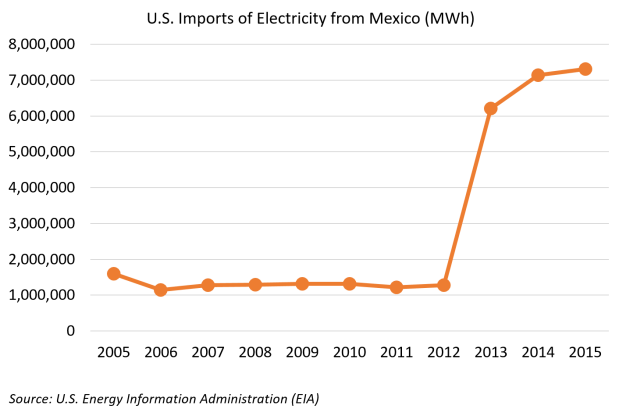
In recent years, U.S. imports of electricity from Mexico have grown significantly, mostly through bilateral energy sales into California. As Mexico implemented its electricity market reform earlier this year, Mexican officials expressed a desire to foster enhanced cross-border trading with the U.S. to the north and with Central America to the south.

Now Mexico appears poised to become part of the California ISO (CAISO) Energy Imbalance Market (EIM), which would have generators in northern Baja California actively participating in the CAISO real-time energy market. And with future plans for integrating the Baja grid into the Mexico National System, this could further extend integration of the Western U.S. and Mexican markets.

us-electricity-imports-from-mx

mx-map

What is the EIM?

The EIM is an organized market that allows participating generators across portions of eight western U.S. states to offer their units into the CAISO real-time energy market. This means that generators located within the service territories of Arizona Public Services, Nevada Energy, PacifiCorp, and Puget Sound Energy can now offer to ramp their generation up or down based on economic decisions made by the CAISO. In return, these generators are compensated through real-time energy payments as determined by the CAISO real-time energy price.
eim-map

This market creates benefits including:

  • More efficient dispatch of units between regions since efficient units in one region are now available to handle real-time needs in other regions
  • More efficient dispatch of units within regions since dispatch is now done automatically based on economic generation offers
  • Reduced curtailment of renewable energy resources since unexpected variability in one region can be balanced by resources in other regions
  • Reduced need for regions to carry flexible reserves since the requirements for reserves can be shared between regions

CAISO’s analysis shows the EIM resulted in $26.16 million of net benefit in the 3rd quarter of 2016 and has resulted in a cumulative benefit of $114.35 million since market inception in November 2014. In the third quarter of 2016, the market also allowed an additional 33,094 MWh of renewable energy to be dispatched, resulting in a reduction of 14,164 metric tons of CO2 output compared to what it would have been if the market was not in place.

Mexico’s Participation in the EIM

In October, the CAISO and the Mexico ISO, El Centro Nacional de Control de Energía (CENACE), announced the initiation of a study to explore participation of the Baja California Norte grid in the EIM. Baja, which as of 2014 has about 600 MW of renewable generation (including geothermal energy sold in a bilateral contract to the City of Los Angeles) has the potential for significantly growing renewable generation. As referenced in a recent paper by ICF International, studies have suggested that Baja could develop as much as 10,000 MW of wind generation with additional geothermal and solar resources.

But with internal demand of only a few thousand MW on a typical day, northern Baja is unable to utilize its potential resources without an external means of balancing variable renewable supply. Meanwhile, California is moving forward with implementing its 50% renewables requirement, and imports from Baja may well be a low-cost renewable source. So, we have a potential low-cost supplier sitting next door to a buyer with significant needs and an existing market mechanism that can make it happen fairly easily. Given these factors, we can conclude that despite recent negative political rhetoric about cross-border trade with Mexico, U.S. and Mexican electricity markets are going to become increasingly integrated.


Posted in Electricity | Tagged , , , | 1 Comment