The Energy Industry: A Review of 2013 Highlights and What May Come in 2014, Part I

By Bill Malcolm, guest author

As we turn our calendars to a new year next Wednesday, it’s time to look back at major developments in the energy industry in 2013 and make some educated predictions at what we may see in the year ahead:2014

The elephant in the room: Low electric load growth
I am unaware of any time period in recent history in which electric load growth has been so low. What caused “the perfect storm” that led to such low load growth?

  • the lingering recession
  • energy efficiency programs and mandates
  • growth of demand response (now 16,000 MW in PJM)
  • more efficient appliances
  • the price elasticity of demand (i.e., higher rates cause consumers to use less)

Of course, low demand growth leads to low growth for new generation resources. Regional exceptions include ERCOT in Texas, Southern California (with the closure of San Onofre), and North Dakota (where a baseload coal plant was cancelled and the oil boom enhanced demand in the western part of the state).

The only need for new resources could be attributed to EPA impacts (causing power plant closures and retirements) but only if such plants are not replaced (which many are with new gas plants, wind, etc.). 

With a flat kWh sales denominator, any expenditure or program, however worthy, pushes up rate levels. In many Midwest states, impacts of power plant and transmission line construction have taken historically low-cost states like Wisconsin and Indiana to the middle of the pack. Indeed, one Wisconsin utility now has an average rate around 15 cents/kWh (compared to a state average residential rate of 12.5 cents/kWh over the period 2008-2012). 

The Badger State had enjoyed lowest-in-the-Midwest electric rate status for many years. Perhaps the rate increases will result in re-thinking whether there is need for new generation and transmission.

Worst trend of the year award: Closing nuclear plants for economical reasons
With power surpluses in many parts of the country and anemic demand growth we have seen surprise closures or announcements of potential closures of both aging coal-generating plants and nuclear power plants — some of which just had their NRC licenses renewed.

Perhaps the poster child for this unfortunate trend was the closing by Dominion in Wisconsin of the Kewaunee nuclear power plant. The owner had just received a license renewal from the NRC and employed 700 workers.

Not only did the previous buyer of the power from this plant decline to renew their contract with the plant, they are potentially replacing it with a new gas-fired plant.

So Wisconsin ratepayers  already suffering from higher than national average rate levels  are stuck paying to replace the embedded-cost nuclear power with a new plant and potentially volatile fuel prices.

Other announced nuclear plant closures include the Entergy Vermont Yankee plant as well as potential closures in Illinois discussed recently by Exelon. Southern California Edison’s (SCE’s) San Onofre also closed this year for operational and safety reasons.

Runner up: Debates on retail choice
You know times are changing when a state like Indiana, which just adopted daylight savings time a few years back, decides to debate retail electric choice. However, the continued low wholesale power prices have made retail access a success story in neighboring states while Indiana has lost its electric rate advantage. Legislation is anticipated in 2014, and it will be an idea debated in the state’s energy plan.

We Energies in Michigan’s Upper Peninsula lost 85% of its retail load to marketer Integrys this year. Insiders predict legislation that will further increase retail choice is unlikely until 2015 in Michigan. In any event, look for retail choice debates to spring up again in 2014.

Next week we will examine a few more hot topics and/or key trends including the impacts of distributed generation (DG), net metering, and solar; RTO expansion; challenges of wind integration; cost recovery trackers and regulatory streamlining; and natural gas as a choice fuel.

About the author: Bill Malcolm is an energy economist based in Indianapolis. He has worked for PG&E, MISO, and ANR Pipeline. He can be reached at billmalcolm@gmail.com.

Posted in Electricity, Natural Gas | Tagged , , , , , , , | 1 Comment

Customized Course Answers the Question “How Does a Utility Make Money?”

By John Ferrare, Enerdynamics CEO

Earlier this year one of our utility clients came to me with an interesting challenge. Years after it had been filed, a rate case decision was coming and would result in substantial rate increases for gas and electric service. Fearing that ratepayers would see this as “the greedy utility” taking advantage of customers, the utility wanted its employees to fully understand and be able to explain to friends, family, neighbors, etc., that the hefty increase in rates did not mean the utility was laughing all the way to the bank.


Having worked at a major California utility for more than a decade, this project uniquely appealed to me. In my experience there and with other utility clients I’ve learned that utility employees rarely understand how their company makes money. And, more importantly, they don’t get how different the money-making process is from that of a competitive company.

With a competitive enterprise, the formula is fairly simple: Take in more than you spend and you are profitable! For a utility, however, the formula is a bit different. In many cases pricing is not competitive but rather decided by a regulatory body.

Also up to the regulators are the services that a utility can offer, whether or not a utility can spend money and, if so, how the money can be spent. Additionally, the regulator can disallow expenses it finds unreasonable, and what’s politically acceptable one year may be totally unacceptable a few years later. Thus, it makes for a rather complicated paradigm! 

This was one of the most challenging classes Enerdynamics has developed. The client wanted a half-day class that would be presented twice in one day, thus allowing 60 people to participate each day. This meant a lot of information had to be presented in just four hours. Also, we had to ensure that the topics (including concepts like rate base, depreciation, and rate of return) were presented in a way that is accurate enough for the experts yet simple enough for the novices.

Though challenging to develop, the class has received a great response from its attendees and the client, who plans to continue the course offering in 2014. As one who teaches this class, it’s rewarding for me to hear attendees explaining concepts like “rate base” with clarity and confidence after just a few short hours of focused learning.

While this class was customized for this particular utility/client, most of the course content is applicable to any gas and/or electric utility. Customization is available for this and any class offered by Enerdynamics. If your company has a challenge that could be addressed via a customized training session, Enerdynamics has the experience and resources to make it a reality. Contact me via email at jferrare@enerdynamics.com or by phone at 866.765.5432 ext. 700.

Posted in Energy Training | Tagged , , , , , , , | Leave a comment

Stealth Demand for Natural Gas Fuel is Quietly Building

by Belinda Petty, Enerdynamics Instructor

Those in the natural gas industry are very aware of the natural gas supply surplus in the U.S. Articles fill industry trade newsletters and mainstream media. Additionally, there are numerous blurbs outlining big future demand draws such as incremental electric CNG fuel tanks on truckgeneration, LNG marine exports, and new industrial demand in the chemical and plastics industries.

However, there is another tranche of growing demand considerations that hasn’t stole as many headlines but has the potential to permanently raise the demand level. This “other” demand category, or stealth demand, can be divided into two major components: production demand and transportation demand. This article’s focus is on transportation demand.

While CNG cars and buses have been around for decades, they have typically been concentrated in urban areas for fleet use and intercity transportation. Existing natural gas vehicle fuel demand is miniscule in comparison to other gas customer groups. The new transportation demand is focused on LNG. The demand may come from three different sources: fuel for long-haul freight trucks and heavy equipment, fuel for trains, and fuel for marine vessels.

Historically, all of these engines used diesel fuel. But with today’s oil and gas prices, experts estimate the savings to convert from a gallon of diesel to the equivalent amount of LNG is about $1 to $1.50 per gallon. For heavy-duty trucks and heavy equipment, the conversion payback is less than three years.  Companies like Caterpillar and GE have opened divisions to convert and/or build LNG-powered heavy equipment to serve this growing market.

GE is also building and testing LNG conversion kits for its Evolution diesel locomotive line. Even though the Evolution line significantly reduced emissions and provided some fuel saving, the LNG conversion could cut fuel costs by about 50%, further cut CO2 and NOX levels while also increasing range between fueling. The Canadian National Railway already has two LNG locomotives in service as part of its LNG pilot program.

Limited refueling infrastructure has presented a major obstacle to its widespread use as a fuel. Shell is investing significantly in freight truck and marine fueling infrastructure. The company announced an agreement with TravelCenters of America, a major truck stop operator, to build LNG fueling lanes at up to 100 of its sites along the interstates. Shell has also announced the construction of micro LNG plants in the Gulf Coast area to fuel marine traffic as well as fleet services.

With several well-capitalized companies working along the full gas value chain, it’s possible that natural gas could be the vehicular fuel of choice for heavy transport in decades to come.

Posted in Natural Gas | Tagged , , , , , , , | Leave a comment

Germany’s Energiewende – Transformation by Government Policy or Utility Business Imperatives?

By Bob Shively, Enerdynamics President and Lead Instructor

Throughout most of the world, Germany is known for its business-oriented practicalitygermany and adherence to fiscally conservative policies. Germany’s leader, Angela Merkel, is dubbed throughout Europe as Germany’s “Iron Lady” or Mrs. Nein for her refusal to grant easy money to failing southern European economies.

Yet Germany’s “Energiewende” energy policy is based on renewables, energy efficiency, and energy democratization[1]. Has Germany foolishly gone soft, or is the country cleverly positioning itself as the future leader of the next energy transformation?

Both viewpoints are well documented and can be found with a quick web search. According to a recent article in Economist magazine, “It is hard to think of a messier and more wasteful way of shifting from fossil and nuclear fuel to renewable energy than the one Germany has blundered into[2].”

Yet, the article goes on to say, “But that does not mean the entire enterprise will fail.”

As has been noted by many, including Bill Gates, energy transitions take a long time. A recent analysis by Robert Wilson, a PhD student in mathematical ecology, suggests that renewable growth in Germany is slightly faster than initial growth rates of the past German transition to nuclear power but significantly slower than the earlier transition to natural gas. So it could be that supporters of renewable energy are expecting too much too soon, while opponents are happy to tout the inevitable bumps in the road.

The recent actions of a major German utility, RWE, suggest that something is afoot. RWE, long a master of building large-scale central power plants, has begun a move to refashion itself as a “capital light” network company focused on being a project enabler, plant operator, and system integrator of renewables[3].

In a recent webinar, an analyst from Platts commented that the only reason RWE would do this is because their stock price is so low, and has been that way for so long, that they can’t see any other way to move forward. So while it is clear that governmental policy such as Energiewende influence energy transformations, the speed of transformations may be significantly impacted by utility business imperatives.


References:

[1] For a somewhat whimsical view of the “soft” side of Energie Wende” see the independent movie Welcome to the Energiewende at http://welcometotheenergiewende.blogspot.de/

[2] See http://www.economist.com/node/21559667

[3] See articles at http://www.reuters.com/article/2013/10/31/us-rwe-strategy-idUSBRE99U0CE20131031, and http://cleantechnica.com/2013/10/24/rwe-dramatically-changing-business-model-making-radical-departure-conventional-utility-model/

Posted in Renewables | Tagged , , , , , | Leave a comment

Indiana, Michigan Debate Merits of Electric Retail Choice

By Bill Malcolm, guest author

Belief in electric retail choice continues to be split in the U.S. with no consensus among the various states. But industrial customers in states without choice continue to look for price tag with plugoptions. Discussions about retail choice are active in the both Indiana and Michigan.  Here is what is going on in each state.

Indiana
Indiana’s industrial electric rates have jumped from 5th lowest to 25th in the last few years causing the state to lose its historic low-cost advantage.

Governor Mike Pence’s energy advisor, Dan Schmidt, told attendees at the Indiana Energy Conference on Nov. 5 in Indianapolis that the state would “have a conversation” on the issue as part of the forthcoming state energy plan. He noted that the rise in the state’s ranking in electric rates sparked some customers to push for retail choice.

Chris Olsen Tate and Lyle (a large corn processor in Lafayette) had told the Legislature’s Regulatory Flexibility Committee in September that rising electricity costs are the single largest deterrent to expanding its Indiana operations. Since 2011, electricity prices in Illinois and Ohio (which allow retail choice) have declined relative to those in Indiana.

Dr. Ken Rose (appearing for the Indiana Energy Association) said there appears to be no clear benefit to customers from retail rate restructuring at this time. Recent price decrease in restructured states could quickly reverse if natural gas prices increase again.

The legislature reconvenes in January, and word on the street is that legislation is expected.

Michigan
After a year-long process, the PSC and the state energy office released a report on Nov. 20 that included an evaluation of the merits of expanding retail choice from the current 10%, which applies only to the lower Peninsula. The report on electric choice was sent to Governor Rick Snyder.

“Michigan’s hybrid electric choice structure (where choice is capped at 10%) is unique in the nation,” said PSC Chairman John D. Quackenbush and Michigan Energy Office Director Steve Bakkal.  “As a result, it exhibits characteristics of both a regulated and deregulated electric market.”

The final report is available on the Michigan.gov/energy website.

The Energy Choice Now Leadership Council, a new group that supports lifting the 10% retail choice cap, formed a steering committee that will work with Governor Rick Snyder and lawmakers in Lansing to end Michigan’s “monopoly-style electric market that prevents competition and has led to the highest energy rates in the Midwest for families and job providers.”

Electricity prices went up an average of 2.7% nationally since 2008, while rates have increased over 30% in Michigan according to the group.

A national retail choice advocacy group, COMPETE, expressed concern that the key draft report failed to reflect the factual record in support of Michigan lifting its arbitrary limits on customer choice and retail competition and was weighted against expanding choice.

A group that opposes lifting the cap is also active. The Michigan Jobs & Energy Coalition was formed to ensure that Michigan’s energy policies safeguard the state’s energy future. In 2010, the electric power industry in Michigan represented $11.7 billion in direct investment and supported $4 billion in additional economic activity. They embrace and support three fundamental goals for energy policy:

  • Provide regulatory certainty to encourage investment: Consumers Energy, for example, is the state’s second-largest investor and is currently engaged in a five-year plan to invest $7 billion in utility operations.
  • Strengthen Michigan’s energy infrastructure and take the lead on clean energy investments
  • Power Michigan’s economic future

Insiders tell me that legislation, if any, is not expected until 2014 or even 2015.

About the author: Bill Malcolm is an energy economist with extensive experience in the energy industry having worked for PG&E, ANR Pipeline, and MISO in the area of state regulatory affairs and rates. He currently does volunteer work with Hoosiers for Passenger Rail and is a columnist for The Broad Ripple Gazette. He also writes “RTO Watch” and “Commission Corner” in The Cruthirds Report, a Houston-based energy newsletter covering the mid-Continent. Contact Bill at Bill Malcolm@gmail.com.

Posted in Electricity | Tagged , , , , , , , , , | Leave a comment

Can Incentive Regulation Save the Future of Utilities?

By Bob Shively, Enerdynamics President and Lead Instructor

Utilities in the U.S. are caught in a quandary.  The traditional model for creating earnings growth for investors is built around increasing sales and growing capital investment.  Yet as we move forward into the 21st century, market forces and government/regulatorybulb vs money policies are constraining demand and encouraging alternatives to utility generation. Utilities fear a death spiral, where fewer and fewer customers are asked to pay more and more to support utility fixed costs.

Meanwhile, many in the industry believe that consumers are soon to awake from their century-long acceptance of monopoly utility services to demand options not dissimilar to phone and internet services[1].  Utilities in the United Kingdom (U.K.) are facing similar concerns, and over the last two years the U.K. regulator Ofgem (Office of Gas and Electricity Markets) has begun implementing a new incentive-based monopoly pricing mechanism designed to move their utilities into the new world[2].  Ofgem’s mechanism is worth studying as a possible future for U.S. utilities.

When the U.K. electric and gas utilities were restructured in the 1990s, the business was separated into four sectors – production (generation in the case of the electric business), transmission, distribution, and retail supply.  Transmission and distribution were defined as monopoly network companies subject to regulation.

But since the network companies no longer had generation resources or could make a margin selling supply to customers, the U.K. had to develop new methods of creating a profitable but fair revenue stream.  The U.K. decided on performance-based regulation (PBR) and has been implementing and refining this model since.

The latest methodology is called RIOO.  The name is taken from the equation Revenues = Incentives + Innovation + Outputs.  RIOO will set allowed prices for network companies for an 8-year period.  According to Ofgem, the regulation will encourage network companies to:

  • put stakeholders at the heart of decision making
  • invest efficiently to ensure continued safe and reliable service
  • innovate to reduce network costs for customers
  • play a full role in delivering a low-carbon economy and wider environmental objectives

The mechanism will allow the network companies to attain a specified rate of return based on performance as measured against criteria such as customer satisfaction, reliability and availability, safe network services, connection terms for new customers, environmental impact, and social obligations.  Note that return is not based on the amount of capital invested to achieve these criteria; that decision is left up to utility management.

So will we soon move to radically different regulatory models in the U.S. similar to those in the U.K.?  As most readers know, nothing moves fast in the utility industry. And the U.K. has been refining its model for over 20 years. But the U.K. experience provides some interesting ideas for states to consider as regulators and utility management try to figure out how to keep utilities viable as we move into a new energy world.


References:

[1] See for instance the Utility Customer of 2020 from PwC: http://assets.fiercemarkets.com/public/sites/energy/utility%20customer%202020.png

[2] See Ofgem’s site describing the regulatory mechanism here: https://www.ofgem.gov.uk/network-regulation-%E2%80%93-riio-model

Posted in Electricity, Natural Gas | Tagged , , , , , , , , | Leave a comment

Could Nuclear-Renewable Hybrid Help Stave Off Greenhouse Gases?

By Bob Shively, Enerdynamics President and Lead Instructor

Bill Gates, who knows a bit about developing new technology, says that failure rates in green energy start-ups will be well over 90%.

170232353

“This is a very complex set of technologies, and so we need thousands of companies to be trying these things to increase the odds that 10 or 20 companies will get to that magic solution,” said Gates at a conference in 2012[1].

Given that, we can’t afford to reject any new idea out of hand, nor can we assume that we have already discovered “the holy grail” to future energy sources. Bill Gates also says we shouldn’t reject nuclear power as a key future energy source[2]. Thus, it is worth considering an intriguing idea from MIT research scientist Charles Forsberg that suggests combining nuclear power with renewable sources in a hybrid design might provide a better match to the variable output of renewables than batteries.

Writing in the November 2013 edition of the Energy Policy Journal[3], Forsberg describes a hybrid system to address mismatches between electricity production and customer demand in a nuclear renewable electric grid. Both nuclear and renewable energy are zero carbon sources.

Currently, fossil fuel units are the most common generation source used to account for the variable output of renewables. Fossil fuels are easy to store, and fossil units can be ramped relatively easily.  But all fossil fuels emit greenhouse gases.  Nuclear units, which emit no greenhouse gases, are not currently well suited to pairing with renewables because they are not designed to ramp in response to the variable availability of renewable power.

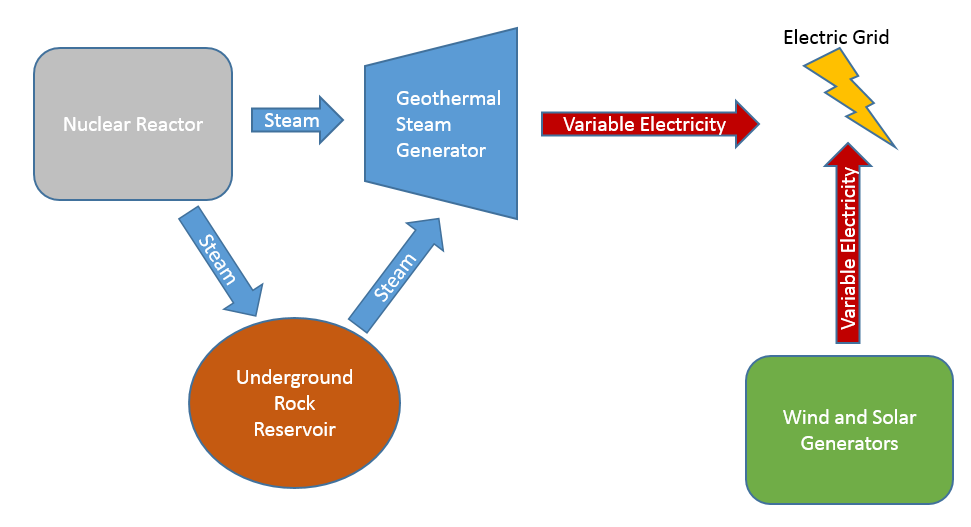
In his article, Forsberg describes a possible zero carbon grid designed around variable electric and steam output. In his design, nuclear units would remain baseload units, but they would focus on production of steam, not electricity.  When electricity is needed for the grid, the steam is used to produce electricity in a geothermal steam turbine generating unit. But when renewable sources are producing plentiful electricity, the steam would instead be stored as heat in an artificial underground rock reservoir.  The heat source would then be used to produce electricity at a later time.

nuclear hybrid diagram

Does this sound fanciful? Well it certainly will take some time to develop.  But when you consider the amount of nuclear power that either exists and/or is being constructed in some parts of Asia and the Middle East, there may be something to the idea. 

Research into nuclear hybrid systems is ongoing at institutions such as the U.S. Idaho National Lab[4], the Joint Institute for Strategic Energy Analysis[5] as well as in various international coalitions. Results may or may not prove fruitful, but as Bill Gates points out, we need to keep trying various ideas to address our energy needs.

Posted in Renewables | 1 Comment

Do Solar and Wind Cause Power Plants to Release More Pollution? No Says NREL

The main research windmills at NREL

The main research windmills at NREL (Photo credit: Wikipedia)

Thanks to our friends at SolarReviews.com  for this insightful post!

by Chris Meehan, SolarReviews.com

One rather odd—but somehow sticking—protest against solar and wind power is that they cause fossil fuel power plants to release significantly more emissions as they cycle electric production up and down to balance the load of electricity on the grid. A new study from the National Renewable Energy Laboratory (NREL) essentially calls that concern hogwash and dispels the myth—again. It’s the latest positive news for the wind and solar industries.

The new study, Phase 2 of the Western Wind and Solar Integration Study (WWSIS-2), finds that when emissions related to cycling of power plants for wind and solar power are compared to the emissions without renewable energy, wind and solar offer significant reductions in overall emissions. Carbon emissions induced by more frequent cycling of fossil fuel power plants are negligible at less than 0.2 percent. However, the study also finds that sulfur dioxide emissions reductions from wind and solar are 5 percent less than expected due to the cycling of fossil-fueled generators. Emissions of nitrogen oxides are reduced 2 percent more than expected, it states. So, there are some slight increases in emissions during the ramping up and down of fossil fuel plants.

Emissions impact of Cycling. Courtesy NREL.

More important are the overall reductions in emissions that would be caused by higher levels wind and solar electricity. The study finds that the high wind and solar scenarios (33 percent of electric generation) reduce carbon dioxide emissions by 29 percent to 34 percent across the Western Interconnection, which ranges from the Western tip of Texas to California and up into the Canadian provinces of British Columbia and Alberta.

While sulfur dioxide emissions were higher than expected because of cycling, the study still found that overall emissions were reduced by 14 percent to 24 percent in the high scenarios. Nitrogen oxides (NOx) are reduced more than expected by cycling—between 16 percent to 22 percent in the high scenarios. “This is because the average coal plant in the West has a lower NOx emissions rate at partial output than at full output,” NREL says.

“Adding wind and solar to the grid greatly reduces the amount of fossil fuel—and associated emissions—that would have been burned to provide power,” says Debra Lew, NREL project manager for the study. “Our high wind and solar scenarios, in which one-fourth of the energy in the entire western grid would come from these sources, reduced the carbon footprint of the western grid by about one-third. Cycling induces some inefficiencies, but the carbon emission reduction is impacted by much less than 1 percent.”

It should also be noted that cycling power plant production up and down is nothing new. “Grid operators have always cycled power plants to accommodate fluctuations in electricity demand as well as abrupt outages at conventional power plants, and grid operators use the same tool to accommodate high levels of wind and solar generation,” Lew explains. “Increased cycling to accommodate high levels of wind and solar generation increases operating costs by 2 percent to 5 percent for the average fossil-fueled plant. However, our simulations show that from a system perspective, avoided fuel costs are far greater than the increased cycling costs for fossil-fueled plants.”

Cycling costs from a System Perspective. Courtesy NREL.

High levels of wind and solar power—up to 33 percent in the study—would reduce fossil fuel costs by approximately $7 billion per year across the West, while incurring cycling costs of $35 million to $157 million per year, according to the study. That equates to added operations and maintenance costs between 47 cents to $1.28 per megawatt-hour (MWh) of generation for the power plants. As the costs of solar continue to come down, the costs-savings in terms of reduced fuel use will be greater as well. And NREL finds that solar could be cost-competitive with natural gas as soon as 2025—without subsidies.

“From a system perspective, high proportions of wind and solar result in lower emissions and fuel costs for utility operators,” Lew says. “The potential cycling impacts offset a small percentage of these reductions.”

The newly released study is a follow-up to the first study, which was released in May 2010. The first study evaluated the feasibility of integrating high levels of wind and solar power into the western electricity grid, and raised questions about emissions and wear and tear costs. The 2010 study also found that 4 MWhs of renewables will replace 1 MWh of coal generation and 3 MWh of natural gas. “The biggest potential cycling impact is the significant increase in ramping of coal units,” the study says.

The research was supported by the Department of Energy’s Office of Energy Efficiency and Renewable Energy and the Office of Electricity Delivery and Energy Reliability. The study was undertaken by NREL, GE, Intertek-APTECH, and RePPAE. The study was reviewed by utilities companies, researchers, analysts, and other experts.

Posted in Renewables | Tagged , , , , , , | 1 Comment

A Decade After Enron’s Demise, Can Energy Markets Still Be Manipulated?

By Bob Shively, Enerdynamics President and Lead Instructor

Back in the days when Enron was a high-flying energy trading company, energy traders joked that when a new ISO tariff came out the trading companies would take their87690247 smartest analysts, lock them in a room with a large pizza, and not let them out until they had found all the profitable loopholes.  

Based on the recent stipulation between the Federal Energy Regulatory Commission (FERC) and JP Morgan’s energy trading arm, it sadly appears that such activities still exist[1]. More than a decade after Enron crashed in disgrace, and with the implementation of ISO Independent Market Monitors and FERC’s Office of Enforcement[2], how can energy trading companies still manipulate markets?

One issue for competitive wholesale electric markets is they are inevitably complex, which opens up opportunities for traders to find ways to exploit the rules to increase profits. In the case of JP Morgan, FERC alleges that the company’s strategies crossed the line into market manipulation[3].

Here are just a few of the strategies JP Morgan is alleged to have used. (If you need some background information on CAISO markets, see our electricity article in our most recent edition  of Energy Insider).

  • In one strategy units offered a high Pmin, but then offered day-ahead energy at -30/MWh (meaning the unit would pay CAISO for the right to generate). The unit then offered to ramp down in real-time using a real-time price that made it highly likely that CAISO would ramp the unit down to its minimum operating level.  The result was the unit would only generate its minimum amount and would be paid for that at a level approximately equal to $90/MWh (when market prices were typically $30-35/MWh).
  • In another strategy, units submitted self-schedules every third hour, while submitting high prices of $73 to $98/MWh for the next two subsequent hours. The result was that CAISO would self-schedule the units as requested, but then would be obligated to pay the as-bid price for the next two hours as the unit ramped down.
  • In a third strategy, units submitted -$30/MWh day-ahead offers for the end of an operating day. For the next day, the unit submitted offers for the hours between midnight and 2 a.m. at $999/MWh. As with the prior example, CAISO would be obligated under its tariffs to pay the $999/MWh price while the unit ramped down.

What can we learn from this?
First, it is extremely difficult, if not impossible, to write ISO tariffs that fairly reward generators for their costs while not providing opportunities for excessive profits. ISOs and their members must be continually alert for market participants’ manipulating rules (CAISO has since rewritten its rules in an attempt to block such strategies). 

And for companies involved in trading, strong processes are needed to rein in traders’ proclivity for maximizing profits any way possible. As FERC has pointed out, compliance with tariffs is not sufficient to avoid running afoul of market manipulation statutes. And activities that are perceived to be market manipulation can be very expensive when you get caught. 

As one of my friends who works for a utility told me after attending market behavior compliance training – it is a lot safer for a generator to just offer its true costs and let the market reward units that deserve profitability. But not all companies are focused on being safe!

 References

[1] On July 20, 2013 FERC and JP Morgan’s energy trading arm agreed to a stipulation whereby JP Morgan would pay a civil penalty of $285 million plus give back an additional $125 million of alleged unjust profits. The stipulation concludes an investigation opened by FERC’s Office of Enforcement in response to multiple referrals by CAISO and MISO Departments of Market Monitoring.  The case investigated JP Morgan’s bidding strategies during the time period September 2010 through November 2012 when JP Morgan was responsible for bidding the output of several gas-fired power plants into CAISO and MISO markets.

[2] Under the Energy Policy Act of 2005, the Federal Energy Regulatory Commission (FERC) has strong authority to act to combat gaming of energy markets. FERC is authorized to issue penalties as high as $1 million per day per incident and can also suspend an entities ability to charge market based rates for its services. To assist FERC, each ISO has an Independent Market Monitor (IMM).

[3] For more details on FERC’s case and the specific strategies used, see: Order Approving Stipulation and Consent Agreement, Dockets Nos. IN11-8-000 and IN13-5-000 available athttp://www.ferc.gov/EventCalendar/Files/20130730080931-IN11-8-000.pdf

[4] The description of strategies is based on the description in the above stipulation.

Posted in Electricity | Tagged , , , , , , , , | Leave a comment

Gas and Electric Industries Seek a Happy Codependence, Part II

by Bill Malcolm, guest author

In last week’s post we introduced the discussion on how the gas and electric industries are153187634 seeking ways to better coordinate the way the two industries operate. This is especially important as gas-fired electric generation is on the rise.

So what’s been done to enhance such coordination, and what’s the position of those involved?

In an effort to provide certainty to the industry and remove barriers to the sharing of non-public operational information, the Federal Energy Regulatory Commission (FERC) issued a Notice of Proposed Rulemaking (NOPR), Communication of Operational Information between Natural Gas Pipelines and Electric Transmission Operators, in Docket No. RM13-17-000 on July 18, 2013.

The NOPR proposes to revise FERC regulations to authorize the exchange of non-public, operational information between electric transmission operators and interstate natural gas pipelines. The NOPR also proposes to adopt a “no-conduit rule” to prohibit recipients of the non-public operational information from subsequently disclosing, or being a “conduit” for, the information to another entity. The NOPR was opened after numerous FERC workshops on the issue were held.

Comments filed on the FERC proposal include:

  • Interstate Natural Gas Association of America (INGAA)
    INGAA encouraged the ISOs/RTOs to continue examining long-term changes to amend the restructured wholesale electric power market rules which fail to compensate generators for the cost of subscribing to services necessary to ensure electric reliability, regardless of the fuel needed to generate electric power. INGAA says that it wants to work with stakeholders to explore changes to the gas day and nomination schedule that meet the needs of the growing electric power market and historic firm customers and consider the operational requirements of the producers. At the same time, INGAA says that the organized electric markets must work to review their electric day and dispatch schedules to ensure that generators are able to make timely nominations on pipelines. INGAA also supports studying the modification of wholesale electric market rules to compensate generators for holding long-term pipeline transportation contracts and supporting infrastructure expansions.
  • American Public Power Association (APPA)
    APPA believes that the Commission should encourage voluntary information sharing between generators and their electric transmission system operators. (APPA noted at a recent EISPC meeting the inability of shorter term “eastern style” capacity markets to support the signing of long-term firm gas transportation agreements to support new gas-fired generation.)
  • Electric Power Supply Association (EPSA)
    EPSA requests that the Commission amend the language in the proposed rule to require generators to share information with transmission operators in the event of a “material possibility that the generator’s natural gas service may be disrupted.” This change would clarify that such a requirement would apply only in the event of a high probability of imminent failure of the generator’s natural gas service.
  • American Gas Association (AGA)
    AGA says that communication improvements should not be seen as the only way of addressing natural gas and electric system interdependencies. Communications can supplement, but are no substitute for, the timely planning and construction of adequate natural gas infrastructure to meet growing power sector demands.

In another development, FERC recently ruled on an ISO New England proposal. In a dispute with the power generators, FERC agreed with ISO-NE in its proposal to impose performance obligation on capacity resources (barring economic outages based on decisions not to procure fuel or transportation). 

However, FERC also found that a demonstrated inability to procure fuel or transportation may legitimately affect whether a capacity resource is physically available and therefore may excuse nonperformance. 

What may happen next?
Numerous discussions and initiatives are ongoing around the country[1]. What will come out of these discussions is unclear. We will continue to watch this situation to see what, if any, actual changes move to implementation.

References:

[1] For more details on these discussion and initiatives see State of Natural Gas and Electric Interdependency
http://www. energycentral.com/ generationstorage/ fossilandbiomass/articles/ 2736/?utm_source=2013_10_01& utm_medium=eNL&utm_content= 65370&utm_campaign=PULSE_ WEEKLY and FERC’s Gas-Electric Coordination Quarterly Report http://www.ferc.gov/ legal/staff-reports/2013/A-4- report.pdf

About the Author
Bill Malcolm is a 37-year energy industry veteran who has worked for Seattle City Light, Pacific Power, PG&E, ANR Pipeline (now owned by TransCanada), and MISO. He currently is a freelance energy reporter and has a column in The Cruthirds Report (a Houston energy newsletter) on RTO and PSC matters. He holds a M.A. in economics from the University of Washington and a B.A. in economics from UC Santa Cruz. He also is a columnist in the Broad Ripple Gazette and has organized a new group, Hoosiers for Passenger Rail, in an attempt to save the daily Amtrak service from Indianapolis to Chicago.

Posted in Electricity, Natural Gas | Tagged , , , , , , , , , | Leave a comment