Utility Commissions Speak on the Future of the Utility: A New Type of Regulation for Hawaii

by Bob Shively, Enerdynamics President and Lead Instructor

In our pursuit of understanding how state utility commissions envision the future of the waikikiutility, last week we explored how the Hawaii Public Utilities Commission views the future of the Hawaiian Electric Companies (HECO).  This week we’re looking at how the Commission may evolve policy and regulation to attempt to achieve the desired outcome.

Policy and Regulatory Reforms to Achieve Hawaii’s Clean Energy Future

To achieve the strategic initiatives described in last week’s blog post, the utilities will need to transform their business models to de-emphasize supply procurement and increase roles in systems operations and integration.  Key aspects include:

  • sufficient senior management attention and corporate resources to effectuate the transformation
  • an assumption that the utility’s “traditional role as owner and operator of a fleet of fossil generation will diminish over time”
  • consideration of precluding utilities from acquiring new generation and incentivizing utilities to accelerate retirement of existing inefficient generation
  • a transition to new key utility roles including: 1) system planner and operator of high renewables grids (somewhat like an ISO on the mainland) and manager of fuel procurement for IPPs; and 2) transmission and distribution system integrator

To achieve these changes, the Commission recognizes that it must change the current regulatory cost-recovery model with company profits tied to return on utility plant investment. Concerns with the current regulatory model include lack of correct incentives to control power supply costs, no direct financial incentive to pursue clean energy projects developed by independent power producers, no direct financial incentive to accelerate retirement of fossil generating units, and lack of transparent price signals to evaluate the supply of ancillary services.

The Commission describes a number of potential regulatory solutions including:

  • incentive mechanisms to increase renewable energy, minimize power supply costs, reduce emissions, and maintain bulk power supply reliability
  • incentive mechanisms to encourage accelerated retirement of existing fossil units possibly including securitization to financially protect the utilities’ loss of rate base
  • a prohibition on HECO developing new generation resources or undertaking major modifications to existing units
  • unbundling ancillary services
  • incentive mechanisms to reward investment in transmission and distribution grids to enable the type of system envisioned

Pricing changes might include:

  • unbundling of supply, energy delivery, and ancillary services
  • greater utilization of capacity-based fixed-cost pricing (instead of recovering most costs in a per kWh charge)
  • utilization of time-of-use and dynamics pricing
  • a supplemental power supply service for customers with self-generation

To achieve its vision, the Commission recognizes the regulatory compact may need to be changed, but it does not yet have a recommendation on how. The Commission notes that if consumers have the option to economically take care of their own supply needs then the utility obligation to serve must also be reconsidered.

States the Commission: “The long-term obligation for Hawaii’s electric utilities to interconnect customer-owned generation, to supply distributed generation customer with supplemental or back-up power supply and to provide grid capacity to enable power exports has not been defined.”  The Commission concludes by stating that it is now incumbent on HECO to develop a new sustainable business model.

hawaii utility

Source: Hawaii Electric’s May 7, 2014 Earnings Conference Call

Posted in Electricity, Renewables | Tagged , , , , , , , | Leave a comment

Utility Commissions Speak on the Future of the Utility: The Future Hawaiian Grid

by Bob Shively, Enerdynamics President and Lead Instructor

Much discussion lately has focused on the future of the electric utility. Some believe that honoluluutilities won’t change much despite all the hype, while others fear a death spiral will result in the failure of utilities. And others envision a transition to new business models centered on network-only companies or robust energy services companies.

Everyone recognizes that regulated utilities can’t make preparations for the future without the support and consent of their state regulatory commissions. Lately in California and Hawaii, the commissions have formally shared their views of the future. This week and next on our blog we will explore the Hawaii Public Utilities Commission’s thoughts. In a later blog post we will look at thoughts from the California Public Utilities Commission.

In Hawaii, the Commission recently rejected the Hawaiian Electric Companies (HECO) Integrated Resource Planning (IRP) filing. In rejecting the filing, the PUC stated that the IRP appeared to be a series of unrelated capital projects without focus on moving toward a sustainable business model. To support its concerns, the PUC released a 30-page exhibit titled “Commissions Inclinations on the Future of Hawaii’s Electric Utilities: Aligning the Utility Business Model with Customer Interests and Public Policy Goals”[1].

In the Exhibit, the PUC notes that “Hawaii has already entered a new paradigm where the best path to lower electricity costs includes an aggressive pursuit of new clean energy sources.”  This is because renewable energy is now cheaper than the state’s existing fossil fuel-based supply.

The PUC goes on to say that the objectives of lower stable electric bills, expanded customer energy options, and reliable energy service in a rapidly changing system operating environment are essential principles for the future strategic business direction of the utilities. The PUC then provides guidance for future business strategy in three areas of generation, transmission and distribution, and regulation.  This article explores the first two.  Next week we will look at regulation.

Creating a 21st Century Generation System

According to the Commission, HECO should:

  • seek high penetrations of lower-cost new utility-scale renewable resources
  • invest in required changes to allow integration of the maximum level of cost-effective renewable resources, possibly with “innovative shared-savings incentive mechanisms”
  • pursue a balanced portfolio of new energy resources including wind, solar, biomass, hydro, geothermal and waste-to-energy, with geographic dispersion and a mix of utility scale and distributed resources
  • invest in grid flexibility to support utility scale and distributed renewable resources including investments in increased flexibility of traditional generation, plus new tools such as storage, demand response, and load management techniques consistent with the Integrated Grid articulated by EPRI[2]
  • develop strategies to ensure that all generation resources support system stability, whether owned by the utility, an Independent Power Producer (IPP), or a customer
  • unbundle provision of ancillary services to allow all technologies including demand response, energy storage, and customer-owned generation to compete
  • expeditiously look at changing the traditional generation fleet through retirements, efficiency improvements, and switching fuel to Liquefied Natural Gas (LNG)

Creating Modern Transmission and Distribution Grids

Steps HECO should take include:

  • preparing to lead development of advanced grids that can interlink a bulk power system that has a high level of renewable generation with a profusion of DER (distributed energy resources)
  • prepare for a growing role of non-utility energy service providers that can “intermediate the relationship between the utility and the customer” by aggregating distributed resources in controllable resources that replicate current conventional generation resources (“virtual power plants”)
  • incorporate virtual power plants and integrated energy districts (essentially what is often called microgrids) into power system design and operations
  • consider non-transmission projects as an alternative to new transmission
  • take steps to effectively integrate new large-scale renewable projects such as locating them at existing power plant sites
  • investigate interconnection of the various island grids
  • develop Integrated Energy Districts (microgrids) that can become alternatives to transmission expansion
  • adopt advanced distribution system technologies to allow high penetration of distributed generation and electric vehicles and to transition the system from one-way to bi-directional power flows
  • develop an advanced metering infrastructure program
  • develop a distributed generation interconnection plan that “identifies how customers will install, and the utilities will utilize as an integrated DER portfolio, advanced inverters, distributed energy storage, demand response, and electric vehicles.” This includes provision of ancillary services on the distribution system, two-way communication with customer resources, a non-export service option for owners of distributed generators, and utilization of distributed storage
  • develop and maintain cyber-security requirements for new distribution technologies

So given what the Commission wants the Hawaiian electric grid to become, how do they intend to make it happen?  We will explore that next week in our discussion on regulation.

References:

[1] To obtain a copy, go to http://puc.hawaii.gov/wp-content/uploads/2014/04/Decision-and-Order-No.-32052.pdf

[2] See http://www.epri.com/Our-Work/Pages/Integrated-Grid.aspx

Posted in Electricity, Renewables | Tagged , , , , , , | 2 Comments

Supreme Court Enables EPA to Implement Strict Power Plant Emissions Rules

by Bob Shively, Enerdynamics’ President and Lead Instructor

In late 2011, the electric industry was prepared for the implementation of new EPA US courthouseemissions rules called the Cross-State Air Pollution Rule (CSAPR) designed to reduce the amount of sulfur dioxide (SO2) and nitrous oxides (NOx) that upstream states send across state borders.

On December 30, 2011, just two days before the new rules were to take effect, the United States Court of Appeals for the D.C. Circuit issued its ruling to stay the CSAPR pending judicial review. The Court of Appeals instead left in place the 2005 Clean Air Interstate Rule (CAIR). Subsequently the D.C. Court vacated the new CSAPR rule.

But on April 29, 2014, the U.S. Supreme Court reversed the district court ruling and reinstated EPA’s right to implement the rule as proposed. Coupled with a recent D.C. District Court ruling in favor of the proposed EPA Mercury and Air Toxics Standards (MATS) that limits mercury and other toxic emissions from power plants plus earlier rulings supporting EPA’s regulation of greenhouse gas emissions, the message is clear – any coal unit that is to continue in service will have to strictly limit its emissions[1].

Reminder of what the CSAPR rule means
The CSAPR rule implements more stringent limits on emissions using four separate and distinct cap and trade programs[1]:

  • an annual SO2 program covering 16 “Group 1” states in parts of the Midwest and Northeast[2]
  • a separate annual SO2 program covering 7 “Group 2” states in the Southeast, parts of the Midwest and Texas[3]
  • a se asonal NOx program covering covering 25 states
  • an annual NOx program covering 23 states

(For a more thorough discussion on CSAPR allowances and how they can be traded, read the related article from our Q4 2011 issue of Energy Insider.)

The various programs are applied to different states depending on the EPA’s evaluation of where environmental issues exist.  The following map indicates where each program applies:

(source: www.epa.gov)

Overall, the new regulations cover 28 states in the East, Southeast, Midwest and in Texas.  Western states are not covered. When implemented, the new limits will significantly reduce the amount of emissions allowed in covered states:

Program
% reduction in 2012 compared to 2010 levels
% reduction in 2014 compared to 2010 levels
Group 1 SO2
18%
57%
Group 2 SO2
18%
24%
Annual NOx
9%
15%
Seasonal NOx
29%
33%

What will the impact be?
The impacts of the Supreme Court ruling are still uncertain. Most owners of coal units had already assumed that they will need to either install state-of-the-art emissions control equipment or shut their units down. So whether the Supreme Court ruling will cause more movement to shut-down coal units is uncertain.  It is not even clear when or if the EPA will move forward with implementing CSAPR. As of May 5, the EPA website says the agency “is reviewing the opinion. At this time, CAIR remains in place and no immediate action from States or affected sources is expected.”[2]

And the court did leave open the possibility for individual states to challenge whether they should be part of the program or whether circumstances have changed.

What does seem likely is that the EPA will feel more confident in moving forward with implementing the various emissions[3] rules that impact the electric generation business. Expect to hear more news about coal units being retired and no slowdown in the growth of gas-fired generation and renewables.

References:
[1] For more background see our prior blogs and Energy Insider covering the rules see: https://blog.enerdynamics.com/2012/01/09/court-halts-implementation-of-new-csapr-power-plant-emissions-rules/ and http://marketing.enerdynamics.com/Energy-Insider/2011/Q4Electricity.html

[2] See http://www.epa.gov/airtransport/CSAPR/

[3] These include CSAPR and MATS as mentioned above, Carbon Pollution Standards (see http://www2.epa.gov/carbon-pollution-standards) and National Pollutant Discharge Elimination System (NPDES) rules affecting discharge of cooling water (see http://cfpub.epa.gov/npdes/stormwater/swbasicinfo.cfm)

Posted in Electricity | Tagged , , , | Leave a comment

Must Indiana Learn to Live with No Growth in Electric Demand?

By Bill Malcolm, guest author

For the first time in the state’s history, Indiana electricity demand for the next 20 years is expected to be flat. This is the finding of a recent forecast of Indiana electricity supply and demand prepared by Purdue’s State Utility Forecasting Group for the Indiana Utility Regulatory Commission (IURC).

“Indiana Electricity Projections: The 2013 Forecast” was prepared for the IURC per a 1985 law that requires Purdue’s State Utility Forecasting Group (SUFG) to assemble a state-wide electricity demand and supply forecast every two years[1]. The recent study finds that electricity demand is projected to grow at an annual average rate of 0.74 percent over the next 20 years. By contrast, the forecast two years ago predicted a 1.3% annual growth rate.

Why is this happening?
“This growth rate is considerably lower than Indiana has historically experienced and lower than the 2011 SUFG projections,” Douglas Gotham, SUFG director, said in a recent press release. “The lower growth in electricity usage is primarily due to increasing efficiency; that is, using less electrical energy to operate homes and businesses.”

According to Gotham, efficiency gains are projected to occur from three sources:

  • utility-sponsored conservation efforts
  • higher projected electricity prices making investments in higher efficiency equipment more cost-effective
  • and stricter federal energy efficiency standards.

“This is something we’ve never seen before: essentially no growth in electricity for the rest of the decade,” noted Gotham.

About those electric rates…
The Purdue study also looked at rate impacts. Adjusting for inflation, electricity rates are expected to rise 32% by 2023. Three factors are attributed to the projected increase:

  • new EPA rules
  • the impact of higher rates on usage (elasticity of demand)
  • and the increase in energy efficiency.

Essentially, increased costs of operation for the utility must be paid for by less use. Thus rates have to go up. The 2013 forecast predicts Indiana electricity prices will continue to rise in real (inflation-adjusted) terms through 2023 and then level off through the remainder of the forecast period.

A recent story in the Indianapolis Business Journal noted Indiana has lost its low-cost electric rate advantage with industrial rates, and those rates are now higher than neighboring Illinois, Ohio, and Kentucky. Ten years ago, the rates were lower than neighboring states except Kentucky. The story notes that the Indiana Energy Association cites Federal pollution control mandates as the culprit since the state gets 80% of its electricity from coal. The new $3.5 billion Duke Edwardsport coal gasification plant is also a factor for Duke’s customers[2].

Read about more key findings of the Purdue Study plus Indiana’s legislative response to the issues at hand in the full version of this article originally published in Enerdynamics’ Q1 2014 Energy Insider.

References

 1. A copy of the report is available on the State Utility Forecasting Group’s website athttp://www.purdue.edu/dp/energy/SUFG/

 2. Indianapolis Business Journal, Feb 17-23, 2014, page 27A

  About the Author: Bill Malcolm is an energy economist based in Indianapolis. He has worked for PG&E, MISO, and ANR Pipeline. He can be reached at billmalcolm@gmail.com.

Posted in Electricity | Tagged , , | Leave a comment

Natural Gas Liquids and the Shale Gas Boom

by Bob Shively, Enerdynamics President and Lead Instructor 

There’s a lot of industry talk and media coverage about the shale gas boom in the United Ethane whiteStates. But barely mentioned in the discussion is the fact that Natural Gas Liquids, or NGLs, are key to keeping the  shale gas boom going.

NGLs — the hydrocarbon components extracted when natural gas is processed — are  critical to creating enough revenue for producers to keep exploring and drilling even when natural gas prices are low. So to understand the future of shale-driven natural gas markets (say for instance, you want to know whether the U.S. could feasibly send LNG to Europe to reduce its dependence on Russian gas), you also need to have some understanding of liquids markets. Key pieces to this understanding include:

  • what NGLs are
  • why NGLs are critical to the economics of shale
  • why it’s so difficult to predict the future of liquids markets

So…what are NGLs?
Natural gas liquids (NGLs) include ethane, propane, butane, isobutane, and pentanes. As indicated in the following chart from the Energy Information Administration (EIA), the various liquids have different uses and are sold into varying markets:

 Source: EIA, available at http://www.eia.gov/todayinenergy/detail.cfm?id=5930 

Gas wells with a significant amount of NGLs are often called “rich plays.” NGL content is commonly measured in gallons per thousand cubic feet of gas (GPM). Dry gas contains around 1 GPM. Rich gas plays are usually considered to have at least 2.5 GPM, and really rich wells may be as high as 9.0 GPM. Here are some examples of GPM for rich gas shale plays:

Source: Brookings Energy Security Initiative Natural Gas Task Force, Natural Gas Briefing Document #1: Natural Gas Liquids

Why are NGLs critical to the economics of shale?
Let’s look at the expected revenue from a well with a fairly robust liquids output of 5 GPM. Based on pricing for the various commodities that can be sold and assumptions about the percentage of each hydrocarbon in the gas stream, the revenue per MMBtu might look like this:

$/MMBtu
Natural gas  
  $5.00
Ethane 
  $1.00
Propane
  $1.25
Butane
  $0.75
Natural gasoline (pentanes and “heaviers”) 
  $0.60  
Total Value 
  $8.60

As you can see in this example, 40% of the value is created by NGLs. And in recent times when natural gas prices were lower, NGLs might make up more than 50% of the value. Thus, for a producer deciding whether and where to drill, the potential liquids revenue stream is critically important.

Why the future of liquids markets is hard to predict
Unfortunately, NGL markets are much less transparent than other energy markets and are poorly understood by all but a few insiders. Factors that must be considered include:

  • NGLs are used in various industries and each has its own demand fundamentals.
  • Pricing for different NGLs is tied to different factors including weather, oil prices, agricultural demand, industrial demand, refinery needs, and in some cases foreign competition.
  • Pricing is not very transparent and there are limited public sources of price data.
  • Hedging markets for NGLs are thin.
  • The facilities for processing, transporting, and storing NGLs are not well documented for access by outside observers.
  • There are various technological flexibilities that result in variable NGL outputs under certain conditions. For instance, certain amounts of ethane can be left in the natural gas stream, or it can be taken out and sold as a product in its own right. Whether it makes sense to leave it in or take it out depends on factors such as the market price of natural gas, the market price of ethane, the amount of demand for ethane, availability of transport, and pipeline gas quality rules.

This discussion is but a mere introduction to the intricate relationship among NGLs, shale gas, and the natural gas industry as a whole. The important point, however, is that the shale boom cannot be fully understood without also recognizing and understanding NGLs and the game-changing economic ties they have to shale gas.

Posted in Natural Gas | Tagged , , , , , | Leave a comment

One Merchant Generator’s Plans for a “Distributed Generation-centric, Disaggregated Future”

by Bob Shively, Enerdynamics President and Lead Instructor

The threat that new technologies and market evolution have on the current utility business model is very real. In a world of declining load growth driven by energy efficiency and 178380557increasing viability of distributed generation, utilities are faced with finding new strategies for success.

Meanwhile, it seems that merchant generators who make their money selling power from centralized fleets are even more vulnerable. After all, utilities assume consumers will need a distribution grid for some time and have some regulatory protections.

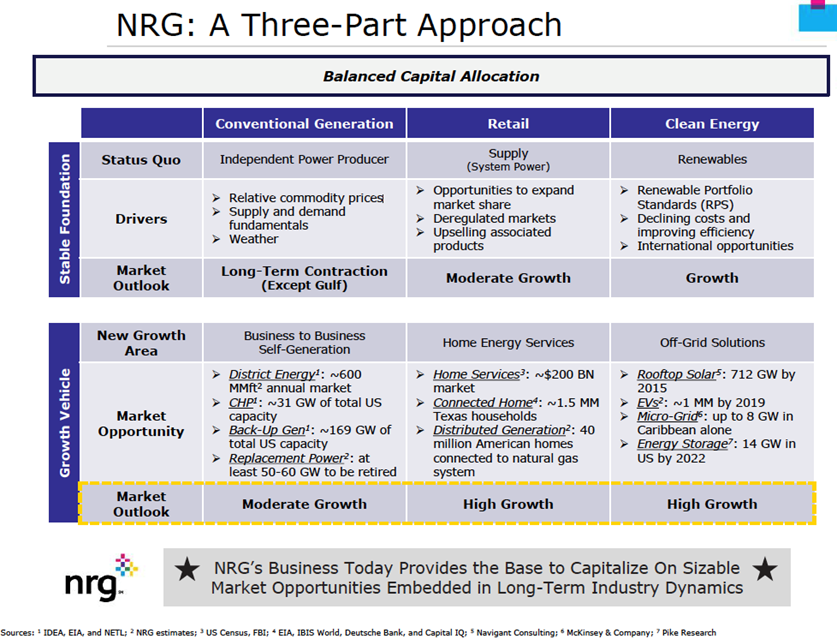
For a glimpse into how the transition to the future may go, we listened in on NRG Energy’s fourth quarter earnings call on Feb. 28, 2014.  NRG Energy, the largest merchant generator in the United States, is paradoxically increasing its fleet of central generation at the same time that CEO David Crane describes an “inexorable trend towards a distributed generation-centric, disaggregated future.”

According to Crane, this future will feature “individual choice and empowerment of the American energy consumer . . . That this future is going to occur is, in my opinion, inevitable. That it is going to occur faster than almost every person thinks it’s going to occur is highly probable.”

In fact, during the call’s question-and-answer period, Crane made the statement that he believes residential solar will become cost competitive in 20-24 states within 12-24 months.  He described a hybrid solar/gas-power Stirling engine technology called the Beacon 10 that he says will create a “non-intermittent” distributed generation (DG) system to combine the best of solar power with the wide availability of the natural gas distribution grid. This differs from many other solutions that depend on large amounts of batteries to firm renewable power.

NRG provided the following chart to address how it plans to bridge the current world with Crane’s vision of the future:

NRG chart

Exciting change for the future? It sure seems so. But as Crane reminded everyone at the close of his remarks, success depends on NRG taking care of day-to-day business. If you can’t survive the next few years, you can’t build the future.  And taking care of business now requires successfully running a central fleet of generation.


Posted in Electricity, Renewables | Tagged , , , , , , | Leave a comment

Electric Industry Overview v3 Features New Look, Updated Content

By John Ferrare, Enerdynamics CEO

At Enerdynamics we recently released an updated version of our popular online online trainingcourse Electric Industry Overview. Here is a brief behind-the-scenes glimpse at our process of ensuring that Enerdynamics’ online courses are timely, accurate, and effective training tools.

Our online courses are updated about every three years. As anyone working in the industry knows, a lot can change in three years! For instance, the previous version of Electric Industry Overview had no mention of the Smart Grid. We also combined our regulation and deregulation modules into a single module called Electric Regulation. Additionally, customer data has been updated, and the course also addresses the increasing use of natural gas and renewables as fuels for electricity.

Above and beyond updating content, a course revision also entails updating the technology used to deliver the course, and, in this case, the actual look of the course. The evolution of our online courses in the last 10 years has been significant. Our original “online” offerings were actually recordings of live courses we offered. We’ve learned a lot about eLearning since then — first and foremost that successful online training is its own medium and thus requires its own approach.

As evidenced by the latest release of Electric Industry Overview, our online courses today offer a user-friendly, interactive experience designed specifically for the online environment. Today, our Electric Industry Overview subscribers enjoy a fluid and easy-to-navigate tour of the electric business including:

  • Electric consumers and their needs
  • The components of the physical system and how it is designed to deliver power to end users
  • How the physical system is operated for maximum efficiency and safety
  • How and why the electric industry is regulated and why it has experienced various degrees of deregulation
  • How markets function and the wholesale and retail services offered in them
  • And, for the first time, an in-depth look into what the future holds for the electric business

We also recently updated the online training “skin,” which is the online player from which a learner navigates the course, advances to other parts of the course, uses the search feature, accesses the glossary/acronyms, and participates in course exercises and quizzes. This update makes Electric Industry Overview more navigable and aesthetically pleasing.

Our other training products are updated with similar goals in mind. Our live instructor-led courses are updated every time they are delivered. And books are revised on a schedule similar to that of our online courses — not an easy task, but we believe that keeping our curriculum current and relevant is crucial to the efficacy of the learning.

Want to test drive the newly released version of Electric Industry Overview? A free online demo is available on our website.

The recently launched version of Electric Industry Overview is available in two versions: the U.S. version and the Canadian version, which expands on the U.S. version to include data on Canada when it differs from what is presented for the U.S. Each version is $295 per subscriber. Companies seeking to purchase bulk subscriptions enjoy discounts when purchasing as few as 10 subscriptions.

For more information on any of our training products, please contact me directly at jferrare@enerdynamics.com or 866-765-5432 ext. 700.

Posted in Electricity, Energy Training | Tagged , , | Leave a comment

EU Asserts Need for Energy Independence after Russia’s Actions in Crimea

by Christina Nagy-McKenna, Enerdynamics Instructor

Last week I wrote about Ukrainian, Russian, and European natural gas markets and the recent developments that may present an opportunity for U.S. gas producers.

Well, it’s been another busy week in the European natural gas market. Gas pipeline projects are already responding to the events in the Ukraine: South Stream is dead. Shah Deniz lives. The EU is strategizing to reduce its energy dependence on Russia while EU x Russiaprotecting all of its members from possible energy blackmail. And Bulgaria wants to be a hub for all new pipelines to Europe.

Perhaps the clearest insight regarding the state of Euro-Russian relations comes from Andrea Merkel, the chancellor of Germany, who said that there is “unbelievable loss of trust in Russia.”

Merkel, the leader of Europe’s strongest economy, is advocating that pipeline flows across Europe be reversed if necessary to protect countries to the East that are almost completely dependent upon Russian natural gas. Given that Germany and Russia are linked by the Nord Stream pipeline, Merkel’s statements seem to indicate that Germany will ship Russian gas eastward to help out its neighbors if necessary.

Gazprom built the Nord Stream pipeline system along the Baltic Sea to Germany, deliberately creating a direct path to the EU, which bypassed Ukraine. The next project, South Stream, is supposed to cross the Black Sea, again bypassing Ukraine. Natural gas companies from Germany, Italy, France, Hungary, Bulgaria, Greece, and Serbia are partners with Gazprom. However, given the events in Crimea, desire to add Russian gas supplies to central and western Europe has dissipated.

Paolo Scaroni, CEO of ENI, an Italian energy company and a partner in South Stream, said last week that the future of the pipeline is “somewhat gloomy.” European Council President Herman Van Rompuy stated that the EU leadership has decided to reduceits their energy dependence “especially with Russia.”

Another natural gas pipeline suitor is on Europe’s doorstep, however. Shah Deniz is a project that will bring Azerbaijani natural gas to Europe. In December 2013 EU leaders and Azerbaijan came to an agreement for the project that will originate in Azerbaijan and travel through Georgia, Turkey, Greece, Italy, Bulgaria, and Albania. The project has several large phases, but in the end, not only will a new non-Russian source of supply be available to the EU, but the southern European gas systems will finally be interconnected.

PipelinesEurope

Standing precariously in the middle of this malaise is Bulgaria as it tries to not offend either Russia or the EU. The former Eastern Bloc country simply wants to be the natural gas hub for all new pipelines, whether they originate in Russia or elsewhere. It’s probably the safest strategy for a country that not so long ago was not free to decide anything on its own.

References:

Bulgaria Braces for Larger Role Amidst Ukraine Crisis, Natural Gas Europe, March 17, 2014.

Gas Politics After Ukraine, Brenda Shaffer, Foreign Affairs, December 17, 2013.

Europe Scrambles to Break Gas Dependence on Russia, Offers Ukraine Military Tie, Ambrose Evans-Pritchard, The Telegraph, March 21, 2014.

Russia’s Invasion of Crimea Has Caused It To Lose the Latest Battle in the Pipeline Wars, Steve LeVine, Quartz qz.com, March 25, 2014.

South Stream Victim of Crimea Annexation, EurActiv.com, March 23, 2014.


Posted in Natural Gas | Tagged , , , , | 1 Comment

Ukraine, Russia, and European Natural Gas: Is This an Opportunity for U.S. Producers?

by Christina Nagy-McKenna, Enerdynamics Instructor

In early March after the Ukraine’s President Viktor Yanukovych fled the country, Gazprom, the state-owned Russian natural gas company, announced it would no longer honor a deal to provide the Ukraine with deeply discounted natural gas. This past week,479135481 Russian forces seized a natural gas terminal in the small Ukrainian town of Strelkovoye, just over the Crimean border. Days later, the citizens of Crimea voted to rejoin Russia.

What impact will these actions have upon the natural gas supply of Eastern and Western Europe?  And what impact, if any, will it have on the United States?

Twice in recent years – in January 2006 and January 2009 – Russia stopped the flow of gas through the Ukraine because of political issues. Over half of Russia’s gas exports flow through the Ukraine. Sixteen percent of the total gas consumed in Europe passed through the Ukraine in one of three major pipelines that carry Russian gas to many E.U. countries as well as non-Balkan E.U. states, Norway, Switzerland, and Turkey according to estimates by the EIA[1]. This gas accounted for 34 percent of European gas demand[2].

If the flow of natural gas to Europe is again curtailed, Europe will be directly affected by lower supplies and presumably higher prices. However, this time such actions may also create an opportunity for the United States to begin selling LNG into the European market.

Congressman Cory Gardner of Colorado is already working to give U.S. gas producers a foot into the European market. Last week he introduced a bill to approve export applications for LNG immediately in order to spur U.S. exports and reduce Europe’s dependence on Russian natural gas.

We will follow up on this discussion and provide updates as events continue to unfold.

Footnotes and references:

[1] “16% of Natural Gas Consumed in Europe Flows through Ukraine,” Today in Energy, U.S. Energy Information Administration, March 14, 2014.

[2] “In Ukraine Crisis, Russia’s Natural Gas Tactics Could Backfire,” Kenneth Rapoza, Investing, March 5, 2014.

“Russia Seizes Gas Plant Near Crimea Border, Ukraine Says,” David M. Herszenhorn, Peter Baker, and Andrew E. Kramer, New York Times, March 15, 2014.

“Can Crimea Survive Without Ukraine’s Power?” David J. Unger, The Christian Science Monitor, March 17, 2014.

“Ukraine Moves to Protect Europe Natural Gas Pipelines Amid Russia Crisis,” Platts, March 17, 2014.

“U.S. Should Support Ukraine with Gas, Lawmaker Says,” UPI Business News, March 18, 2014.

Posted in Natural Gas | Tagged , , , , | 1 Comment

Lucrative Retirement Plan Includes Solar Energy

The following post is courtesy of Clean Energy Collective and provides a unique angle to investing in solar energy.

By Emily Hois, Clean Energy Collective

Today’s life expectancy in America is eight years longer than it was in 1970. That’s eight more years to enjoy retirement; and eight more years of savings to put away. In a road with solar and windchallenging economy, there are various factors that can threaten a comfortable retirement, such as declining property values and interest rates, higher living and health care expenses, and a lower percentage of employer contributions. A well-planned retirement strategy is crucial.

Stuart Ritter, vice president of T. Rowe Price Investment Services, says it can be difficult to stay on budget while trying to make a lump sum last 30 years, especially in the first years of retirement. “That’s why we encourage people to think of it more in terms of income [stream], and not as a balance,” he tells USA Today.

One source that can be used to generate steady revenue—a source we can rely on for millions of years—is sunshine. More people are discovering that by purchasing their own solar panels and harnessing the sun’s energy to produce their own power, it’s possible to collect a paycheck without lifting a finger.

On the Rooftop
Orange County, Calif., residents Wendy Moonier and her husband Fidel Garza were brainstorming how to manage their money for retirement. After the mortgage was paid off, the electricity bill would remain—and increase as the years progressed. With a roof that needed replacing and the attractive California solar rebates, it was the ideal time to go solar.  Moonier and Garza purchased a 30-panel solar photovoltaic (PV) rooftop system from Southern California Edison. They’re saving several thousand dollars each year on electricity and expect their system to pay for itself in 15 years. “It’s the best investment we’ve ever made on our home,” Moonier reveals. “When I saw how well this works, I thought everybody should have this … It’s the only thing we’ve done on our home where we’ve seen an immediate return.”

Newt and Inez Stevens, a couple in their 80s, utilize the sun in multiple capacities. Living in a retirement community in Phoenix, Ariz., the Stevens use solar PV and solar thermal panels to charge their electric vehicle, heat 90 percent of their hot water and power half of their duplex. “For us, solar was a practical solution,” Newt tells The Daily Green. “Our primary motivation was economic … And if we produce more than we use, the power company will pay us the difference. We’re seeing a better return on our investment than anything I can get at the banks or stock market.”

Community-Owned Solar
Installing solar on your home or business may not be practical—or desirable. Community-owned solar allows anyone with a utility bill to own solar panels, offset their electric bill, and collect income for the clean energy they produce. “It seems the cost of electricity has only and is only going up, as well as how much electricity we need,” said Jim McDaniels of Colorado Springs, Colo. “I wanted to reduce my electricity cost and help the environment at the same time. I wanted to plan for my future.”

McDaniels began researching online, reading newspaper articles and posting questions on solar energy forums when he discovered community solar developer Clean Energy Collective. He purchased 25 solar electric panels in the Colorado Springs Community Solar Array with a 10-year loan, offsetting 120 percent of his electricity use (the maximum percentage that Colorado Springs allows). “I decided it was a great deal so I went with the maximum and surplus months,” McDaniels said. After his projected 13-year payback period, he’ll receive free electricity – earning an estimated $160,000. “The savings should give me a better chance at an affordable retirement,” McDaniels said.

Do-It-Yourself
For the hands-on, ambitious type like Rich Herr, a retired electrical engineer, constructing a solar system from scratch was the most appealing option. With the help of his friends, Herr built a 20-panel ground-mounted system in his Valparaiso, Ind,. backyard for around $13,000, reports the Post-Tribune.  “For the money I put in it, the return on [the solar system] is better than the return I get on my 401 (k),” Herr said. “I’m not getting money in my hand, that’s just money I don’t have to pay.”

Posted in Electricity, Renewables | Tagged , , , , , , | Leave a comment