SCOTUS Rules On Demand Response

By Matthew Rose, Enerdynamics Facilitator and Director at EMI Consulting

Background: FERC Order 745, issued in 2012, required RTOs to pay the full locational marginal price (LMP) to economic demand response resources participating in real-time and day-ahead markets as long as the resource was cost effective. A coalition of generators sued FERC making the case that FERC had overstepped its authority by setting rates for demand response. The plaintiffs argued that demand response is a retail, not wholesale, activity and, since FERC only has jurisdiction over wholesale activities, the decision should be vacated. The argument was upheld by the DC Circuit Court in May 2015, resulting in an appeal to the U.S. Supreme Court. For more information on how demand response affects wholesale markets see: http://marketing.enerdynamics.com/Energy-Insider/2012/Q2Electricity.html

After much anticipation and posturing within the demand response (DR) community, thecourthouse and American flag Supreme Court of the United States issued its decision in Federal Energy Regulatory Commission v. Electric Power Supply Association et al (EPSA), restoring FERC Order 745 after the DC Circuit vacated the Order last spring (May 2015).

The Supreme Court’s opinion held that FERC did not overreach its authority. The Court ruled that the FERC Order directly affects wholesale rates and only incidentally affects retail rates. This ruling allows FERC to continue its regulatory oversight over demand response in the wholesale market. There are many interpretations of the ruling, but there is consensus that the ruling highlights how wholesale and retail markets are converging and getting closer together. Wrote Justice Kagan:

“It is a fact of economic life that the wholesale and retail markets in electricity, as in every other known product, are not hermetically sealed from each other.”

Most of the industry believes the immediate impact from the Supreme Court’s decision is certitude. Wholesale market operators and the associated suppliers and aggregators can now move forward without fear that the rulemaking must be changed. PJM issued a statement saying it was pleased with the ruling:

“Certainty and continuity are important in markets. Demand response brings value to competitive wholesale markets and is a vital component of electric system reliability.”

The decision also upheld FERC’s authority to set compensation, which requires grid operators to pay DR providers the relevant locational marginal price (LMP) equal to generation. The Supreme Court noted that in technical areas such as electric rate design, courts provide FERC “great deference” in decision-making.

The court rejected complaints that FERC was overcompensating for the demand response resources by paying the full LMP.  It did not agree with the claim that a DR participant’s avoided retail cost of power should be subtracted from the wholesale compensation. As noted in the ruling, The Court, throughout its opinion, endorsed FERC’s rationale for Order 745’s policy and deferred to its judgment on the technical issue of the level of DR compensation, finding payment of full locational marginal price was not “arbitrary and capricious.” The decision to pay full LMP to demand response providers, despite not facing overhead costs of generators and benefits from not having to pay for their foregone reduction in power, was a controversial issue throughout the various court proceedings.

There is some consensus that the Supreme Court decision ensures the continuation of the status quo, since all the regional transmission organizations (RTOs) under the FERC’s jurisdiction have been operating under the existing rules all along. There were some RTO attempts to advance alternative DR program design plans, but none of the plans were ever adopted or approved. The industry view seemed to follow that there was much more downside risk to the alternative outcome (shifting demand response rulemaking to the states) than upside to the court decision.


References:

Adam Liptak, Supreme Court Upholds Efforts on Managing Electricity Through Pricing, Jan 25, 2016 The New York Times

Rich Heidorn Jr., Supreme Court Upholds FERC Jurisdiction On DR-LMP Pricing Also Upheld, January 25, 2016 RTO Insider

Debra Ann Palmer And Melan Patel, Supreme Court Issues Ruling on FERC Order No. 745, February 3, 2016 Schiff Hardin-Energy and Environmental Law Advisor

Barry Cassell, U.S. Supreme Court Upholds FERC Authority to Set Demand Response Compensation. January 25, 2016 Transmission Hub

The United States Supreme Court, Federal Energy Regulatory Commission v Electric Power Supply Association. Docket No. 14-180, decided January 25, 2016


Posted in Electricity, Energy Training | Tagged , , | Leave a comment

Will This Generation of Utility Employees See the Last Coal Unit Close?

by Bob Shively, Enerdynamics President and Lead Facilitator

The City of Fort Collins Utilities, a municipal utility in northern Colorado, has a conundrum. Through its partial ownership of Platte River Power Authority (PRPA), Fort Collins Utilities gets about 75% of its electricity from coal-fired power. Not too long ago this looked like a winning proposition as PRPA owns Rawhide power plant, one of the most efficient and reliable coal units in the country.

But environmental issues are critical for the voters of Fort Collins. In March 2015, the City of Fort Collins adopted a new Climate Action Plan Framework[1] with targets to:

  • Reduce greenhouse gas (GHG) emissions 80% below 2005 levels by 2030
  • Achieve GHG neutrality by 2050

Given that electricity makes up 52% of the city’s GHG emissions, it is clear that the city cannot achieve its goals without ending PRPA’s existing ownership in part of the Craig power plant and all of Rawhide. According to the city, implementation of the Framework will have dramatic results:

  • The Craig coal units (154 MW) would both retire at the end of 2019 rather than running to the planned retirement date of 2042
  • The Rawhide capacity factor would fall from its current level of 90% to about 60% by 2029
  • Rawhide is “theoretically” retired from the fleet in 2029 rather than running to its planned retirement date of 2046

Is this scenario representative of the future of coal units around North America? With natural gas prices hovering below $2 even in the middle of winter[2], solar and wind costs still dropping, and with developing load flexibility and storage technologies, it certainly makes it a lot easier for even skeptical utility planners and regulators to decide to shut down coal units no matter their efficiency.

Below are a few graphics that illustrate the not-so-promising future of the coal industry as we’ve known it.

Coal generation appears to have fallen below natural gas output permanently starting in mid to late 2015:

U.S. output 2001-2015.jpg


The cost of natural gas generation has fallen to equivalency with coal even with zero cost attributed to carbon output:

cost of generation


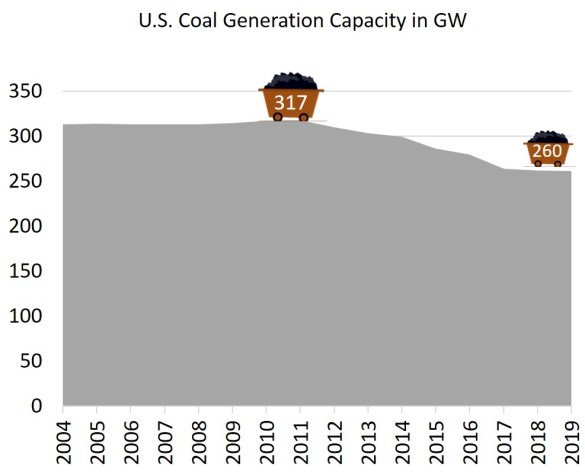
According to Energy Information Administration data, coal generation capacity will fall by 57 GW between 2011 and 2019:

U.S. coal generation capacity


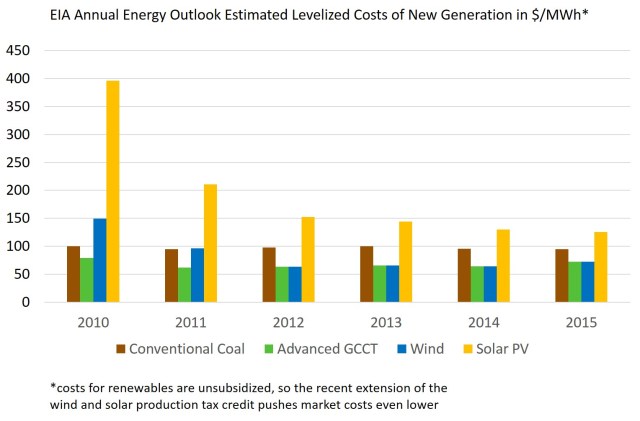
In the last five years, coal as a new generation resource has gone from low cost to high cost relative to renewable technologies:

EIA levelized costs of new generation


The Province of Ontario closed its last coal unit in 2014:

Ontario coal generation

So will these trends continue? It is hard to believe they won’t absent a dramatic reversal. What could drive such a reversal? An environmental disaster so bad that the shale gas industry gets shut down; a dramatic engineering development that makes carbon capture and storage cost effective; or a complete disavowal of public concern about climate effects of greenhouse gases.  That enough of these will occur to save the coal industry appears a long shot. More likely, today’s college graduates joining the utility industry will oversee the closing of the last coal-fired generation units in North America.


Footnotes and references:

[1] http://www.fcgov.com/environmentalservices/pdf/cap-framework-2015.pdf

[2] A recent IHS study Shale Gas Reloaded claims that we have sufficient low-cost natural gas for domestic consumption plus exports for several decades.  See for instance:  http://shale-gas.info/north-americas-unconventional-natgas-volumes-sharply-higher-ihs-says/

Posted in Electricity | Tagged , , , | Leave a comment

Gas Storage Safety:  What is Next After Aliso Canyon?

by Christina Nagy-McKenna, Enerdynamics Instructor

On Oct. 23, 2015, the Aliso Canyon natural gas storage field owned by Southern California Gas Company developed a vast, persistent leak that the utility was unable to contain until Feb. 12, 2016. 

Full repercussions of this leak are still unknown.  Neighbors from the nearby Porter Ranch community complained of dizziness, coughing, eye and throat irritation, vomiting, nose bleeds, and fatigue. The utility relocated residents in approximately 2,200 households to hotels and other residences for the duration of the leak. 

Some residents have already filed lawsuits against the utility, and more are likely to come as the long-term implications of prolonged exposure to methane and gas odorants is unknown and because property values in Porter Ranch will likely decline. Less tangible consequences include the lack of confidence that residents, statewide officials, and lawmakers have in not only the utility but in the California Division of Oil, Gas, and Geothermal Resources.  Many of the affected parties are calling for independent safety testing before the Porter Ranch area is deemed safe for residents to return home.

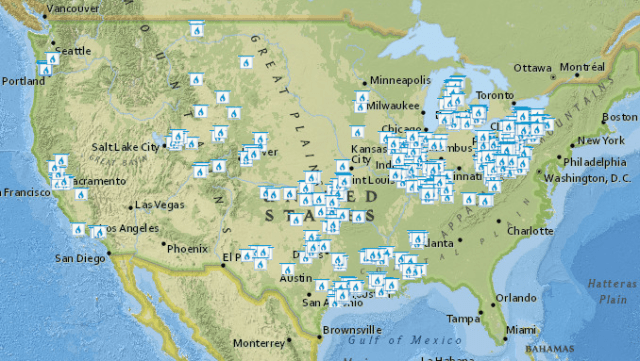
gas storage mapsSource: https://www.eia.gov/state/maps.cfm

The United States is home to more than 400 natural gas storage fields that form a valuable system to help manage the country’s natural gas storage inventory.  Most of the storage fields are depleted oil or gas fields, such as Aliso Canyon.  They are valued because they are often located relatively close to consumers and they are plentiful. Pressurized gas is injected into the fields when natural gas demand is lower, and it is withdrawn when consumer demand is higher. By having a storage facility closer to the end-use-customer, it also serves as insurance against problems on the gas pipeline system that may impede delivery of gas to the utility from suppliers who may be located hundreds of miles away. 

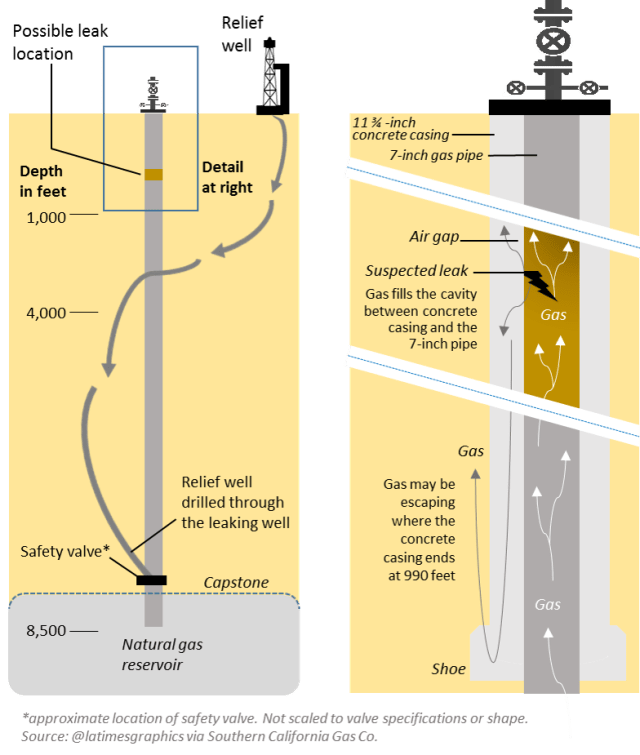
Most customers are unaware that gas storage systems exist until something goes wrong[1].  In the case of Aliso Canyon, one of the approximately 115 wells in the storage field developed an underground leak hundreds of feet below the earth’s surface. It is believed that a crack formed in the pipe and that gas is escaping either at the end of the concrete casing around the pipe or that there is a leak in the casing as well. The natural gas that escaped the well was no longer under pressure and rose through the ground in the most expedient way possible given the geological constraints of the area.

gas leak diagram

Leaks at a storage field can occur at any location where there are connection points between pieces of equipment. Thus, seals, flanges, and fittings are all vulnerable points, just as with any other piece of mechanical equipment. Changes in pressure and temperature can also cause stress to a pipe and its fittings, and repeated stress can cause them to ultimately fail.  Lastly, connections that are even slightly faulty may take time to develop into larger problems, and normal wear and tear of equipment can lead to failure if not maintained correctly. 

So, what can be done to prevent leaks from occurring at the hundreds of gas storage fields around the country? This issue will be widely debated in the coming year just as pipeline safety has been debated since the 2010 San Bruno natural gas explosion. 

At a minimum, routine inspections and maintenance must be completed on a regular basis. However, equipment also needs to be inspected if extraordinary events like extreme weather changes and pressure changes occur. Safety valves, such as one removed at Aliso Canyon in 1979, are not required by law, but that may soon change. The U.S. Pipeline and Hazardous Materials Safety Administration issued an advisory bulletin on Feb. 2, 2016, to all natural gas storage facility operators.  The agency directed operators to try identify where potential leaks may occur due to chemical or mechanical damage, corrosion, or other substantial issues pertaining to storage-related equipment and parts.  The difficulty that storage operators face that pipeline operators do not is that pipes and casings are hundreds of feet below ground and are simply not easy to access. 

Ultimately, the Aliso Canyon leak was capped temporarily by drilling an additional well that intercepted the leaking one and then filling it with cement. The lack of a safety value on the well will be debated as well. The leaky well will be cemented closed, but its legacy is likely to shadow the affected customers, Southern California Gas Company, and the gas storage industry for several years to come.


Footnotes and references:

[1] To see if there is a gas storage field near you, go to https://www.eia.gov/state/maps.cfm, set the map to only show underground gas storage fields, and then zoom in to your community.

Almasy, Steve, “SoCalGas Stops Leaking Natural Gas Well Near Porter Ranch,”CNN, February 12, 2016.

Atler, Charlotte, “The Worst Gas Leak in California’s History Isn’t Close to Being Fixed Yet, Time, December 15, 2015.

Penn, Ivan, “Gas Leak Will Cost SoCal Gas Billions, Experts Say,” L.A. Times, January 9, 2016.

Snow, Nick, “PHMSA Issues Advisory Bulletin on Underground Gas Storage Facilities,” Oil & Gas Journal, February 3, 2016.

Torres, Zahira and Frank Shyong, “Leaking Gas Well in Porter Ranch Area Lacked a Working Safety Valve,” L.A. Times, January 3, 2016.

Vercammen, Paul, “Methane Gas Leak Forces S. California Residents Out of Their Homes,” CNN, December 31, 2015.

Zhang, Sarah, “California has a Huge Gas Leak and Crews Can’t Stop It Yet,” Wired, December 15, 2016.

“Aliso Canyone Updates,” Southern California Gas Co. website, https://www.alisoupdates.com/main

“Aliso Canyon Update,” South Coast Air Quality Management District website, http://www.aqmd.gov/home/regulations/compliance/aliso-canyon-update

“Oil and Natural Gas Sector Leaks, Report for Oil and Natural Gas Sector Leaks Review Panel,” U.S. Environmental Protection Agency Office of Air Quality Planning and Standards, April 2014.

Posted in Natural Gas, Uncategorized | Tagged , , , | 1 Comment

The Four Key Steps to Understanding Utility Rates


by Bob Shively, Enerdynamics President and Lead Instructor

Perhaps the most important factor in the gas and electric utility business is the setting of iStock_000005541542_Medium (1)rates.  This determines what customers pay for their services and establishes the utility’s opportunity to remain financially viable.


Rate setting is accomplished via a proceeding called a rate case. In the case of the Investor Owned Utility (IOU), remaining financially viable means covering costs, being able to attract sufficient debt and equity to maintain reliable service levels, and earning a sufficient profit.  For municipal utilities and co-ops, it means covering costs and being able to attract sufficient debt.  For the purposes of this article, we will discuss the process for IOUs, but the process for the other types of utilities is similar except that there is no component for return on equity.

Utility ratemaking can seem quite esoteric, but understanding ratemaking can be broken down into four key steps:

  1. Determine the authorized rate of return

    The regulator[1] must the set the authorized rate of return on debt and equity. This is covered in our recent blog post What is Reasonable Rate of Return on Utility Infrastructure?

  2. Determine the revenue requirement

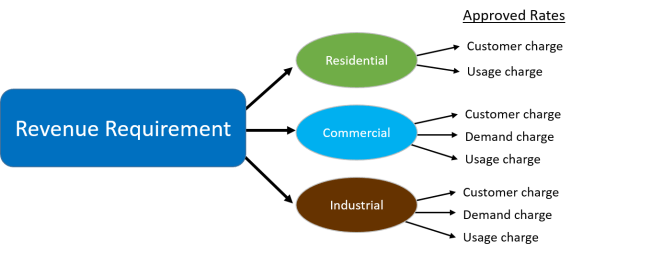
    This is the total amount of money that the utility must bring in over the course of a year to cover costs plus a reasonable profit. Key factors in this step include forecasting the cost to service (called “cost-of-service” or COS) and determining the ratebase, which is the depreciated cost of capital assets plus any working capital[2].

Ratemaking diagram 1

  1. Allocate the revenue requirement

    Next, the total amount of money the utility needs to receive is divided up among each customer type and then within each customer class. The revenue is divided up among charge types such as customer charges, demand charges, and variable usage charges. Then the money associated with each charge is divided by forecasted determinants (number of customers, amount of demand, or amount of usage) to get a rate.

    Ratemaking diagram 2

  2. Adjust rates between rate cases

    Since rate cases are usually held only every few years (or in some cases, only when requested by a utility or the regulator) the regulator must specify how rates can be adjusted between cases as circumstances change. For instance, the commodity cost of gas or electric supply may go up or down, utility operating and maintenance costs may go up, utilities may become more efficient thus reducing operating and maintenance costs, or utilities may need to make significant capital investments.

    Ratemaking diagram 3

So there you have it – now you know how utility rates are set! While each of the steps shown here have sub-steps that can get complex, if you just focus on these four key processes you’ll be well on your way to understanding the origin of the rates your utility charges.


Want to understand more about ratemaking and how your utility makes money? Enerdynamics has both online and classroom seminars that explain this topic is a simple manner.  Enerdynamics’ How Utilities Make Money online class is appropriate for beginner audiences, while Enerdynamics’ classroom seminars on the topic range from beginner versions to executive-level sessions.


Footnotes:

[1] The regulator is the Federal Energy Regulatory Commission (FERC) for federal assets such as interstate pipelines and electric transmission lines and the state regulatory commission for state level assets such as electric and gas distribution utilities.

[2] When capital assets are put into service, their original capital cost is put into ratebase. Over time, this value drops due to depreciation amounts. Working capital is money needed to pay day-to-day expenses to bridge between when expenses are incurred and customer bills are paid.

Posted in Electricity, Energy Training, Natural Gas, Uncategorized | Tagged , | Leave a comment

What Does High Supply, Low Prices Mean for Natural Gas Business in 2016?


by Bob Shively, Enerdynamics President and Lead Instructor

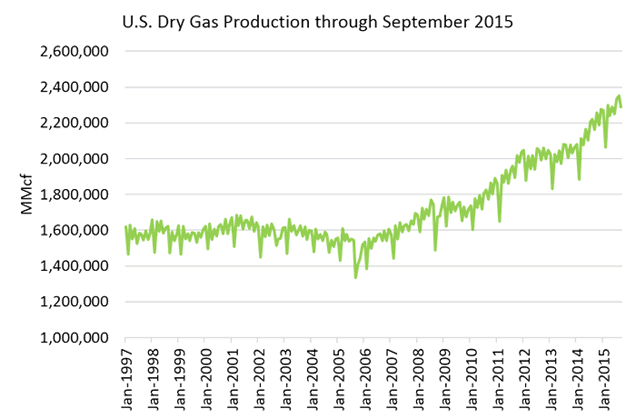
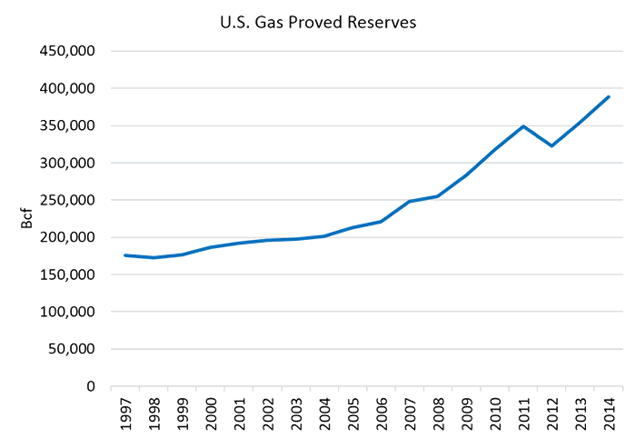
Despite low prices and falling drilling rates, natural gas production is expected to grow more in 2016 due to increased drilling efficiency, price-hedged production, and producers who either physically or financially can’t stop producing quickly.

The Energy Information Administration (EIA) forecasts that annual production in 2016 will increase by almost 2% over 2015 levels, adding additional production of over 500 Bcf. 

u-s-gasproduction

u-s-gasprovedreserves

source: www.eia.gov

Unprecedented supply led to prices in December 2015 that were the lowest seen in any month since 1998. So much for the winter price boost that producers used to count on!

So how will high supply and low prices impact the gas business in 2016? Here are a few of my predictions:

 1. There will be some demand growth but maybe not as much as would be expected given such low prices

Most forecasts for 2016 demand suggest that levels will be similar to 2015 with increases less than one-half a percent. Why is there little demand growth given the falling prices? Most forecasts predict a warm winter in the critical heating markets of the Midwest and Northeast, thus pushing residential and commercial demand levels lower. But we may see an increase in industrial demand given new chemical and fertilizer projects coming online. 

Projections for power consumption are mixed. Natural gas generation output has already passed coal output for the first time in U.S. energy history, and some believe that any price-based fuel switching has already occurred. We believe a bit more price switching will still occur and there will certainly be more coal retirements in 2016 to help gas generation grow. But other factors will hold down the growth rate. Rapidly growing renewable generation tends to displace gas generation, and and the overall growth of electric demand is relatively flat. So while there is a little room for generation demand growth, it appears it will be modest. At most, demand may grow by less than 40% of the expected growth in production.

2. Exports will help some but may not be significant enough to change the supply/demand equation

Exports of natural gas are growing. In 2016 we will see the first major LNG exports from the U.S. with the commissioning of the Cheniere Sabine Pass terminal. Alaska has exported small amounts of LNG for many years. Receiving much less attention is the growth of pipeline exports to Mexico. Despite significant gas reserves in Mexico, a growing gas market cannot wait for industry reform to increase production of these reserves. Instead existing pipelines are carrying gas south from the U.S., and new pipeline projects will provide additional U.S. to Mexico capacity.[1] Unfortunately growing LNG and Mexico exports, like domestic demand, may soak up a portion of the excess supply but will not be sufficient to dramatically change the supply/demand equation.

3. Given supply and demand, low prices are expected to last throughout 2016

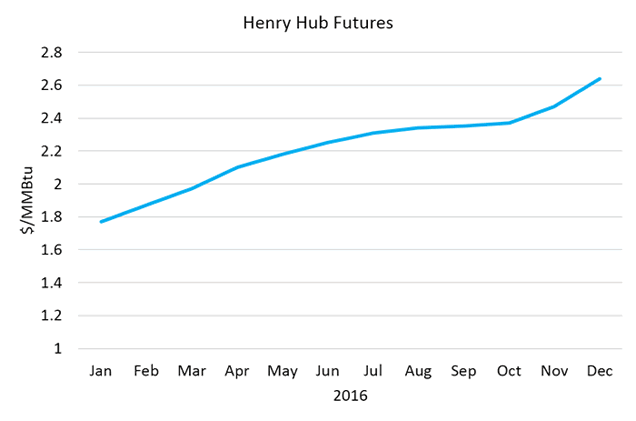
The forward price curve for 2016 does not indicate an increase in prices. In fact, you have to go to January 2018 to find a futures price higher than $3.00/MMBtu and to January 2025 to find one higher than $4.00/MMBtu!

hhfutures                    source: www.cmegroup.com

Certainly drilling will continue its decline. Current rig counts are 25% what they were just four years ago. But producers are somewhat of a victim of their own success as they have increased production per well by such an extent that fewer rigs does not reduce supply as much as one might expect.

So what will 2016 look like?

First, while many seem to focus on doom and gloom for producers, the current situation is a huge boom for many including gas customers and workers in certain industries. Some examples of the upside include:

  • Residents will heat their homes this winter for as little as half what they were paying just a few years ago.
  • Major industrial manufacturers are shifting production back to the U.S. and making long-term investments here based on low gas prices. 
  • In the electric industry, low gas prices have allowed the U.S. to begin cutting greenhouse gas emissions with a low threshold of economic pain. 
  • Supply ready for European export provides geopolitical benefits as our European allies are no longer tied to supply from Russia. 
  • For the producers that survive low prices, a solid long-term market is being locked in now.

I have been in the gas industry long enough to witness three boom-bust cycles. Each time, many preached that we had a “new normal” situation and that the industry should accept that the history of cycles is no longer valid. In each instance when everyone thought we had a new normal, we suddenly didn’t, and a new cycle began. Just remember that at some point, this cycle too shall pass.


Footnotes:

[1] See for instance: http://bv.com/energy-strategies-report/april-2015-issue/fuels-focus-growing-natural-gas-opportunities-in-mexico


Posted in Natural Gas | Tagged , , , | Leave a comment

Key Trends in the Electric Industry in 2016, Part II

by Bob Shively, Enerdynamics President and Lead Instructor

As we settle in to 2016, it seems the months ahead will be pivotal for the electric industry and particularly utilities. Last week we discussed two industry trends that we predict will  gain steam in 2016: 

  • Trend #1: Markets, regulators, and utilities get real about decarbonization of the power sector
  • Trend #2: Utilities can no longer ignore distributed resources

TRENDS 2016, message on business card held by a man

Continuing this discussion, here are two more trends that will help define the electric utility in the year ahead:

Trend #3: Importance of rate cases and resource plans will increase

In many states, rate cases have not been required on regular intervals, and utilities have contently maintained current rate structures and levels. But with ongoing concerns about distributed resources coupled with capital needs for distribution modernization, most utilities will see the need to file rate cases if they haven’t already. 

 Meanwhile, utilities have historically considered only centralized resources in their resource plans and have treated distributed resources (DR) as a reduction in load. With the growth in DR, this likely won’t result in optimal planning outcomes. Given the many issues associated with flat load growth, the need for capital spending, concerns about equity associated with distributed resources, and some regulators beginning to question the current utility business model, outcomes of current rate cases and resource plan filings may determine the future of business for many utilities.  

 Trend #4: Inexorable growth of competitive markets

An important yet little-known fact is that the amount of power bought and sold under competitive markets has continued to grow significantly in recent years. On the wholesale side, organized competitive markets have grown significantly through:

  • MISO’s expansion into Arkansas, Louisiana, Mississippi, and eastern Texas, which brought an additional 50,000 MW of generation into MISO’s markets
  • SPP’s expansion into six upper Midwest states that added 5,000 MW into SPP’s markets
  • the growth of the Energy Imbalance Market in the west, which allows over 26,000 MW across eight states to participate in a real-time market run by the California ISO

Meanwhile usage by end-use customers buying their power directly from marketers has grown from less than 5% to close to 25% of total U.S. usage over the last decade. And in many regions, large customers continue to push for the rights to contract for their own power supply. Many non-traditional companies such as Google, Apple, Comcast, and AT&T are developing customer-focused services that chip away at the concept of utilities as the provider of energy services. Utilities must plan a business future that clearly defines a successful role for utilities in a world of multiple competing service providers. 

 So what does all this mean for the big picture of the industry?

In a recent publication, the Edison Foundation[1] identified three long-term trends that they believe will drive a utility transformation:

  • The transition to a clean energy future
  • A more digital and distributed grid
  • Individualized customer services

We agree, and we believe that the trends we’ve identified for 2016 will make it the year that a complete redefinition of the electric utility and its role begin to take shape. 


Footnotes:

[1] See Key Trends Driving Change in the Electric Power Industry at http://www.edisonfoundation.net/iei/Documents/IEI_KeyTrendsDrivingChange_FINAL.pdf

Posted in Electricity, Energy Training | Tagged , , | Leave a comment

Key Trends in the Electric Industry in 2016, Part I

by Bob Shively, Enerdynamics President and Lead Instructor

In future years, we likely will look back on 2016 as a transformational year in the electric industry. This week and next we will examine key trends that in the coming year may move the industry toward a very different future. 

Trend #1: Markets, regulators, and utilities get real about decarbonization of the power sector

In an unprecedented switch, the last several months of 2015 showed more generation in the U.S. fueled by natural gas than coal.

Coalvgasgeneration2015

            Source: www.eia.gov

With numerous coal retirements and all indicators pointing to a long period of low-priced natural gas supply, it appears this will be a permanent shift. While natural gas is not a no-carbon source of electricity, it does reduce greenhouse gas emissions by at least 50% per MWh compared to coal. Meanwhile, output of non-hydro renewable sources continues to set records in the U.S., and this too will be an ongoing trend.

Nonhydrorenewableoutput

           Source: www.eia.gov

In 2016, we likely will see the first new nuclear reactor go into service in 20 years as TVA’s Watts Bar Unit 2 goes online. Construction will continue on four units (two in Georgia and two in South Carolina) although it will be 2019 before they begin coming online. And despite ongoing political posturing and court filings, most states are already working with utilities and interest groups to prepare initial plans to reduce power plant greenhouse gas emissions under the Clean Power Plan rules issued in 2015 by the Environmental Protection Agency (EPA). 

A likely outcome will be many states creating multi-state carbon cap-and-trade programs like the current Regional Greenhouse Gas Initiative (RGGI) and California/Quebec program. Once there is money to be made in decarbonizing generation, we’re likely to see a new wave of innovation regardless of what happens with the current EPA rules.


Trend #2: Utilities can no longer ignore distributed resources

Distributed energy resources (DER) including distributed generation (DG), demand-side management (DSM), and distributed storage are poised for rapid growth. According to energy collage
EIA data, distributed solar output through September 2015 grew by 29% over output to that point in 2014.

General Electric estimated that in 2012 39% of new capacity additions worldwide were distributed generation (DG)[1]. Meanwhile controllable loads have become an important resource and, according to the North American Electric Reliability Corporation (NERC), make up 5% of reliability capacity in the U.S.[2] Distributed storage is also hitting the mainstream, most notably through a highly publicized announcement by Tesla but also with quieter roll-outs from other companies.

These resources will only grow as technologies become more advanced. In 2016 the cloud-connected smart home will see advances with new products rolled out by companies like Google and Apple, and others such as Microsoft and Amazon are not far behind.

While electric vehicles might be considered new demand, we include them as a resource because their ability to charge when power is most available makes them a new controllable load. In 2016, Chevy will introduce the Bolt with a 200-mile range and a $30,000 price point. Nissan will offer a new Leaf, and Tesla and other European manufacturers are expected to make additional announcements about lower-cost and longer-range vehicles. Even with low gasoline prices, government support in locations like car-heavy California will likely continue to boost EV growth. 

Given these advancements in various technologies, all utilities will need to restructure their distribution planning to assume very different usage/production patterns by customers and rates will likely need to be redesigned to give the right signals to consumers.

Next week we’ll look at two more key electricity trends to watch for in 2016, and in the weeks after we will explore trends that are driving the natural gas industry in the year ahead.


Footnotes:

[1]  Brandon Owens, The Rise of Distributed Power, available at: https://www.ge.com/sites/default/files/2014%2002%20Rise%20of%20Distributed%20Power.pdf

[2] http://www.nerc.com/pa/RAPA/ra/Reliability%20Assessments%20DL/2014LTRA_ERATTA.pdf calculated by going through each reliability council and totaling peak demand and demand response values


Posted in Electricity, Energy Training | Tagged , , , , , | 1 Comment

New Utility Business Models Must Address Solar Integration

by Bob Shively, Enerdynamics President and Lead Instructor

How utilities should compensate customers for solar power put onto the grid and whether they should charge customers for costs of grid connection are key issues that utilities face in 2016 and beyond.

Over 44 states have mandatory net metering rules. These rules require the utility to compensate solar customers by paying the retail rate and allowing the customers to “bank” power generated when the sun is shining and use it to offset power needs at night or on cloudy days.

Unfortunately, there are real issues associated with net metering, and it is hard to gain agreement that the retail rate is truly the right number to pay. Issues include:

  • whether time-sensitive power supply costs and fixed costs to maintain transmission and distribution infrastructure are being shifted from solar to non-solar customers
  • whether the costs of required distribution upgrades are allocated fairly
  • whether solar customers are being compensated for additional values they provide to the system.

Such issues have sparked discussions in more than a dozen states at either the legislative or state commission level about whether something other than net metering is more appropriate.

In most communities public sentiment strongly supports solar energy. Utilities’ requests to move away from net metering ignites accusations that utilities are anti-solar. Some utilities and commissions are seeking a middle ground that keeps net metering but:

  • adds minimum variable or fixed fees
  • moves net metering to time-of-use rates so that bill netting reflects the time value of power provided and/or used[1]
  • creates value-of-solar tariffs that pay a unique price based on calculated value to the grid

We are sure to see many debates, proceedings, and possibly some regulatory decisions on this issue during 2016.  

Meanwhile, utilities and their regulators must be making longer-term decisions on how to react to growing distributed resources (DR) including rooftop solar but also other forms of customer-owned generation, storage, and price-responsive load.

While tweaking the status quo may push the issue off a few years, it is unlikely to create a long-term sustainable business model for utilities unless the growth of DR proves to be an unfulfilled expectation. Utilities instead must plan now for a different future and include DR in their resource planning processes. And utilities and regulators must figure out how to pay for DR in a manner that creates economic benefits for all and creates mechanisms to encourage the proper investment for the right resources.  

Such change will neither be easy nor quick. Transformations always create winners and losers, and in a regulatory environment potential losers fight long and hard to avoid these outcomes. Since most of the pertinent regulation will happen at the state level, the possibility of 50 different solutions exists. It will be interesting to watch in 2016 how the leading states address these issues and how the regulators and utilities in the remaining states respond.


Footnotes:

[1] See for instance the California Public Utilities Commission proposed decision dated December 15, 2015 summarized here: http://www.utilitydive.com/news/california-regulators-propose-to-keep-retail-rate-net-metering-for-solarwi/410873/


Posted in Uncategorized | Leave a comment

New Edition of ‘Understanding Today’s Natural Gas Business’ Now Available

Looking to brush up on natural gas trends in 2016
or just starting in the Enerdynamics_Gas_Cover_NoCrops_Print_reduced size
energy industry and need a solid overview of how the natural gas business operates? 

Enerdynamics recently released its 2015 edition of Understanding Today’s Natural Gas Business, a 150-page detailed overview of the North American gas industry. This book, one of three industry primers offered by Enerdynamics, presents an insider’s perspective on the fast-paced and unpredictable business of natural gas. Topics covered include:

  • natural gas origins
  • the physical system and how it’s operated
  • market dynamics and players
  • risk management techniques
  • an up-to-date look at today’s regulatory environment

Understanding Today’s Natural Gas Business is ideal for those new to the industry as well as veterans seeking a “big picture” look at the natural gas business. The book is easy-to-read, contains a number of charts and diagrams to help simplify complex industry concepts, and includes a glossary and list of acronyms. Many utilities find that providing a copy of this primer to new employees on their first day strongly increases their uptake of the unique business aspects of the industry.

Click here to download a free chapter of Understanding Today’s Natural Gas Business. Buy the paperback edition before Jan. 31, 2016, and save an additional $10 on the discounted cover price. Just use code EISAVE10 at checkout. Click here for details or to purchase this book.

We also offer quantity discounts and free shipping to companies and bookstores that buy 25 copies or more. Contact us at 866-765-5432 or info@enerdynamics.com for details.


Posted in Energy Training, Natural Gas, Uncategorized | Tagged , , , | Leave a comment

Southstream Pipeline: Will Economics Triumph over Politics?

by Christina Nagy-McKenna, Enerdynamics Instructor

Late last month Turkey shot down a Russian fighter jet after it allegedly flew into Turkish airspace. As the world waited for the Russian 145122298 (2)Federation’s response to what its President Vladimir Putin called “a stab in the back,” few expected that a major natural gas project would be sidelined and thus deal a blow to both countries. And yet, the Federation suspended this Gazprom-sponsored project, as well as all other trade with Turkey, as part of economic sanctions meant to penalize the country financially.

This action by Gazprom and the Russian government does not just harm Turkey. Cancelling the Turkish Stream pipeline project will have longer-term negative implications for both countries as well as prospective pipeline customers. After all, what exactly does a region do with miles of pipe that is custom made for a project that was just suspended?  And what do customers like the Italian energy company Eni do when the pipeline they were counting on to be finished in 2018 is now in limbo? Are these issues enough to bring all parties back to the table to negotiate? As of this morning, the answer seems to be yes.

Turkish Stream is the second Russian pipeline project to be scrapped since the winter of 2014 when tensions escalated with Ukraine and Crimea voted to be annexed to the Russian Federation. The $12-14 billion project was to transport Russian gas across the Black Sea to Turkey and then into Southeastern Europe instead of through the Ukraine as originally planned in the Southstream Project.

Now that Russia has suspended Turkish Stream, it will need to store miles of pipe, estimated to be worth $1.95 billion, that is bespoke to the Black Sea. Perhaps the Federation has only hit the pause button on the project. Perhaps after a period of time when tensions have eased, the Gazprom will be allowed to resume construction of the pipeline and its business with Turkey. This certainly seems possible, especially after this morning’s news: President Putin said the project can continue if the European Community (EC) gives certain written guarantees to Turkey. Details about what exactly the Russian Federation expects from the EC will be forthcoming.

Gazprom mapTurkish Stream Pipeline System Map, Gazprom Website, December 2015


References

Burminstrova, Svetlana and Stubbs, Jack, “Turkey Row Leaves Russia Stuck with Abandoned Gas Pipes Worth Billions,” Reuters, December 3, 2015.

Kottasov, Ivana, “Russia Suspends Turkish Gas Pipeline Project Over Downed Warplane,” CNN Money, December 3, 2015.

Nissenbaum, Dion and Peker, Emre, and Marson, James, “Turkey Shoots Down Russian Military Jet,” Wall Street Journal, November 24, 2015.

“Turkish Stream Pipeline Project a Go if Turkey Gets Guarantees from Brussels: Putin,” Daily News, December 17, 2015.


Posted in Natural Gas, Uncategorized | Tagged , , | Leave a comment