Gas and Electric Industries Seek a Happy Codependence, Part I

by Bill Malcolm, guest author

“Gas is from Venus, electricity is from Mars,” quipped Sue Kelly of the American Public Power Association to me in July at the NARUC Conference in Denver. In a nutshell, this summarizes the complex challenge of helping to better coordinate these two industries.

With the increased use of natural gas for electric generation, efforts are underway to better coordinate the way the two industries operate.  A quick overview of the two industries shows the issue is as complicated as the two divergent industries:

electric and gas chart

Resulting concerns include:  

  • Operators of gas and electric systems don’t know what the other is planning to do on any given day. Better communication (and consistent nomination deadlines) between electric system operators including RTOs and interstate natural gas pipelines may be needed.
  • Gas-fired generators that are providing firm capacity and are being counted on by electric system operators may not be able to obtain gas supply when they are dispatched. Requiring gas-fired generators to show they have firm fuel deliverability capability may be something to study.
  • On a cold winter day, gas-fired power plants may get curtailed, resulting in electricity outages.
  • Planned expansion of gas-fired generation may not result in needed expansion of gas infrastructure.

Next week in Part II of this post we’ll look at what has been done to address these issues and the official stance from each party involved.

About the Author
Bill Malcolm is a 37-year energy industry veteran who has worked for Seattle City Light, Pacific Power, PG&E, ANR Pipeline (now owned by TransCanada), and MISO. He currently is a freelance energy reporter and has a column in The Cruthirds Report (a Houston energy newsletter) on RTO and PSC matters. He holds a M.A. in economics from the University of Washington and a B.A. in economics from UC Santa Cruz. He also is a columnist in the Broad Ripple Gazette and has organized a new group, Hoosiers for Passenger Rail, in an attempt to save the daily Amtrak service from Indianapolis to Chicago.
Posted in Electricity, Natural Gas | Tagged , , , , , , , , , , | Leave a comment

Mexico: Long-term Gas Producer but Short-term Gas Importer

by Bob Shively, Enerdynamics President and Lead Instructor

In the energy industry, it is important to distinguish between short-term trends and long-term trends. Just seeing the short-term can result in missing a contrary long-term trend.

For instance, in 2008 natural gas prices rose to all time highs. Yet the shale gas boom and economic downturn was just waiting to change the paradigm. This year, coal generation in the U.S. is expected to rise from 37% in 2012 to 40% while gas generation falls from 30% to 27%.

Without more information, you might think that the two sources of generation are reverting to their historic means, and that no big transformation is going on.  But deeper study suggests that numerous coal units will be retired over the next few years and that coal will be a declining generation source in the future[1].

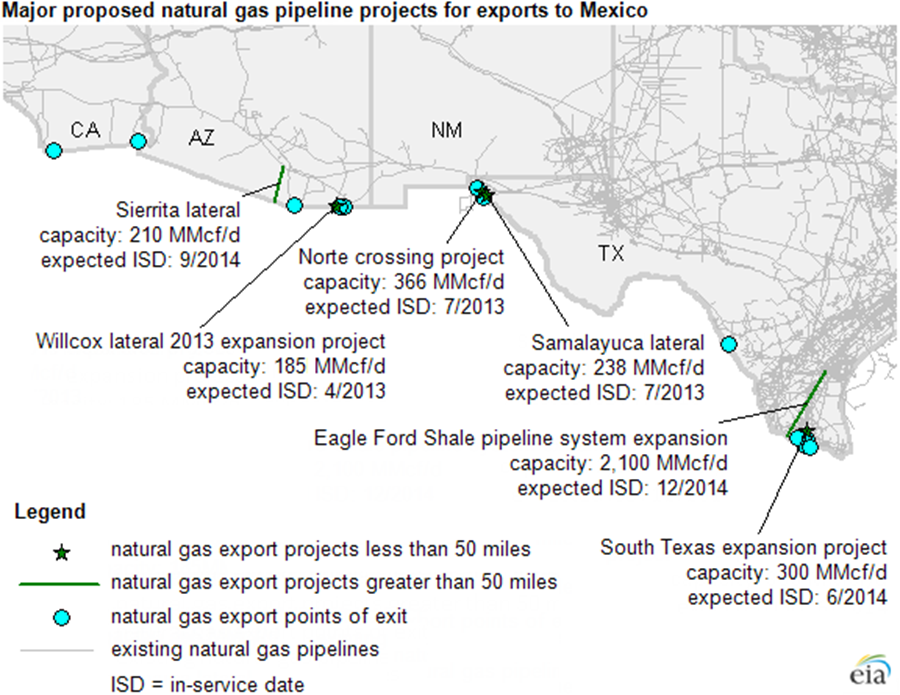
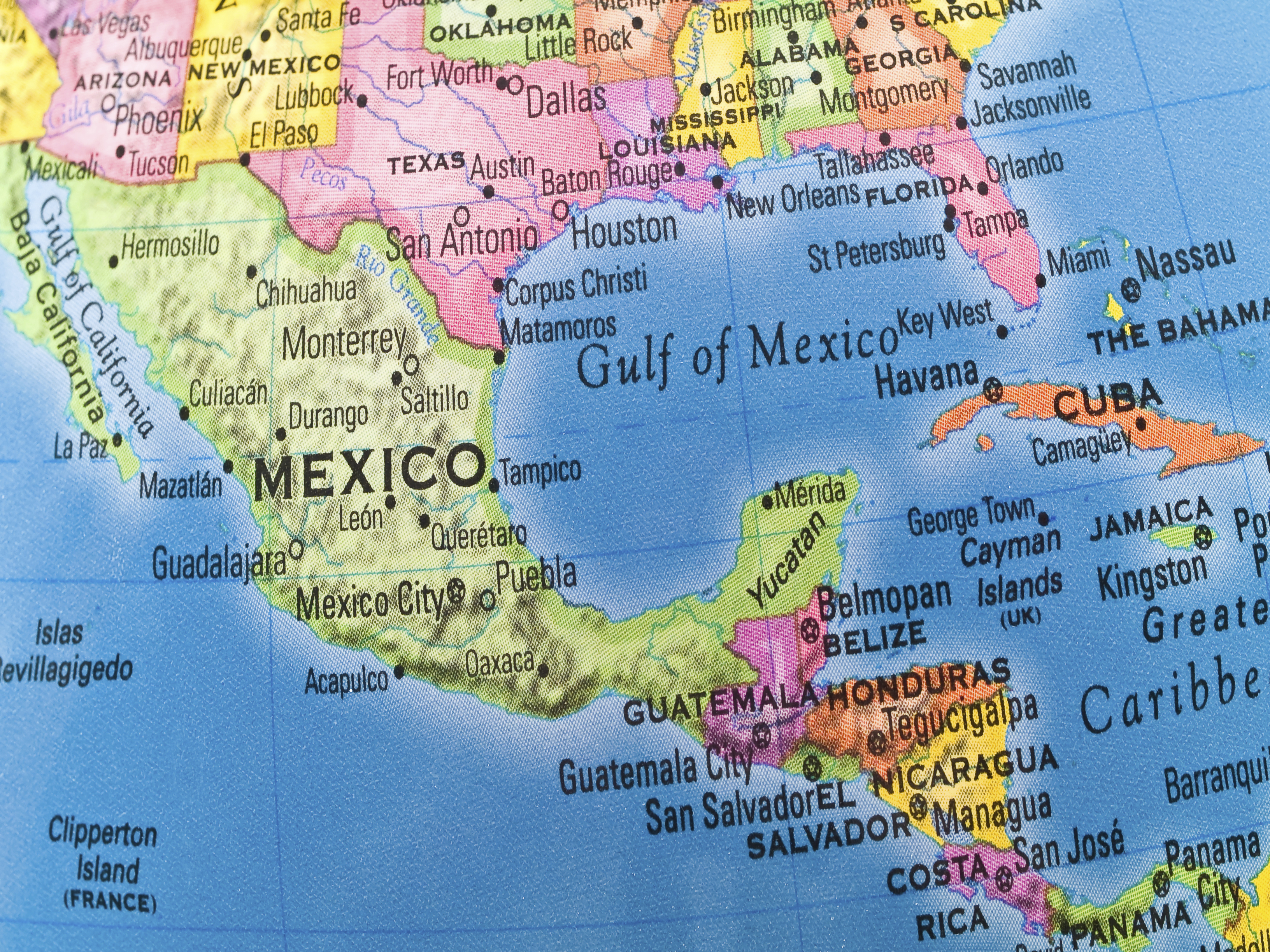
The same is true relative to our recent writing about the potential for Mexico to become a significant natural gas producer[2]. In the near-term, Mexico will become just the opposite – a robust export market for U.S. gas producers.

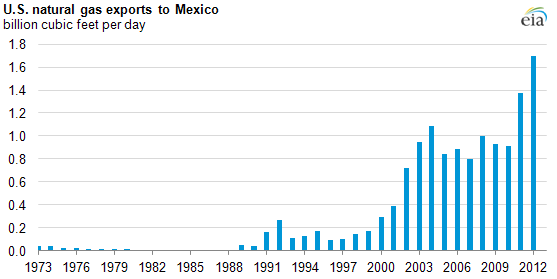
As we noted in our earlier pieces, exports to Mexico have risen significantly in recent years:

blog graph 10.11.13

proposed pipelines to Mexico chart

Source of above graphs:  U.S. Energy Information Administration March 13, 2013, Today in Energy

And exports this year may approach 2 Bcf/day.  Numerous new pipelines are under construction to move gas south.  This will increase export capacity to over 9 Bcf/day by 2015 according to recent presentation by Platts/Bentek[3]. Indeed, Bentek expects U.S. gas demand plus exports to increase from today’s 66 Bdf/day to over 80 Bcf/day by 2018.  Contributing to this growth is domestic industrial and power plant demand, LNG exports, and exports to Mexico.  We thought it is important to point this out since too much talk about long-term Mexican potential might cloud an understanding of gas markets over the next few years.

Posted in Natural Gas | Tagged , , , , , , | 1 Comment

130 Years after Edison’s First Power Plant, Is Energy Storage Finally a Reality?

Thomas Edison built the world's first large-sc...

Thomas Edison built the world’s first large-scale electrical supply network. (Photo credit: Wikipedia)

by Dan Bihn, Enerdynamics Instructor

In 1882, the Edison Illumination Company opened two electric power plants – the famous coal-fired Pearl Street Station in downtown Manhattan and the river-powered Vulcan Street Station near Green Bay, Wis.

Thomas Edison faced two of the biggest problems utilities still face 130 years later: how to maximize utilization of expensive capital assets and – for his hydropower plant — how to maximize the use of the free fuel from the river.

His primary end product was lighting, and you can’t store light. When you need it, you need it — not much flexibility on when. On top of that, his service territory had the geographic diversity of a single neighborhood, so the sun set on all of his customers at the same time.

So, as you might expect, the daily usage profile — the load curve — was anything but flat. Virtually nobody was turning on expensive, short-lived light bulbs in the middle of the day or after they went to bed — in fact many early power stations chose to only operate in the evening.

That was a huge financial problem. Investors were paying for expensive generators and underground wiring, but only selling their product for a couple of hours a day. In 1891, the industry came up with a new term for asset utilization: “load factor.” And it was low — less than 20%.

At Pearl Street when they weren’t making electricity, at least they weren’t burning coal. At the Vulcan Street Station, however, the paddle wheel in the river idled more than 80% of the time. Unable to store that energy until it was needed, the free fuel just flowed unused down the river.

The ongoing quest for storage
Energy storage has been the Holy Grail of both asset utilization and renewable energy ever since the Edison era that began in 1882.

Fast forward to the early 1900s: The economics for generating electricity were getting better. New markets had been developed, often deliberately to improve the load factor. These included electric streetcars for the morning and evening commute, factory equipment during the day, and pumps for the waterworks in the middle of the night.

By 1910, executives were boasting of load factors greater than 40%. The load curve was starting to flatten out.

Today, the load curve is flatter — load factors are closer to 55%. But 55% still means poor asset utilization, and that means opportunity.

A couple of important things have changed since Edison energized his power plants. Today, less than 13% of the electricity used in U.S. homes goes to lighting — 45% now goes to “thermal loads” — heating, cooling, refrigeration, and electric hot water heaters. Thermal loads are different.

Unlike lighting, where even a one-second interruption is both obvious and annoying, thermal loads have time flexibility. Air-conditioner compressors can be interrupted for tens of minutes without anyone noticing. A closed refrigerator can maintain food temperature for four hours without electricity. And electric hot water heaters can be interrupted for hours. You can store heat (and cold)!

The other significant change is electricity metering technology. By the end of 2014, about half of all U.S. households will have smart meters.

With the increased time-flexibility in our loads and this new ability to measure when electricity is consumed, incentives can be adjusted to coax the load to more closely match availability of supply. We now have the technology to put the energy storage in our homes and appliances to good use.

Too much wind power in the middle of the night? Have your refrigerator make more ice. Not enough power on a hot summer afternoon? Use that extra ice to cool your milk and vegetables. The same can be true for all of your thermal loads.

The Energy Storage Holy Grail has been found. It’s locked inside your refrigerator just waiting for your utility or retail electric provider to give you a pricing structure to make it worth your while to open it.

Posted in Electricity, Renewables | Tagged , , , , , | Leave a comment

Infographic Helps Demonstrate U.S. Electricity Flow from Source to Use

By John Ferrare, Enerdynamics CEO

Let’s face it: sifting through data doesn’t typically excite the senses. But for those in the rapidly changing electricity business, understanding the meaning behind industry data is often essential to confused businessmanour jobs. Here at Enerdynamics we make it our mission to help interpret energy industry data for those who really just need the “big picture” of what it means and why it matters.

For example, in many of our instructor-led courses we use a chart from the Energy Information Administration (EIA) that shows how electricity flows from fuel input to consumption by various customer classes and categories. I’ve always found this chart fascinating yet extremely difficult to understand without translation.

So with the help our graphics team, we decided to translate this chart into something understandable, useful, and graphically appealing. The before and after are included below (and we are including a link where you can download the infographic for your own use). This is just one example of how Enerdynamics is able to take what appears to be complicated data and graphically show it in a way that any of us can understand.

This is our goal with all Enerdynamics training products. The energy industry can be a complex and confusing world, even for those who’ve spent decades in it. Our job is to make understanding this world a little bit easier for all. Hope you enjoy the graphic!

Original chart available from EIA (click on image to enlarge):

Electricity Flow

New infographic by Enerdynamics (click here to download):

 For more information on any of our training products, please contact me directly at jferrare@enerdynamics.com or 866-765-5432 ext. 700.

Posted in Electricity, Energy Training | Tagged , , , , , | Leave a comment

Update on Mexico – The Next Paradigm Buster

by Bob Shively, Enerdynamics President and Lead Instructor

“Regarding petroleum and solid, liquid or gaseous hydrocarbons … neither concessions nor contracts will be granted, nor will any that have been granted persist and the Nation will carry out the exploitation of these products in the terms indicated by the respective regulatory statute,”[1]

From Article 27 of the Mexican Constitution

In our May 2013 blog titled Mexican Gas-The Next Paradigm Buster? we discussed that Mexico has long been known to have significant natural gas supplies and that Mexico OLYMPUS DIGITAL CAMERAappears to have significant shale gas supplies, yet in recent years Mexico has become an increasing importer (not exporter!) of natural gas supply. One key reason for this has been provisions in the Mexican constitution that prevented private companies from participating in development of natural gas resources.  We speculated that recently elected President Enrique Peña Nieto might build a political coalition that would change this reality.

The likelihood of such a wide-sweeping change has increased with recent developments.  On Monday, Aug. 12, 2013, the Mexican government revealed a bill that would change the constitution to allow the government gas and oil company PEMEX to partner with private companies to develop new gas and oil supplies.  While private companies would still not own a share of production, they would be entitled to the cash equivalent of the oil they find and produce. 

This is similar to how things work in other countries such as Ecuador, Iran, Iraq, and Malaysia.  The bill would also change the law to allow private electric generators to sell power directly to consumers, potentially increasing demand for natural gas for power generation.

To change the constitution requires a two-thirds majority in Congress and the approval of more than half of Mexico’s 32 state legislatures.  Such a major change is not yet a done deal. On the A3 blog, Sean Dunigan writes: “The ultimate test for Nieto will be the political fallout with the Mexican people. The nationalization of Mexico’s oil is commemorated as a civic holiday. It was the culmination of countless labor protests and legal battles, and held dear to many Mexicans. The ability of President Nieto to sell this idea – and to repeal a nation-defining act – to his own people may prove to the toughest in his presidential career.”[2]

The opposition, led by former Presidential candidate Andrés Manuel López Obrador is attempting to build popular opposition to the proposed bill[3]. But according to the Wall Street Journal, a protest on September 8 had a lower than expected turnout and had to move its planned route because teachers protesting other reforms refused to move to allow the energy protestors to pass[4].

Meanwhile, PEMEX has announced that it will form an entity to drill for shale gas in the U.S. to gain knowledge[5], and in May began production from its first shale gas well in the Mexican state of Coahuila[6].  We all know that in politics nothing is done until it’s done (and in some cases, it still isn’t done even when it seems to be done).  But it is looking more likely that we may see Mexico join the ranks of growing gas producers in coming years.

References:


[1] Quoted from “Analysis: Mexico to rewrite ‘sacred text’ in long-awaited energy reform” at http://www.reuters.com/article/2013/07/25/us-mexico-oil-analysis-idUSBRE96O03I20130725

[4] See “Opposition to Mexico Leader’s Plan Falters” at  http://online.wsj.com/article/SB10001424127887323864604579063482160015354.html

Posted in Natural Gas | 1 Comment

Is Net Metering a Net Benefit or a Net Cost?

by Bob Shively, Enerdynamics President and Lead Instructor

The historical utility business model is for utilities to build large power plants at remote tile roofed home with solar panelslocations, build transmission lines to transport it to load centers, and build distribution lines to distribute the power to end-use customers. Under this model, utilities create profits by earning a “fair” rate of return on capital investments and often can boost their earnings a bit by selling more power than forecast between rate cases.

This model worked pretty well for most of the 20th century and didn’t get much attention until the rate increases associated with expensive new power plants and fuel cost increases in the 1970s. At that point, interest in exploring alternatives lead Congress in 1978 to pass the Public Utilities Regulatory Policy Act (most commonly called PURPA).

PURPA required utilities to buy power from certain non-utility generators at the utility’s avoided cost of power. Over time the law led to the emergence of customer-owned renewables, cogeneration, and independent power producers.  Now the rapidly dropping cost of customer-installed photovoltaic solar (PV) systems is raising the possibility that some utilities may see their traditional business model fall apart as they grapple with issues such as net metering.

PURPA and Net Metering
While PURPA was a federal law, it left implementation up to the state legislatures and regulatory commissions. So each state defined avoided costs and other details differently.  One key issue is how to pay customers who install their own generation such as photovoltaic solar (PV) and then wish to sell excess power (meaning power not consumed internally in the facility) back to the utility.

For small renewable installations, many states implemented net metering.  Net metering is an electric billing methodology that allows eligible customers with distributed generation to sell power back to the grid when generation exceeds internal usage. These customers receive credit for that power to offset purchases of utility power used during times when the customer’s generation is insufficient to cover all loads in the facility. In essence, customers are paid the retail rate to sell power to the grid.

net metering chart 1

Is Net Metering Fair?
In essence, net metering sets the buyback rate at the customer’s retail rate.  In the early years of solar PV, state regulators often justified this by saying that solar was new and needed help getting started, that there were benefits to solar but it was too soon to be able to quantify them, and that the amount of solar is so small it doesn’t matter much.  But now that solar PV is growing and has the potential to grow significantly more, utilities and regulators are struggling to determine what is or is not a fair way to handle net metering.

net metering chart 2

Source: EIA Today in Energy May 15, 2012

Advocates for solar power argue that changing the rules will deter further growth and accuse utilities of wanting to discourage solar power to protect utility profits. Utilities and some customer and traditional generation groups counter that net metering customers are using the grid without paying their fair cost. It will be up to the regulatory commissions around the country to quantify benefits and costs of customers with PV systems connecting to the grid and, based on this, determine what is fair.

Benefits to the grid may include:

  • avoided costs of generation that would be needed in the absence of solar power
  • avoided costs for generation capacity (to the extent that solar power offsets system peak demand)
  • reduced costs for ancillary services
  • lower line losses on the transmission and distribution (T&D) system
  • reduced investments in T&D facilities (to the extent that solar power reduces the need to invest in facilities)

Costs to the grid may include:

  • integration costs to provide reserves power when it is cloudy
  • equipment upgrades on the distribution system
  • higher costs of purchased power when the utility pays the retail rate for net meter power instead of the wholesale rate it could have paid to purchase power instead

The Rocky Mountain Institute reviewed 15 studies of the benefits and costs of distributed PV and found widely varying results[1]. A key issue was distributed PV can offset transmission and distribution system investments.

Debates over attempts to quantify benefits and costs are currently ongoing in numerous states including Arizona, California, Colorado, and Ohio[2] while regulatory commissions in Idaho[3] and Louisiana[4] have recently ruled against utilities in attempts to change net metering. It will be worth watching how remaining proceedings around the country play out as it will directly affect the business future of both utilities and PV solar companies as well as future opportunities for consumers to economically generate their own power.

References:

Posted in Electricity | Tagged , , , , , , | Leave a comment

Update on Natural Gas Fracking

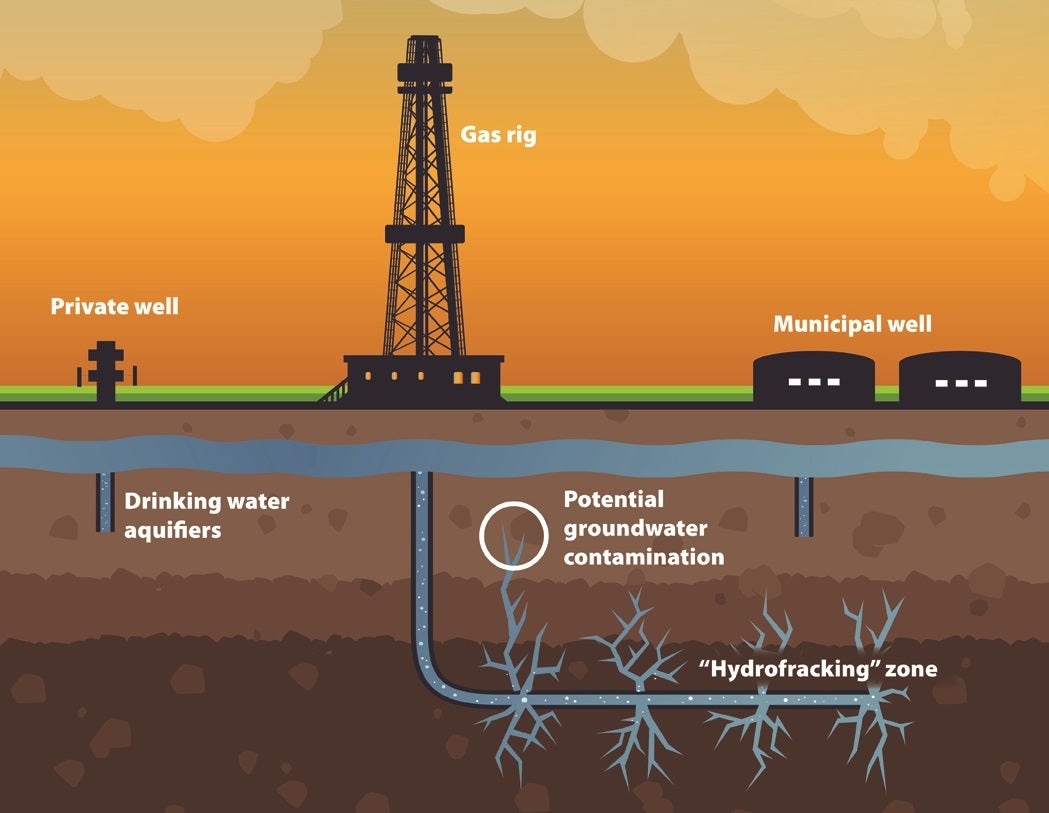
In August 2011, Enerdynamics wrote an Energy Insider article on the issue of natural gas fracking[1].  There we described what fracking is, what it had done for gas reserves as of 2011, and some of the concerns relative to fracking.

Tower for drilling horizontally into the Marce...

Tower for drilling horizontally into the Marcellus Shale Formation for natural gas, from Pennsylvania Route 118 in eastern Moreland Township, Lycoming County, Pennsylvania, USA (Photo credit: Wikipedia)

Since then, the rhetoric over fracking has only gotten stronger.  The famous Gasland movie is becoming a franchise with Gasland 2 now available[2]. According to some observers, fracking is unsafe and cannot be made safe.  And any information to the contrary is a conspiracy lead by the big oil companies.  Many citizens in our communities hear this and believe it.

Meanwhile, supporters of the oil and gas industry argue that fracking is safe when done properly and has been going on for decades. While a detailed analysis of the data concerning fracking is too lengthy for a blog post, following are highlights of the issues surrounding fracking and some links where readers can get more information.

What is new since we wrote our last Insider article?

  • U.S. gas supply projections continue to grow. Based on production increases from shale gas and other unconventional sources, much of which will be produced through use of fracking, U.S. gas supply is projected by the U.S. Energy Information Administration (EIA) to increase by 44% from 2011 to 2040.

fracking blog 8.30Source: EIA Annual Energy Outlook 2013

  • The U.S. is projected to shift from being a net importer of natural gas to a net exporter. For many decades the U.S. has been a net importer of natural gas. The EIA now projects that by 2020 the U.S. will become a net exporter. This represents a fundamental shift in U.S. gas supply and will have significant benefits from an economic and environmental standpoint.

fracking blog 2 8.30

  • Air quality around drilling and gas processing needs to be studied (but issues may or may not be related to fracking). Localized air quality issues associated with drilling activity have become apparent and need to be addressed. Studies have begun finding chemicals in air, some used for fracking some not[3].
  • Earthquakes should be added to the list of potential issues (but again, this may be related to gas production but not to fracking). A soon to be released study suggests earthquakes in South Texas are due to removal of fossil fuels and water from underground, not due to fracking[4].   Others have contended earthquakes are due to disposal of fracking fluids underground near faults[5].
  • Drilling (whether fracking is used or not) is a significant land-use issue. Here in my home state of Colorado, more and more drilling rigs are moving into suburban neighborhoods that didn’t exist 40 years ago during the last boom.  Residents in these neighborhoods are understandably concerned about rigs showing up within 500 feet of their homes, (which is the current allowed setback under Colorado regulations).
  • Fracking’s impact on water supplies remains under dispute. In some limited cases, data may suggest that fracking harmed water supplies.  But it is hard to know since data doesn’t exist on the quality of the water prior to fracking[6].  If you read the fine print on these studies, most suggest the water contamination occurred due to faulty drilling practices or spills. Other studies appear not to show any contamination[7].
  • Regulation continues to evolve. Rules at the local, state and federal level continue to be discussed and, in some cases, implemented.  Many states are looking at regulations developed by Colorado as a starting point[8].  But even so, fracking is very contentious here.

So what can we conclude?  Only that there are varying viewpoints. Some will read this blog and contend that we are apologists for the gas and oil industry.  Others will read it and think we are favoring anti-fracking activists. We are neither. Our company is in the business of teaching others about the energy industry, and fracking is simply one of the most contentious topics in the industry today. Thus, it is deserves a close watch and thorough discussion.

The battle will go on, but in the meantime, more and more natural gas will be developed. This will result in less and less coal and nuclear generation. Given the benefits of plentiful low-cost natural gas supply, fracking isn’t going to stop.  But what is highly likely is that at both the state and federal level we will see a number of new regulations attempting to address the potential negative effects.

References:


[1] See “Fracking: What Is It and Why Does It Matter?” available at http://marketing.enerdynamics.com/Energy-Insider/2011/Q3NaturalGas.htm

Posted in Natural Gas | Tagged , , , | 1 Comment

Does Locational Marginal Pricing Matter to Customers?

by Bob Shively, Enerdynamics President and Lead Instructor

A number of years ago, I was teaching our Electric Market Dynamics course in New York City when a developer new to the power plant business described a project he was going to finance in western New York.  He had just finished his first project in Long Island, which worked out well, and asked me: “Should I be concerned about locational marginal pricing?”  My response was emphatically YES. 

As shown by the graph below, prices in western New York are significantly different from prices on Long Island, meaning that unit revenues for his new project would be significantly lower than his experience on Long Island might suggest.

Average Wholesale Electricity Prices for July 2013:

LMP

Source: NYISO July 2013 Monthly Report

For readers not already familiar with locational marginal prices, or LMP as it is more commonly called, LMP is “the marginal cost of supplying, at least cost, the next increment of electric demand at a specific location (node) on the electric power network, taking into account both supply (generation/import) bids and demand (load/export) offers and the physical aspects of the transmission system including transmission and other operational constraints.”[1]  LMPs vary hourly depending on the factors described above and can vary widely between different locations.  According to economists, they send the right price signal to generators and consumers, telling them exactly when and where power is cheap or expensive.

Of course the developer who took my class has now learned, like other generators, to study LMP intensively as the LMPs at their plant directly impact the unit’s revenues. But we still find that many consumers of electricity are in the dark about the concept of LMP and are not familiar with whether or not locational prices impact them.  Consumers that are served by utilities are usually blind to LMPs because utilities average power supply prices across their territory, so consumers in high LMP areas are charged the same price as consumers in low LMP areas.  This eliminates the benefit of sending consumers accurate price signals, but avoids having to address the historical regulatory concept of non-discriminatory treatment (one could argue, that it is not discriminatory to charge consumers a higher price in a higher LMP area since the cost of service is higher there, but politicians and regulators have not yet been willing to go down that road).

In regions with competitive retail markets, we are starting to see LMP functioning as envisioned for the consumer side of the business. An example is West Texas. West Texas has seen significant load growth in recent years with growth of oil drilling and production but has not seen significant growth in transmission or generation:

far west weather zone actual peak

 Source: ERCOT Report on Existing and Potential Electric System Constraints and NeedsDecember 2012[2]

The result is rapidly escalating power prices for consumers[3] in some cases even if they had contracted for a “fixed” rate[4]. What is the result of this?  Consumer pain for sure which doesn’t sound positive.  But also rather urgent efforts to alleviate the problem including use of demand response[5] and transmission construction[6].  It will be interesting to see whether the market can indeed respond to the West Texas prices. If so, it will speak well to the benefits of transparent prices in competitive markets. If not, there will pressure to go back to regulatory solutions.


[1] Definition is by the California ISO, taken from the presentation “Locational Marginal Pricing (LMP): Basics of Nodal Price Calculation” available here: http://www.caiso.com/docs/2004/02/13/200402131607358643.pdf

[3] See for instance: Electricity Prices Soar as in West Texas as Shale Drilling Expands available at http://fuelfix.com/blog/2013/06/26/west-texas-power-demand-surging-as-shale-drilling-booms/ and At Center of Oil Boom, Electricity Costs Soars available at: http://online.wsj.com/article/SB10001424127887324694904578601793013694354.html

[4] How can a fixed rate increase?  Many contracts are written to pass through congestion costs to consumers even though the remainder of their rate is fixed (congestion costs are usually the main reason for large LMPs differences between regions).

[5] See West Texas Electricity Prices Skyrocket – Demand Response is the Answer available at http://blogs.edf.org/texascleanairmatters/2013/07/31/west-texas-electricity-prices-skyrocket-demand-response-is-the-answer/

[6] See ERCOT transmission studies identify upcoming transmission projects and potential long-term needs available at http://www.ercot.com/news/press_releases/show/26375

Posted in Electricity | Tagged , , , , , , , | Leave a comment

Fracking and Solar: Friends, Foes or the Bridge to Clean Energy Adoption?

This week we’re sharing another guest post from our friends at SolarReviews.com

by Emily Hois, SolarReviews.com

Hydraulic fracturing or “fracking” has been widely criticized by environmentalists who cite concerns with water pollution and methane leakage from this high-volume method of extracting natural gas. However, the burning of natural gas is undoubtedly better for the planet than the burning of coal. Some experts are now saying that—toxic chemicals and contaminated water aside—fracking will facilitate our transition to a clean energy future.

It’s an interesting debate that has been gaining momentum in recent months.

A report by Citigroup fueled the fire when analysts indicated that shale gas (a natural gas trapped in shale formations) is not only “complementary” to renewable energy, but is “in many ways essential” the widespread adoption of wind and solar power.

The logic behind this theory, the report explains, is that wind and power are still intermittent energy sources and require a secondary power source that is able to go online and offline quickly (providing “peaking power”). Natural gas fills this role well. As renewables become more prevalent, they steal demand from the baseload power that provides continuous energy—a role traditionally filled by coal-fired power plants. But the baseload plants don’t have the ability to go on and offline quickly, so as demand decreases more coal plants will be shut down. Therefore, natural gas will be called on to provide both baseload and peaking power as renewables gain momentum toward mainstream energy.

Some experts believe that in the long-run, natural gas will become more expensive and unable to compete with solar energy, which is approaching cost-equality with other energy sources. As the grid becomes more robust and energy storage increases, natural gas will be phased out—by the year 2050, predicts Ernest Moniz, President Obama’s choice to lead the Energy Department. Until then, Moniz says natural gas will act as a ‘bridge’ from fossil fuels to clean energy. “In broad terms we find that, given the large amounts of natural gas available in the U.S. at moderate cost … natural gas can indeed play an important role over the next couple of decades in economically advancing a clean energy system,” Moniz said in a testimony on the Future of Natural Gas.

Citi analysts report that it will take a significant amount of natural gas to make wind and solar power the primary energy sources. This high-volume extraction depends on fracking, which cracks the rock layer deep underground to extract shale deposits filled with natural gas that were inaccessible by conventional drilling.

Fracking supporters praise its economic benefits and its aid in moving the U.S. toward energy independence. Critics highlight the drinking water contamination, air pollution and inherent danger—a house exploded in Ohio after methane gas seeped into its water well.

Aside from being highly flammable, methane gas is the second most prevalent greenhouse gas and 21 times more powerful at warming the atmosphere than carbon dioxide. However, the Environmental Protection Agency (EPA) estimates that the methane levels released by fracking are lower than originally believed due to stringent pollution controls.

After studying the impact of fracking on solar, researchers at the Massachusetts Institute of Technology (MIT) say: foe. They predict that the natural gas boom will limit the expansion of renewable energy, and comprise a third of the electricity market by 2050. That’s a far cry from being phased out completely. Because fracking has led to an abundance of shale gas (which comprises a quarter of all natural gas production in the U.S.), the price of natural gas will remain low for decades, making these plants more attractive than wind and solar, according to the report.

“While treating gas as a ‘bridge’ to a low-carbon future, it is crucial not to allow the greater ease of the near-term task erode efforts to prepare a landing at the other end of the bridge,” states the MIT study.

Posted in Natural Gas, Renewables | Leave a comment

How will utilities cope with shrinking electric demand growth? Part II

by Matthew Rose, Enerdynamics Instructor

In last week’s post and Part I of this discussion, I examined the situation that electric utilities are facing as electric demand requirements across the country have steadily Electricity Businessdeclined over recent decades. So what does this mean for the future of the electric utility’s business model?

Declining demand poses numerous implications to utilities. The biggest challenge is determining how the business model may need to be changed.  From the utility standpoint, the lack of demand growth poses difficulties for sustaining the traditional business model of investing to meet demand and recovering costs through ratepayers. Additionally, the promise of more consumers relying on distributed generation or renewables serves to decrease the number of ratepayers to defray utility investments, potentially causing higher rates for the shrinking pool of ratepayers. This may ultimately resemble the “death spiral” concept: utilities have fewer customers to pay the same fixed costs, which raises rates, which causes more customers to leave.

In California for example, it is estimated that 85,000 PG&E customers have installed distributed solar systems causing approximately $200 million in lost sales to the utility[1]. The utilities are questioning whether it is fair that customers without solar bear these costs.

The situation also directly impacts the central tenet for investor-owned utilities — attracting utility investors through a return on their investment by increasing the value of these investments through growth in earnings (and dividends). This premise is challenged when customers have the ability to reduce their electricity use or find another provider. Left unchanged, this may impact the attractiveness of utility investment.

The reality of the changing landscape is causing some companies to change the way they conduct business and take advantage of “grid edge” opportunities[2]. Looking to the future, there are some utilities seeking new ways to transact and maintain their relationships with customers. The following provide some illustrative examples:

  • PG&E in California has developed a solar offering for customers through the state’s California Solar Initiative (CSI) and remains an important participant in customer transactions.  Other utilities including American Electric Power and Southern Company also are looking at distributed solar as a utility opportunity. Stated Nick Akins, CEO of American Electric Power: “On its face you would look at it and say distributed generation is a threat. But on the other hand we see it as an opportunity because our business is changing. There’s no getting around it.”[3]
  • Exelon Corporation has established numerous businesses to facilitate energy management for customers including serving as a curtailment service provider for large businesses in bidding demand response resources in wholesale markets across the country.
  • The California utilities (as well as others across the country) have successfully negotiated with regulators for risk/reward performance incentives. These incentives provide the opportunity for companies to earn profits from investments in energy efficiency.
  • Electric utilities such as NStar are proactively positioning their roles in supporting electric vehicles as consumer options including examining alternative rates and charging station infrastructure requirements[4].

The future risks and challenges to utilities are substantial. The end result will likely evolve over time and may be varied in accordance with the fragmented nature of the industry with different markets, regulation, corporate culture, and views of relevant stakeholders. The need to manage this transition is also critical to ensure the end result is fair and effective. It’s clear these challenges seem to be more structural, affecting longer-term positions of electric utilities and requiring a focused, transformative response unlike the traditional approach of making smaller incremental changes to the existing legacy system.


References

1. Lauren Sommer, KQED Science, Could Rooftop Solar Kill Utilities? California Grapples with Solar’s Success. May 17, 2013.

2. The terms “grid edge” and “distribution edge” are used by various authors to reflect the boundary space surrounding the electric utility supply and delivery transaction process.

3. Ryan Tracy, Utilities Weigh a Turn to the Sun. Wall Street Journal. May 28, 2013.

4. Massachusetts Electric Vehicle Roundtable, Plug-in Electric Vehicle presentation from Watson Collins, Manager of Emerging Technologies, Northeast Utilities. March 2013.

Posted in Electricity | Tagged , , , , , , , , | Leave a comment