How LNG Exports May Impact the Natural Gas Marketplace

by Christina Nagy McKenna, Enerdynamics Instructor

Natural gas producers are searching for options to increase their revenues as gas prices in the United States have sunk to levels not seen in more than 10 years. As this year’s mild winter continues, gas storage is brimming with inventories that are 42% higher than a year ago and 38% above average. Although producers continue to trim output, spot market prices in the U.S. remain well below levels that producers enjoyed for the past decade.

In the near term, domestic demand will not grow quickly enough to absorb the excess supply and drive up prices, thus some producers are now looking to new overseas markets where the gas commodity carries a greater value. This action will likely raise natural gas, electricity, and coal prices in the U.S.

LNG Exports to Markets of Greater Value
While natural gas prices languish below $3/MMBtu in the U.S., prices in Asia are in the range of $16/MMBtu, and European prices are well over $10/MMBtu. By liquefying their gas and transporting it via tanker ships to Asia and Europe, U.S. producers could compete in these more robust markets. The U.S. currently imports Liquefied Natural Gas (LNG), however imports have dropped significantly as domestic production of shale gas has increased. Still, significant infrastructure exists in the U.S. to produce, process, and transport natural gas to LNG regasification facilities.  Instead of using these facilities to import gas, the U.S. could convert them gas liquefaction and export facilities. As of August 2011, the Department of Energy, Office of Fossil Energy (DOE/FE) had received four applications for permission to export approximately 5.6 billion cubic feet per day (Bcf/d) of LNG.  This represents approximately 8% of the expected U.S. natural gas demand in 2015.

EIA Studies the Issue
In a recent study [1], the U.S. Energy Information Administration (EIA) looked at four scenarios for LNG exports based on the total amount that would be exported and how quickly the exports would increase. It also took into consideration the rate of growth of the U.S. gross domestic product and the production rates of U.S. shale gas wells. The scenarios are as follows:

  • 6 Bcf/d phased in at a rate of 1 Bcf/d per year (low/slow scenario)
  • 6 Bcf/d phased in at a rate of 3 Bcf/d per year (low/rapid scenario)
  • 12 Bcf/d phased in at a rate of 1 Bcf/d per year (high/slow scenario)
  • 12 Bcf/d phased in at a rate of 3 Bcf/d per year (high/rapid scenario)

Source: p. 2 of EIA study

Lastly, the EIA evaluated the impact that natural gas exports would have on domestic coal prices, electricity prices, and utility customers. The time frame for the analysis was split into two periods, 2015-2025 and 2025-2035, and also averaged over the 20 years.

Higher Prices, Decreased Usage
Under all four scenarios, natural gas prices increase for all consumers, their consumption of gas decreases due to the higher prices, and gas production increases. The new production is primarily from shale gas projects and from increased Canadian gas imports. The EIA’s study shows a broad range of increased domestic production from 72% under the most bullish assumptions for shale production and a high, rapid export market, to only 7% for a low, slow expansion, and a bearish outlook for shale production.

Under the more pessimistic EIA assumptions, Canadian gas imports play a larger role.  What is unknown, however, is what may occur if environmental studies conclude that shale gas production is harmful to the environment and is therefore completely halted in the U.S. So far France and Bulgaria each have banned hydraulic fracturing due to environmental concerns.

According to the EIA’s estimates, natural gas prices would rise by a few percent to as high as 36% for one year under one scenario:

Forecast Rise in Natural Gas Prices Due to Exports Source: p. 2 of EIA study

The largest decrease in natural gas usage due to higher prices is forecasted to take place in the electric power sector, which has the ability to switch to alternative fuels and alternative forms of generation.  The second largest decrease is projected to occur among industrial customers. The EIA’s study shows that over time industrial customers will stray even further from natural gas as they replace large equipment with non-gas burning alternatives.  Residential and commercial customers will only make modest cuts in their natural gas usage as they have very few alternatives.

As electricity generators shift some of their load to cheaper coal-fired plants, coal production and prices will show modest increases.  Renewable energy projects can be more expensive on average than natural gas and coal projects, thus they will benefit from higher prices for both competing commodities.  Changes to current environmental standards, which make it more difficult to burn fossil fuels, will benefit renewable projects as well.

Who Benefits from U.S. LNG Exports and Who Pays?
The largest beneficiaries of the potential overseas export markets are the U.S. producers who the EIA forecasts will see annual revenue increases between $14 and $32 billion. The tighter the gas supply, the higher the revenues, thus the highest forecasted increases occurred in the high, rapid expansion scenario coupled with the pessimistic shale gas forecast.

The net profit potential of LNG exports is unknown as the EIA did not compile a forecast of the costs necessary to build and implement a liquefaction project. However, what appears to be certain is that the rest of the U.S. market will pay for the exports of domestic gas to foreign countries in the form of higher natural gas, coal, and electricity prices for years to come.

Such forecasted change has raised many key questions: Given the state of the U.S. economy and the nature of global competition, is it the role of the government to restrict exports and protect the domestic market versus grow the natural gas market for U.S. producers? Should the U.S. government restrict natural gas exports in order to keep prices lower for domestic customers? To do so would be a significant change to our current focus on free markets and might impact other commodities such as coal, where 9% of current U.S. production is exported.

Want to learn more about  LNG?  Learn the business of LNG from liquefaction through regasification in Enerdynamics’ 146-page book titled  Understanding Today’s Global LNG Business. Click here for details or to order this book online.

References:
[1] See Impact of Increased Natural Gas Imports on Domestic Energy Markets, January 2012, available at http://www.eia.gov/analysis/requests/fe/pdf/fe_lng.pdf

Posted in Natural Gas | Tagged , , , , , , , , , , | 2 Comments

Is Europe Still Leading the Charge on Renewables?

by Bob Shively, Enerdynamics President and Lead Instructor

For most of the 30 years I have spent working in the energy industry, renewables have been viewed as an interesting yet impracticable source of electricity except in a few unique circumstances. Utilities loved to do demonstration projects but never actually considered replacing fossil- or nuclear-fueled power plants with wind or solar. In the last few years, however, such thinking has begun to shift, and a few leading European countries, U.S. states, and possibly now China are leading the change in thinking.

The U.S. EIA rather conservatively estimates that non-hydro renewables will increase from 4% of our generation in 2010 to 9% in 2035. But can we look elsewhere for a suggestion that growth rates might be more dramatic?

In 2001, the European Union (EU) adopted the Renewable Energy Directive that set a target of 21% of electricity from renewable sources by 2010 [1]. This directive was replaced in 2009 by another directive that set a target for renewables to make up 20% of all energy (not just electricity) consumed in the EU by 2020 [2]. Since it is currently easier to utilize renewable sources in electricity production than in other energy uses such as transport, this suggests an even higher percentage of renewable electricity.

According to the European Wind Association (EWEA):

  • Europe slightly exceeded the 21% renewable electricity target in 2010 [3] (after subtracting out about 13% of hydro generation this is equivalent to a non-hydro percentage of 8% compared to 4% in the U.S.)
  • More than one-third of Europe’s power could come from renewables by 2020 with as much as 50% by 2030

We will find out soon if such growth rates will become actual European Union policy as the European Commission  is expected to present a post-2020 renewable policy this May as part of its development of the 2050 energy roadmap. If you are getting the idea that Europe plans its energy policy on a much longer timeframe than we seem able to do in the U.S., you are right!

For additional information on this topic including which renewable resources are predicted to contribute to most of the growth in Europe, read the full-length version of this article in our Q1 2012 Energy Insider here: http://marketing.enerdynamics.com/Energy-Insider/2012/Q1Renewables.htm

References and resources:

[1] http://europa.eu/legislation_summaries/energy/renewable_energy/l27035_en.htm

[2] http://europa.eu/legislation_summaries/energy/renewable_energy/en0009_en.htm

[3] http://www.ewea.org/index.php?id=60&no_cache=1&tx_ttnews[tt_news]=                 1928&tx_ttnews[backPid]=259&cHash=5b6ef5175da4b4475793f542a20f3a80

Posted in Renewables | Tagged , , , , , , , | Leave a comment

T. Boone Pickens: Natural Gas Can and Should Fuel Long-Haul Trucks

Thomas Boone Pickens

Thomas Boone Pickens (Photo credit: Wikipedia)

Typical Brazilian fuel station with a choice o...

Typical Brazilian fuel station with a choice of four fuels available: diesel (B3), gasoline (E25), neat hydrous ethanol (E100), and natural gas (CNG). Piracicaba, São Paulo, Brazil (Photo credit: Wikipedia)

By Christina Nagy McKenna, Enerdynamics Instructor

With crude oil prices at a six-month high and natural gas prices at a 30-month low, T. Boone Pickens has renewed his argument that long-haul trucks are better served using natural gas as a fuel as compared to diesel.  Pickens’ advocacy for using gas as a vehicle fuel began in 2008 with his “Pickens’ Plan,” a multi-faceted strategy to end the United States’ dependency on foreign oil.  The former oil investor is now bullish on natural gas and is highlighting opportunities in the transportation arena.

According to Pickens, if trucking companies took the 8.5 million 18-wheel trucks that drive U.S. roads and converted them from diesel to natural gas, it would reduce the daily U.S. oil demand by 2.5 billion barrels.  Long-haul trucks are similar in usage to busses and delivery vehicles in that they take the same routes on a regular basis.  While trucks do not return to the same home base each night, infrastructure already exists for trucks to refuel as needed on major supply routes. With some modifications, most truck stops would be able to add natural gas fueling pumps to their existing diesel and oil fueling stations.

Of course, prices change, and there is concern that, over time as natural gas is increasingly used to generate electricity for environmental reasons, prices will increase as they did in the last decade.  Part of Pickens’ original plan was a switch from natural-gas-fired electricity to wind turbines.  This would have reduced natural gas demand by the electricity sector and freed it up for the transportation sector.  However, building wind farms is fraught with its own list of complications, and this part of Pickens’ strategy has not come to fruition.

Still, with the U.S. natural gas supply looking robust while tensions and prices rise in the Middle East’s oil-producing countries, it’s easy to daydream about a nation in which we could sustain our own energy needs. According to Pickens, switching the preferred fuel of long-haul trucks from diesel to natural gas will move the U.S. closer to this reality.

Meanwhile, there also is interest in expanding the use of natural gas into the pickup truck market.  The “Big Three” U.S. automobile manufacturers — Ford, General Motors and Chrysler — have introduced new hybrid pickups that run on natural gas and gasoline. The trucks made their debut last month at the World Truck Show in Indianapolis. The manufacturers are now offering standard warranty packages and they promise a two- to three-year payback on the hybrid vehicle.  The limiting factors are simply fuel storage and infrastructure, but these can be addressed just as with the long-haul trucking segment.

Posted in Natural Gas | Tagged , , , , , , , , | 1 Comment

Why Don’t Tornadoes Cause More Widespread Blackouts?

Image Source: Wikimedia Commons

By Greg Stark, Enerdynamics Instructor

In the wake of the devastating tornadoes that recently ravaged the Midwestern U.S., a question arose that I think warrants an explanation: “When tornadoes take out transmission lines, why aren’t there widespread blackouts?”

It’s a great question.

Power Lines
Power Lines (Photo credit: Theodore Scott)

First, today’s transmission lines are engineered to withstand extremely high winds in some cases. But even when they don’t, widespread blackouts caused by tornadoes aren’t as common as one might think. Here’s why: The transmission grid is a big interconnected network.  When a transmission has an unplanned trip – which can happen for various reasons – and it goes off, there are a few things that can happen:

  1. Some customers served by that line may have blackout conditions in a local area and that load goes away from the system until power can be rerouted.  This tends to be more localized.
  2. Power that was moving through the tripped line automatically looks for other paths to get where it is trying to go through multiple other network paths.  As long as that power can find a different transmission line to flow over to get where it is ultimately trying to go, the lights will stay on AS LONG AS THESE OTHER LINES ARE NOT OVERLOADED. If the other lines are overloaded, they would trip off too and could result in a blackout over a much wider area.
  3. System operators have backup generation units available on reserve status.  These are called spinning reserves.  If a line trips out, the power that is lost can sometimes be replaced by quickly ramping up the output of one of the reserve units and delivering the power through a different transmission path or delivering the power locally in the area where there is unserved demand.  System operators may also have the ability to reduce loads quickly through implementation of curtailment contracts with customers willing to reduce loads under emergency conditions.

Today, such scenarios are all modeled in advance through the Power Flow Models and computer simulation programs running at the control centers.  The transmission system model looks at the current system configuration and then runs through a series of “what if” scenarios that consider what would happen if any line would trip.  This computer-generated modeling helps ensure the transmission system has adequate contingencies for the loss of a line. If the current configuration has some issues regarding reliability from loss of any given line, the computer program may suggest a reconfiguration of the transmission substation switches so as to provide better contingencies (i.e. alternate paths to what exists right now) or may suggest ramping of reserve units or implementation of customer curtailments.

Having said that, there still can be areas of the grid where there aren’t as many contingencies as the operator would like. I’ll use Colorado as an example since the person who asked this question lives in northern Colorado: Some of the areas north and east of Fort Collins, Colorado, (the state’s northern-most city) have much lower population densities and less transmission infrastructure. Because of the reduced transmission infrastructure, there may not be enough network inter-connections to provide the level of contingencies that metro areas like Denver, Colorado Springs or even Fort Collins have.

Posted in Electricity | Tagged , , , , , , | Leave a comment

Is Renewable Power Cheaper Than Coal?

by Bob Shively, Enerdynamics President and Lead Instructor

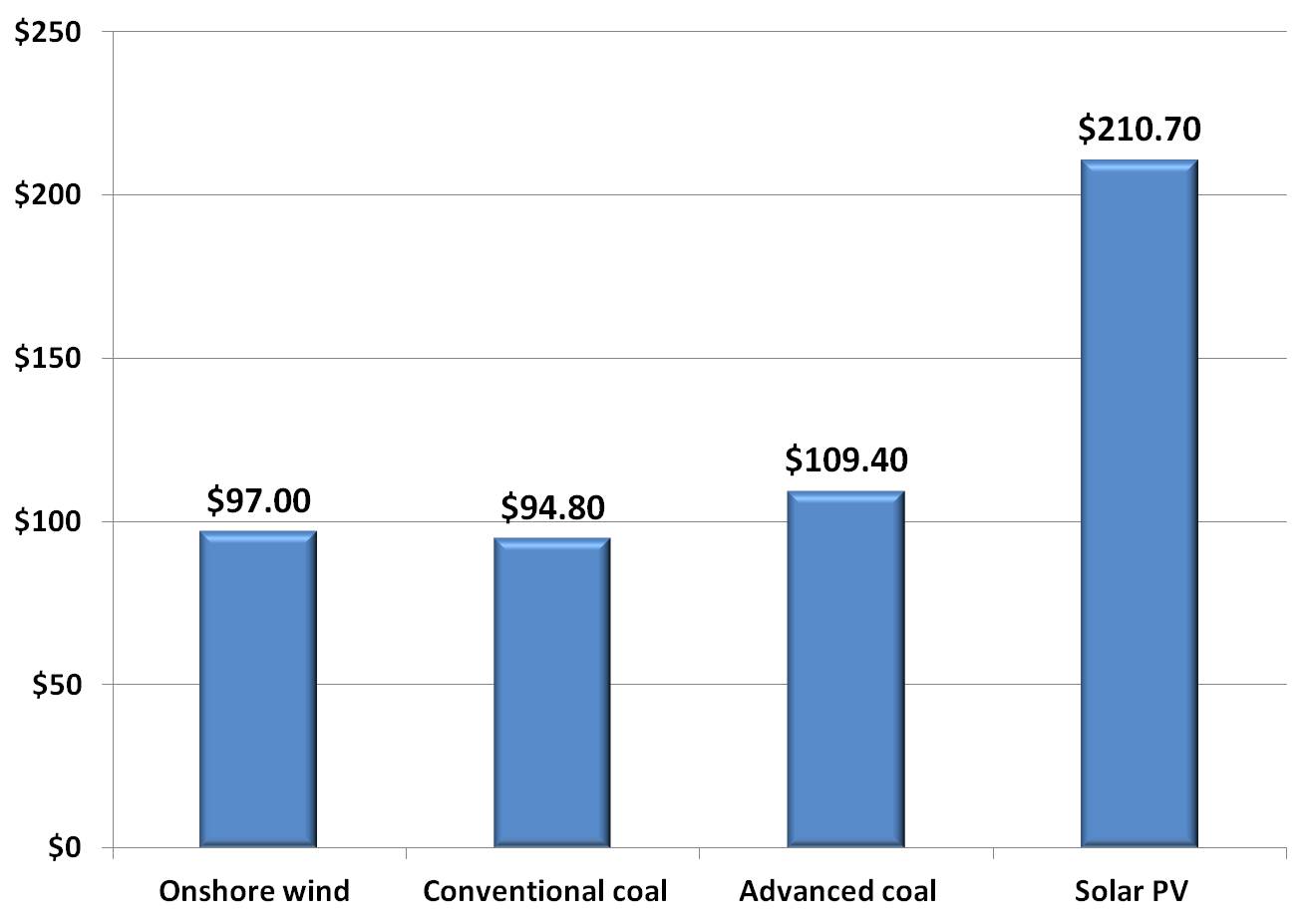
It has for many years been accepted “knowledge” in the electric industry that renewable power simply can’t compete with coal power on price. It’s commonly believed that if we want clean renewable power we are going to have to pay more for it.  But that belief is now being questioned, at least for new construction. The latest Energy Information Administration (EIA) levelized cost analysis released in 2011 lists the following levelized cost for units put in service in 2016[1]:

Levelized Cost by Resource in $/MWh

Given these numbers, wind certainly looks competitive, especially given that under current environmental regulations it would be tough to build anything but an advanced coal unit.

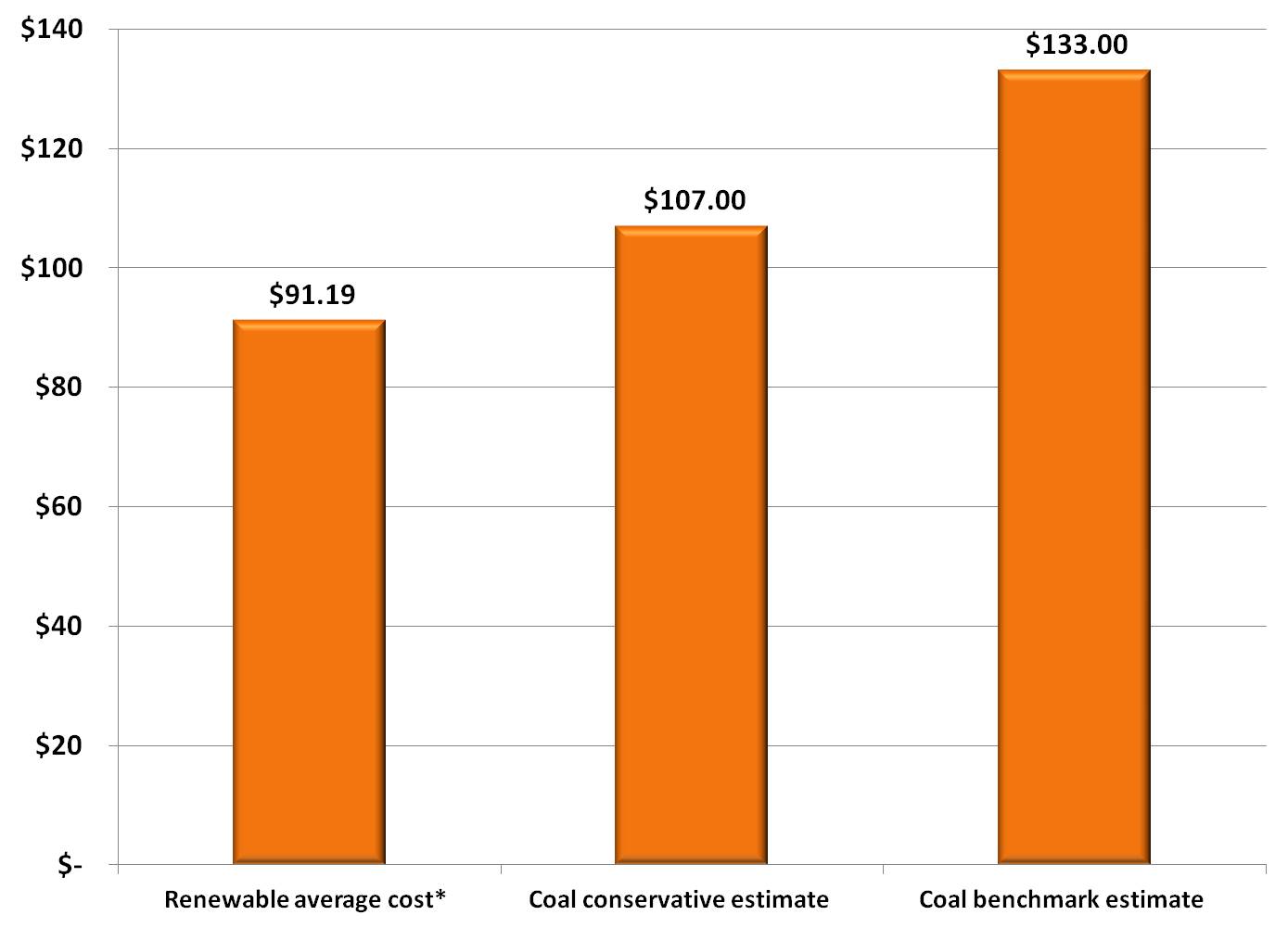
In a February 2012 report by the Michigan Public Service Commission (MPSC)[2], the MPSC states:  “Almost all actual renewable energy contract prices are lower than the coal guidepost rate.”  The MSPC’s estimates (based on actual contract costs for renewables) show the following:

Contracted Construction Costs per MWh

Xcel Energy in Colorado recently signed a wind energy power purchase agreement for an initial cost of $27.50/MWh.[3] With an annual price escalator of about 2%, the price of this contract will remain well below the levelized cost of other technologies.

Now, of course we could go on to argue things like capacity value, transmission costs, or the need for backup power, and these would all be valid issues to consider.  But we can at least now say that we can’t just assume renewables are too expensive.  It is time for all market participants to consider this issue more deeply before making future plans!


[2] Report on the Implementation of the P.A. 295 Renewable Energy Standard and the Cost-Effectiveness of the Energy Standards, Michigan Public Service Commission, Feb. 15, 2012 http://www.michigan.gov/documents/mpsc/implementation_PA295_renewable_energy2-15-2012_376924_7.pdf

Posted in Electricity, Renewables | Tagged , , , , , , , | 2 Comments

Is the U.S. Electric Generation Mix Adequately Diversified?

by Bob Shively, Enerdynamics President and Lead Instructor

“My own bias is that natural gas, or shale gas, displaces coal. But the best approach is to manage the risks by diversifying. I’ve seen all the cycles up and down and trying to predict and forecast what will happen is a fool’s game. There are too many variables and too much uncertainty.”  Mark Kinevan, vice president of energy trading and chief operating officer for The Energy Authority in Jacksonville, Fla., as quoted in Energy Biz Insider.

Overall in the U.S., reserve margins for generation look solid thanks to a significant slowdown in demand growth due to the economic downturn and due to recent focus on energy efficiency among many utility regulators.  In fact, some analysts within the industry argue that electric demand will never grow much again given our ability to create more benefits with less electricity. Others argue that as we become more efficient, we’ll simply do more with electricity and that as the economy picks up, so will demand.

But even if demand grows slowly, or not at all, the U.S. will need to build new generation at some point and in many cases sooner than later.  This is because new environmental concerns are likely to lead to significant shutdowns of existing coal units.  In fact recent studies (see for instance the U.S. DOE report at http://energy.gov/sites/prod/files/2011%20Air%20Quality%20Regulations%20Report_120111.pdf) have suggested that up to 29 GW of coal generation may no longer be economic to keep open.

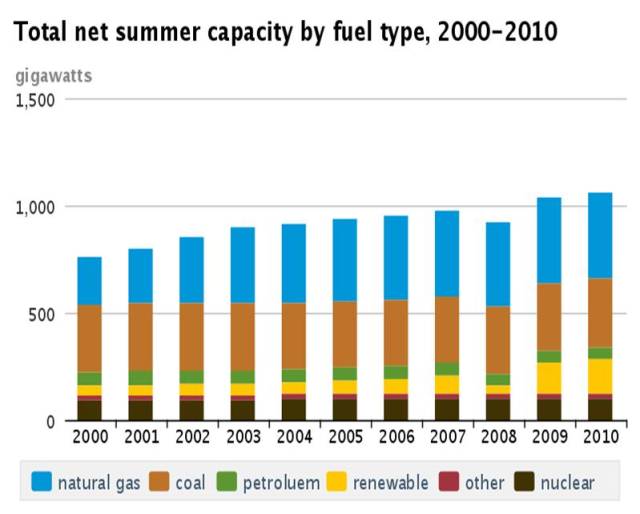
So in some regions of the country, older coal units will need to be replaced by new generation.  As you can see from the following graph taken from the Energy Information Administration (EIA) website, most recent generation growth has been from renewables and natural gas units:

Source: EIA

And looking at planned capacity for the next five years, we see the same trend (remembering that some renewable projects don’t show up in later years since they have a shorter planning horizon than other fuel sources):

  GW

Source: EIA

It is clear that as a whole, we are rapidly diversifying away from our current dependence on coal generation in the U.S.  This will likely to have a number of future impacts, but that discussion is a topic for another day.

If you would like an explanation about how various generation technologies work, please see Enerdynamics’ YouTube channel at www.YouTube.com/Enerdynamics.

Posted in Electricity, Renewables | Tagged , , , , , , , , | Leave a comment

Should I be Worried about Breathing Methane with Gas Drilling and Fracking Going on Around Me?

by Bob Shively, Enerdynamics’ President and Lead Instructor

Earlier this week, I got the following e-mail from one of my co-workers in our Colorado office:

“Do you know how bad it is to breathe in methane? I’m wondering since there is so much drilling around me. I read a report that says by using an air monitor north of Denver, they estimate losses of 4% in drilling areas.”

My response was, no don’t worry about breathing methane.  First of all, methane is lighter than air so it would not be expected to sit close to the surface where you are walking around or sitting in your house.  And secondly, methane is not toxic to breathe unless it is concentrated enough to asphyxiate you.  A good discussion is located here from the Canadian Centre for Occupational Health and Safety.

A much bigger concern relative to the methane in the air is that methane is a potent greenhouse gas.  In fact, it is over 20 times more effective in trapping heat in the atmosphere than carbon dioxide (CO2) over a 100-year period according to the EPA[1].  So while the methane in the air isn’t negatively affecting your health when you breathe it, it is contributing to the concentration of greenhouse gas in the atmosphere.  And this is an issue that the gas industry needs to address in cooperation with environmental regulators and environmental organizations.

For a discussion of this issue, see the article in Nature at http://www.nature.com/news/air-sampling-reveals-high-emissions-from-gas-field-1.9982  and then go to the America’s Natural Gas Alliance at http://www.anga.us/critical-issues/howarth-a-credibility-gap for the rebuttal.  This issue is far from settled, and it may indeed become important in our future energy plans.


[1] http://www.epa.gov/methane/

Posted in Natural Gas | Tagged , , , , , , , | 1 Comment

Capacity Factor – A Key Determinant of the Value of a Power Plant

by Bob Shively, Enerdynamics President and Lead Instructor

One area I find in our classes that we often spend time discussing is the concept of capacity factor.  This is important because it describes how often a given power plant is putting electricity onto the grid.  If you don’t fully understand the concept don’t feel bad – it’s a common situation but with just a bit of explanation we can make it clear.

Units of Capacity and Energy
First you need to be sure you understand the concepts of capacity and energy and the units that are associated with them.  If you need review or explanation, please take a moment to view this video:

Given that you now understand capacity and energy, let’s discuss how these apply to capacity factor.

Rated Capacity
Each generating unit has a rated capacity, also known as the maximum power rating. This quantity defines the maximum power in megawatts that the unit is designed to provide to the grid.  While the unit may be able to produce electricity at a higher level, it will reduce its life in doing so.  And thus units are not often run beyond their maximum rating.  However, many units can be operated at levels well below their rated capacity.  For example, an operator may have a 300 MW rated unit, but only needs 200 MW at a certain point in time.  So the unit is operated at 200 MW, even though it could actually produce 300.

Energy
The amount of electricity put onto the grid over time is called energy, and is determined by the unit’s actual operating level multiplied by the amount of time the unit is run.  This quantity is typically stated in MWh.  For instance, if the 300MW unit is run at 200 MW for two hours it will have an output of 200 MW x 2 hours, or 400 MWh.

Capacity Factor
The ratio of a unit’s actual output to its maximum possible output at its rated capacity is called capacity factor.  In the example of the 300 MW unit whose output was 400 MWh over two hours, the unit would have a capacity factor of 400 MWh divided by 300 MW x 2 hours, or 600 MWh, which would be its maximum output.  So the capacity factor of the unit for those two hours was 67%.  Capacity factor is used to determine how fully a unit’s capacity is utilized.

Why It Matters
Capacity factors vary significantly by unit type.  Based on Energy Information Administration (EIA) data for 2010, here are U.S. capacity factors by fuel type:

Fuel Type/Capacity Factor
Coal/62%
Petroleum/7%
Natural Gas/24%
Nuclear/86%
Hydro/38%
Wind/27%
Solar/15%
Geothermal/58%

One thing this tells us is that a dollar invested in nuclear capacity, for example, buys significantly more energy than a dollar invested in petroleum capacity.  For units owned by utilities, this is important to ratepayers because the capital costs of the unit with a high load factor can be spread over more kWh, thus resulting in lower rates required to recover the capital costs.  Similarly for units owned by merchant generators in competitive markets, the owner has more kWh to recover a reasonable return on their investment and thus can charge a lower price for their output.

So it is clear that high load factors are more attractive when making investment in new power plants.  But for existing units, the above data tells us at least one more interesting fact.  Since natural gas power plants are only used at 24% capacity factor, there is lots of room for gas units to provide more power to grid.  This means that, at least on average across the U.S., natural gas has significant potential to reduce the output of coal power as gas prices fall and coal units must spend more money on environmental compliance[1].

[1] Interested in learning more about the impacts of environmental compliance on electric markets?  Inquire about Enerdynamics’ latest seminar offering – Power Emissions Regulation and Markets – now available for groups within your organization.

Posted in Electricity | Tagged , , , , , , , | Leave a comment

Energy Workforce Development: Training Programs Help Fill Industry’s Knowledge Gap

By John Ferrare, Enerdynamics’ CEO

We’ve all heard that it’s coming: a significant workforce gap created by the huge percentages of the gas and electric workforce that are at or near retirement age. When waves of seasoned industry professionals retire, a young and relatively inexperienced breed of new hires will eagerly fill the positions. But with little or no industry experience, how will affected companies survive the learning curve? Proactive training. Forward-thinking companies have anticipated the inevitable and created mentoring and educational programs to help fill the knowledge gap.

In my role at Enerdynamics, I have been fortunate to work with a number of companies seeking to fill this unavoidable gap. For many, energy business acumen (or in laymen’s terms, a basic understanding of how the gas and electric industries really work) can take decades to master. Or, for those whose area of expertise is a specific function such as accounting, a solid understanding of the energy industry’s inner workings may never be mastered. So the question becomes this: How does a company effectively and efficiently teach the fundamentals of its industry to an increasing number of new hires who have no industry experience whatsoever?

Enerdynamics offers a variety of solutions. The one that best fits an organization greatly depends on a company’s culture. For some, our introductory seminars – Gas Business Understanding and Electric Business Understanding – are a perfect match. Each presents a comprehensive introduction to the industry in a two-day, instructor-led seminar held on site at a company’s location of choice. Advantages include an intense and interactive learning environment and the opportunity to have industry concepts explained or questions answered by a subject matter expert.

For other corporate cultures, online training is a better option. For these companies Enerdynamics offers Gas Industry Overview and Electric Industry Overview, each a four-hour online introduction to its respective business. While similar to their seminar counterparts, these online courses require just a four-hour time commitment versus two days to attend a seminar. Per-employee costs are less, and each is presented in shorter modules (typically 45 minutes to an hour) that can be finished in one sitting.

Lastly, for those cultures that still value the written word, our training books – Understanding Today’s Natural Gas Business and Understanding Today’s Electricity Business – are an excellent option. In fact, I just spoke to a client today who plans to send these books to company interns in advance of their arrival in hopes they show up on Day One with a basic understanding of the business.

Of course, energy business acumen training is but one piece of the very large training puzzle HR departments face in the coming years. Yet the benefits to clients who do offer energy business acumen training are clear. Participants tell us time and time again: a) an understanding of industry basics helps them do their jobs better; and b) they wish they’d had the training earlier. The alternative, of course, is to hope that industry knowledge will be gained on the job. But with fewer and fewer veterans to transfer that knowledge, I suspect this will get more and more difficult.

Enerdynamics’ introductions to the gas and electric business are available in a variety of media and price points: instructor-led seminars, online courses and books. Please contact me at jferrare@enerdynamics.com for more information on a custom program that meets your budget and your needs.

Posted in Electricity, Natural Gas | Tagged , , , , , , , , , , , , | 7 Comments

Is the Photovoltaic Industry Living Up to Its Hype?

by Bob Shively, Enerdynamics President and Lead Instructor

In recent blog articles we have examined solar photovoltaics (PV), a generation technology that directly converts sunlight to electricity.  In related posts we posed the questions:  Are PVs on the verge of a transformation in electricity generation technology? Can solar power on our rooftops compete with existing generation on price? Despite all the buzz surrounding it, 2011 was a bumpy year for PVs.  Costs came down and installations continued to grow, although not as dramatically as in 2010. But here in the U.S. much of the latest news has been about the Solyndra bankruptcy and a brewing PV trade war with China.  So is the PV industry living up to all its hype?

Installations Have Continued to Grow but Growth has Slowed
According to estimates by Digitimes Research[1], worldwide installations of PV systems, which in 2010 dramatically grew an estimated 133% compared to 2009, grew by an estimated 18% in 2011. They are further forecast to grow by 12% in 2012.

Worldwide Installations of PV Systems (in MW):

Since about 80% of the world’s installations have historically been in Europe, we can look to that region to explain the drop in growth.  The answer is that the key governments such as France, Spain, Germany, and the Czech Republic have trimmed subsidies designed to foster solar growth, but installation growth in other markets such as China, India, and the U.S. has only picked up some of the slack.  This pattern is expected to continue in 2012.

Production Costs Have Dropped While Production Capacity Has Grown
2010 was characterized by not enough production to meet demand for PVs, meaning that producers could charge a premium to consumers.  In 2011 this situation changed dramatically. By the end of 2011, estimated world production capability was a whopping 267% of 2009 capability. In fact, it has grown so quickly that capability now exceeds actual production by 50%[2].

Worldwide PV Production Capability (blue)
and Actual Production (yellow) in MW
 

Production capability has grown rapidly because entry barriers to producing PV cells have dissipated as methods of migrating well-known silicon chip production techniques to PV cells have become understood. Also, silicon feedstock constraints have been eliminated, and equity markets in the Western world and governments in Asia have been willing to fund construction of PV manufacturers.  The result – lots of new PV factories.  This is hard on producers who in the past could charge a premium for PVs in short supply, but now find themselves having to compete on price.

But the oversupply is good for customers who benefit from competition. Prices for PVs fell significantly in 2011.[3]   According to First Solar CEO Michael Ahearn: “In an industry without entry barriers, which we believe is the case for the polysilicon PV module industry, the easy re-entry of competitors and expansion of capacity will keep downward pressure on prices and margins indefinitely.[4]”

This means that in some markets with government subsidies, the right installation is already near or at grid parity.  In fact, I recently had dinner with friends in California who told me they purchased a $25,000 PV system for their house with a pay-back of less than five years.  This means that since they own the system free and clear, they’ll have free energy starting in 2016.

But What Will Happen When Government Subsidies Drop?
With the current state of the world economy and both Europe and the U.S. concerned with governmental debt levels, it is likely that subsidies for solar power will continue to decline.  So can the PV industry survive with less support? In a recent announcement to investors, First Solar announced a new strategy designed to deal with an environment of low PV costs, high competition and reduced government support.  The new strategy is to move away from roof-top installations, where the assumption is consumers will pick the cheapest supplier regardless of whether it is manufactured in the U.S. or in China, and to compete on utility-scale PV power plant installations where superior project development and engineering skills can win out.

At least one key investor is buying the story – Warren Buffet’s MidAmerican Energy Holdings recently acquired two utility-scale developments in California including one being built by First Solar.  Although it remains to be seen, perhaps 2012 will be year that the PV industry begins the transformation from dependence on government support to success in the competitive marketplace.


References and resources:

[1] See Global PV Market, 2011 available at http://www.digitimes.com/Reports/Report.asp?datepublish=2011/5/2&pages=RS&seq=400

[2] Global production capability and output data are taken from the December 14, 2011 First Solar 2012 Guidance Conference Call available at http://investor.firstsolar.com/eventdetail.cfm

[3] Stated in a conference call to investors December 14, 2011

[4] See: http://investor.firstsolar.com/releasedetail.cfm?ReleaseID=630941 and http://www.midamerican.com/newsroom/aspx/newsdetails.aspx?id=541&type=current

Posted in Renewables | 4 Comments