
Electric and Gas Utilities’ Response to Wildfires

by Bob Shively, Enerdynamics President and Lead Instructor

Here in Enerdynamics’ Laporte office we can see the smoke from the High Park Fire – reportedly the third largest wildfire in Colorado history – as it burns in the hills west of town.  And sadly, we know that at least a thousand homes and ranches lie nestled in the once beautiful meadows and hills that are now either consumed or threatened by flames. We also know that these residences receive electric service from our local rural co-op.  Such events raise the question of how utilities respond when wildfires devastate the landscape.

The answer has both short-term and longer-term components. First comes emergency response:  Once reports of a fire are received, the utility must determine where the fire is and where it is likely to move. As quickly as is possible, the utility must then de-energize all electric transmission and distribution lines, and, if gas service exists, shut off gas flow into the affected area.  This can be difficult because the utility wants to minimize the number of customers shut off from service but wants to be sure it gets all lines or pipes in the path of the fire.

In some cases the utility has remote capabilities to de-energize facilities, but in some cases it may require personnel in the field to manually pull a switch or turn a gas valve.  This requires close cooperation with firefighting agencies to ensure that utility personnel can enter an area safely.  If not, a larger area will have to be de-energized even though it will inconvenience other customers.  After all, safety is the highest priority.

Why is it so important to cut off power and gas in the area of a fire?  Distribution poles can burn and fall, causing electric lines to contact the ground.  This can cause new fires to break out, but even worse can cause significant danger to firefighters in the area.  In fact, there is an unconfirmed story being told that a fire crew rushing to protect a home in the High Park area got separated because a live distribution line fell between two groups of firefighters and they all knew better than to try to cross a live line.  This fire spread so quickly that it moved into a rural neighborhood before the utility company could respond.  And gas lines, if there is a leak, can result in even more intense fire or even explosions.

So after the power or gas has been shut off, what comes next?  That’s when utilities simply have to wait until the fire crews can do their work and make it safe for utility crews to go back into an area.  Utilities tend to work very closely with fire authorities so that areas can be entered safely and as quickly as possible.

When they can get in, they will first focus on any critical loads.  In the case of the High Park Fire these included water pumping facilities and a key communications tower.  Each line must be physically inspected for damage and all protective equipment must be tested.  Then damage must be repaired.  In some cases, temporary facilities can be installed to restore service more quickly.  But before lines can be re-energized, each customer facility must be checked to determine whether it is safe to restore power or gas.  As you can imagine, checking and repairing facilities can be a time-consuming process.  Throughout, the utility needs to stay in close contact with its customers and let them know what to expect and when to expect it.

Notice on the Poudre Valley REA website concerning the High Park Fire

Finally, the utility must make longer-term facility repairs and upgrades to return the system to its optimal state. Prior to this, the utility will evaluate whether the system can be improved and made even more resilient to any future disasters.

Posted in Electricity, Natural Gas | Tagged , , , , , , , , | Leave a comment

Integrating Renewables into the Electric Generation Resource Mix

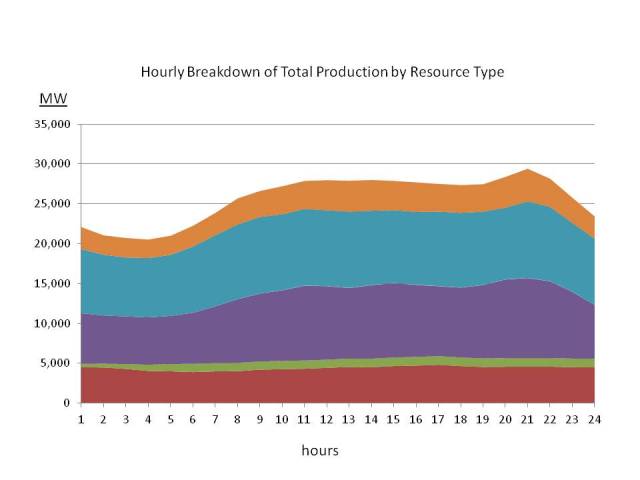
We recently posted the following graph (of California ISO Hourly Breakdown of Total Production by Resource Type for May 1, 2012) on our Facebook page and asked followers to guess what resource the red section represented:

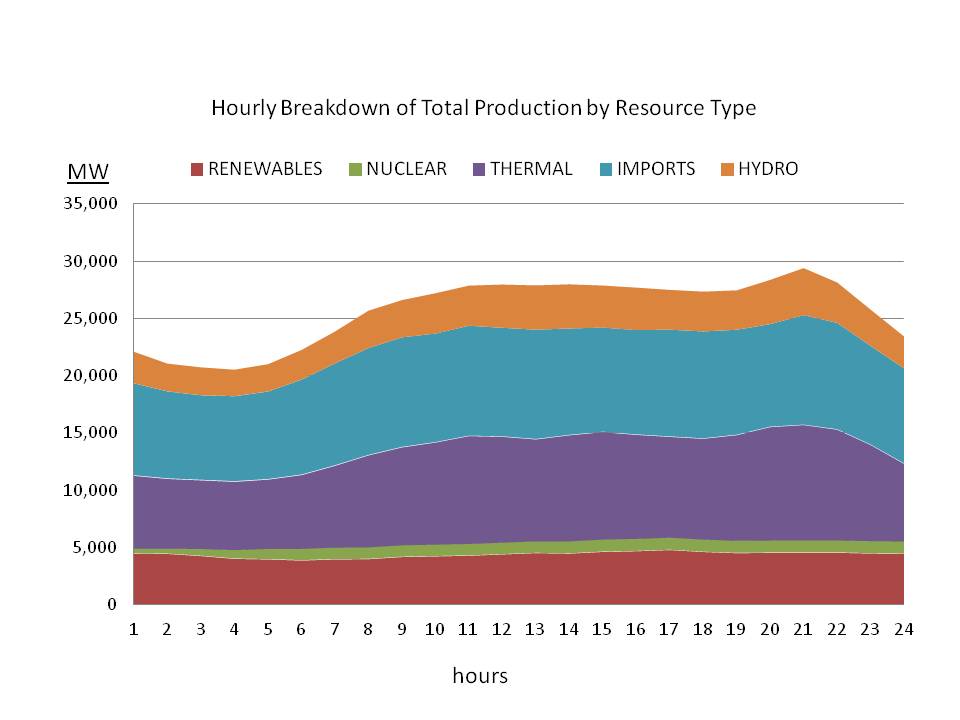
Below is the same graph with the resource labels included. The red resource type on the bottom is renewables.  Then, moving from bottom to top is nuclear; thermal sources, which are mostly natural gas combined-cycle turbines; imports that come from other states outside California; and hydro power. 

We often hear that renewables can’t handle baseload needs because they are too variable.  But by combining different renewable generation technologies across broad geographic areas variability can be reduced.  For instance, the Western Wind and Solar Integration Study performed by the National Renewable Energy Lab (NREL) concluded that if renewables were integrated across the western grid that variability due to 30% wind and 5% solar penetration would result in no increase in variability over load-only variability  (see: Figure 7, page 18 of the Executive Summary at http://www.nrel.gov/docs/fy10osti/47781.pdf ).

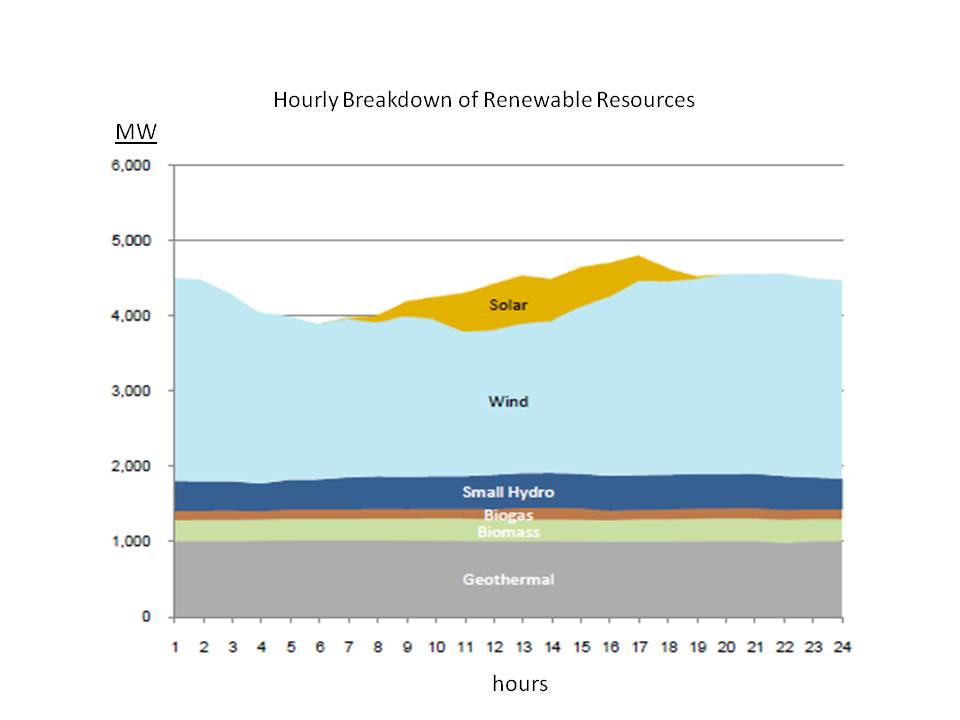
To see how this works, take a look at the California renewables supply curve May 1 broken down by renewable resource:

We see that when wind dipped during the middle of the day, solar nicely filled much of the gap.  And the rest of the dip in wind occurred early in the morning when loads are lower.  So will this work out so nicely every day?  Probably not, but it does show that integrating renewables isn’t as daunting as it may seem without understanding the details.

Posted in Electricity, Renewables | Tagged , , , , , , , , , , | Leave a comment

FERC Order 1000 – One More Step Toward Regional Wholesale Markets

by Bob Shively, Enerdynamics
President and Lead Instructor

R0012844.tif
Photo credit: Sigfrid Lundberg

Back in the early 2000s when FERC was pushing Standard Market Design, some in the electric industry believed we would soon transition to four or five uniform wholesale markets in the U.S.: Perhaps the West, the Midwest, Texas, the South, and the Mid-Atlantic/Northeast.  Traders excitedly thought about the prospects of open markets and consumers in high-cost states looked forward to access to cheaper power.  But politics and the physical realities of a limited transmission grid slowed down the development of large inter-regional markets, and FERC has been forced to foster changes through incremental steps rather than broad policy changes.

A new major step in the transition to larger markets occurred when FERC issued Order 1000 titled Transition Planning and Cost Allocation.  The Order was designed to address four issues that have been observed in the marketplace:

  • Existing rules did not require regional transmission planning, so each transmission provider tended to develop plans that created local benefits but did not take into account greater regional good. This tended to favor smaller, low-voltage transmission projects.
  • Existing rules did not require planning to take into account public policy requirements such as renewable power portfolio requirements.  This tended to hold back development of renewable energy in transmission-short areas.
  • Independent transmission owners were discouraged from building projects by rules that gave incumbent transmission owners the right of first refusal on new projects.  This meant that a developer could spend time and money getting a project conceptualized and included in a transmission plan, only to see it built by the incumbent transmission owner.
  • Cost allocation methodologies did not provide for regional consideration of costs and benefits.  This meant that a local project that would have regional benefits might not be able to collect revenue from those benefitting, thus making it much less likely that the project would get built.

Initially issued in July 2011 and reaffirmed through a denial of rehearing in May 2012[1], Order 1000 established minimum criteria for the transmission planning process including development of regional plants, consideration of transmission needs driven by public policy requirements, and coordination between neighboring regions.  The order also required regional and interregional cost allocation methods that are “roughly commensurate” with estimated benefits and protect entities that don’t benefit from having to pay.  And lastly, the order encourages non-incumbent transmission owners to build new transmission by removing the right of first refusal given to incumbent transmission owners.

The order is expected to have wide impacts in wholesale markets.  Already, the various ISOs, utilities, and transmission companies are working to develop new rules. Initial compliance filings are due in October 2012 with final filings on regional coordination and cost allocation due in April 2013[2].

Market changes due to the new rules may include increasing investment in transmission construction, significantly more construction of larger high-voltage transmission projects, growth of transmission-only companies (transcos) thus transitioning the transmission construction role from utilities to transcos, growth in transmission projects designed to foster movement of renewable power, and the integration of more regions into wholesale trading markets. Examples of the latter include Entergy’s plan to move into the Midwest ISO by 2013.

And FERC may not be done trying to foster more competitive regional wholesale markets.  We can expect to see more orders addressing other issues as the growing competitive wholesale markets unfold.

References:
[1] See:  http://www.ferc.gov/media/news-releases/2012/2012-2/05-17-12-E-1.asp

[2] For an example of this, see the report that SPP commissioned at http://www.brattle.com/_documents/UploadLibrary/Upload1032.pdf

Posted in Electricity | Tagged , , , , , , , , , , | Leave a comment

Natural Gas Wellhead: What It Does and How It Works

As part of our “What in the World Wednesday” contest on our Facebook page, we posted this photo and asked our followers to tell us what it is. Below is the answer as well as a quick summary of what it does and why this matters to those in the energy business:

This is the above-ground portion of a natural gas wellhead.  The wellhead sits on top of a natural gas well.  After the well has been drilled, the well must be completed.  This process includes installation of the wellhead which is equipment at the top of the well that ensures safe operation and manages the flow of natural gas out of the well into the gathering system.  Wellhead components include the casing head, the tubing head and the Christmas tree.  For a description of these components and what they do, see: http://www.naturalgas.org/naturalgas/well_completion.asp.

While many people are concerned about the impact of gas drilling, many don’t realize that once the well is completed the resulting installation is fairly unobtrusive.  So many of the impacts of gas drilling come during the initial process and are not long-term.  For a good video on how the drilling process works in a well that must be fracked, see:  http://www.marcellus.psu.edu/resources/drilling/index.php.

Posted in Natural Gas | Tagged , , , , , , | Leave a comment

Why Huge Trading Losses Keep Happening

by Bob Shively, Enerdynamics President and Lead Instructor

According to President Obama, the CEO of J.P. Morgan is “one of the smartest bankers we got…and they still lost $2 billion and counting.”  Of course, we’ve heard this story before: the collapse at Enron despite being the “smartest guys in the room”; Amaranth Advisors that lost $6 billion in the natural gas markets[1] in 2006; and the largest bankruptcy filing in U.S. history by Lehman Brothers.  How can this keep happening, and what does it mean for the energy industry?

Since the deregulation of wholesale markets, trading has been part and parcel of participation in electricity and natural gas markets.  Any energy of company of much size in the U.S. and Europe either has a trading floor or outsources trading to third-party organizations (such as J.P. Morgan).  And since energy companies are buying and/or selling large volumes of energy products, they are subject to risk.  Indeed, in our classes, we teach that you can’t understand the energy industry without understanding risk management.

So how does “risk management” become a multi-billion dollar loss?  Well in reality “risk management” covers two sides of the risk coin: hedging and speculating. And as Manhattan College finance professor Charles Geisst stated to the Wall Street Journal, “I don’t think there’s a clear line of demarcation between hedging and speculating.  There never really has been.”

But even actions taken solely for the purpose of hedging risk can result in significant losses if circumstances go the wrong way. Risk is managed through use of models that are designed to evaluate the aggregate corporate risk of commodity movements under “normal conditions.” The basic model used is called Value at Risk or VAR.  To quote our book Understanding Today’s Electricity Business: “VAR can be described as an estimate of a portfolio’s potential for loss due to market movements, using standard statistical techniques and an estimate of future volatility.”[2]

So the question we need to ask is what happens when:

  • estimates of volatility are wrong;
  • market behavior fails to reflect the history on which the model is based; or
  • market outcomes fall outside the level of statistical certainty chosen to model?

The answer is that losses can far exceed the VAR level.  Risks are commonly hedged by investing in derivatives tied to indices that historically have moved in correlation to the market position being hedged.  But if this correlation breaks down, the hedge no longer works.

According to a published report by Reuters, VAR for one division of J.P. Morgan swung significantly depending on which of two competing VAR models was used.[3]  And this uncertainty may have masked the true risk that J.P. Morgan was taking on. Another story by Risk Center suggests that J.P. Morgan’s models failed because the volumes the bank traded far exceeded the historical trading volumes for the involved financial derivatives. This signaled the market that something was going on, resulting in trading activity that changed the historical correlations between different indices used by J.P. Morgan in their deal structures.  This invalidated the risk model’s results opening J.P. Morgan up to large losses.[4]

In our classes, we end our discussions of risk management with the following visual:

And in today’s complex energy business, companies involved in trading must continually strive to protect against the risk of large losses. But some won’t always be successful, and we will periodically see history repeat itself.


References:

Posted in Electricity, Natural Gas | Tagged , , , , , , , | Leave a comment

Integrated Gasification Combined Cycle (IGCC): What’s the Big Deal?

This week on our Facebook page, we posted this picture and asked followers to guess what the image is:

We didn’t get any correct guesses, so for those left scratching their heads, here is the answer and a quick explanation of its significance:

This is the Heat Recovery Steam Generator (HRSG) under construction at Mississippi Power’s future Kemper County Integrated Gasification Combined-Cycle (IGCC) power plant.  A combined-cycle power plant’s first power cycle comes from a gas turbine.  The waste heat from the gas turbine is then recovered and used to create steam, which is used for a second power cycle in a steam turbine.  By recovering the waste heat, the power plant is more efficient than single-cycle power plants.  The device that recovers the steam is called an HRSG as seen in the photo. For more information on the combine-cycle gas turbine see: http://www.youtube.com/watch?v=1wujJuVGGY4.

The construction of the Kemper County IGCC is notable because only two coal IGCC units are under construction in the U.S. and only two existing units are in operation.  So the success of this project will impact whether this technology grows.  IGCC units are tough to get built in the U.S. given the current low cost of natural gas, but elsewhere in the world there is strong interest in the technology.  The benefit is that when coal is gasified, a synthetic gas is created that burns much cleaner that solid coal.  For more information on the Kemper County project, see: http://www.mississippipower.com/kemper/power-for-our-future.asp.

Posted in Electricity, Natural Gas | Tagged , , , , , , | Leave a comment

U.S. Chemical Companies Benefit from Low Natural Gas Prices

by Christina Nagy-McKenna, Enerdynamics Instructor

As natural gas and coal companies watch their stock prices sink due to low natural gas prices, U.S. chemical companies are experiencing a boom and watching their stocks rise.  Companies such as Dow Chemical Company (Dow) and DuPont saw first quarter 2012 profits exceed the expectations of Wall Street analysts.  Both companies produce products that use natural gas as a feedstock. They and other chemical companies are taking advantage of cheap natural gas by expanding facilities and building new ones.

The foundation for the low natural gas prices is the abundance of gas supplies in the U.S. due to the influx of shale gas production.  The bullish expansion underscores U.S. chemical companies’ beliefs that, despite the controversy surrounding shale gas production, low prices and high shale production are here to stay.

Expansions
A big splash was recently made by Dow, which announced in April 2012 that it will build an ethylene cracker and a new propylene production facility in Freeport, Texas.  Freeport already is home to a large complex of Dow chemical plants.  In fact, the $1.7 billion expansion is only part of a planned $4 billion expansion in Southeast Texas.  The new facility in Freeport will not open until 2017, which indicates Dow’s belief that cheap, abundant shale gas will be available in Texas for years to come.

Such a project would have been unthinkable five or 10 years ago when natural gas prices were higher and gas supplies much tighter.  Dow’s expansions will also bring jobs to a U.S. economy that sorely needs them.  In total, Dow expects to employ 4,800 workers during construction of the project.   Ultimately it will employ up to 600 workers who will earn an average of $75,000.

Chevron Phillips recently announced that it will build a plant in Baytown, Texas, that will be the world’s largest capacity plant for the production of 1-hexin, a component of plastic resin.   While only 14 long-term jobs will be created by the plant, the company will need up to 500 engineering and construction professionals as they build the facility.  The plant is scheduled to be up and running by early 2014.

Chevron Phillips also plans to build an ethane cracker similar to one in Dow’s project in Freeport.  Lastly, in Old Ocean, Texas, Chevron Phillips will expand it natural gas liquids processing plant.

Shell is also studying an expansion project, which would put an ethane cracker in Pennsylvania.

The Foundation for Growth
The underpinning for these chemical company projects is a steady supply of cheap natural gas.  Dow’s CEO Andrew Liveries stated in an interview given to the Houston Chronicle that natural gas would need to rise over $10MMBtu while oil remained over $100/barrel in order for there to be problems with the return on investment of the project in Freeport.  Clearly, Dow does not expect natural gas prices, currently trading between $2 and $2.50MMBtu in the U.S., to reach those heights for many years.

The majority of the incremental gas for these expansions will come from shale gas projects being developed in Texas.  And the state of Texas is fully behind the expansions.  With respect to the Dow projects in Freeport, it is going so far as to invest $1million of the Texas Enterprise Fund in the new plant. Both Governor Rick Perry and Lt. Governor David Dewhurst were present at the Dow project announcement.

Threats to Expansion
There are two threats to recently announced expansions of the U.S. chemical industry. First, if the U.S. government finds that fracking, the process of extracting shale gas from its natural environment, is harmful to the ecosystem or causes groundwater contamination, it will be under tremendous pressure to shut down shale gas production across the country.  Second, if natural gas producers begin to export excess natural gas overseas where prices are more robust, U.S. gas prices will rise.

The export issue is particularly thorny as U.S. natural gas consumers would prefer to enjoy low prices while producers would like to return to the higher prices and greater profits of the past decade.  Petrochemical companies argue that it would be more beneficial for the U.S. economy to sell their value-added products overseas. However, natural gas producers would not see the same level of financial benefit from such a strategy.

For now however, companies such as Dow, DuPont, and Shell are planning for a bright future for their chemical businesses and are holding press conferences outlining plant expansions.  They are optimistic that natural gas prices will remain low for years to come, and the state of Texas is confident as well as it welcomes the new jobs created by these projects.

References and Resources:

“Cheap Natural Gas Feeds Chemical Industry Boom”, Zain Shauk, Chron. Com, April 19, 2012.

“Cheap Natural Gas from Shale Leads to Dow Texas Expansion,” Zain Shauk, Houston Chonicle, April 21, 2012.

“Chemical Makers Prfitiing from the Decline of Natural Gas,” Todd Shriber, Traders Huddle.com, April 19, 2012.

“Dow Seizes Natural Gas Opportunity in Texas,” Breakbulk.com, April 24, 2012.

Posted in Natural Gas | Tagged , , , , , , , , , , | Leave a comment

Natural Gas Glut Dramatically Impacts U.S. Electric Generation Picture

by Bob Shively, Enerdynamics’ President and Lead Instructor

The dramatic drop in natural gas prices in the U.S. has been widely discussed in recent months.  Prices as of April 27 range from $1.90 to $2.54/MMBtu at various trading points around the U.S. and are at the lowest point in a decade. Some analysts have even suggested that full storage in Fall 2012 could result in spot natural gas prices falling close to $0/MMBtu as producers have to give away gas to keep wells flowing and to produce more valuable natural gas liquids.  As you might expect, this scenario has negative impacts on earnings for gas producers, but it also has a dramatic beneficial impact on consumers who depend on natural gas.

In a future blog we will explore the impact that low prices are having on the industrial sector in the U.S.  Here, we will use the Atlanta-based utility Southern Company to demonstrate how dramatically low gas prices are impacting the electricity generation sector.

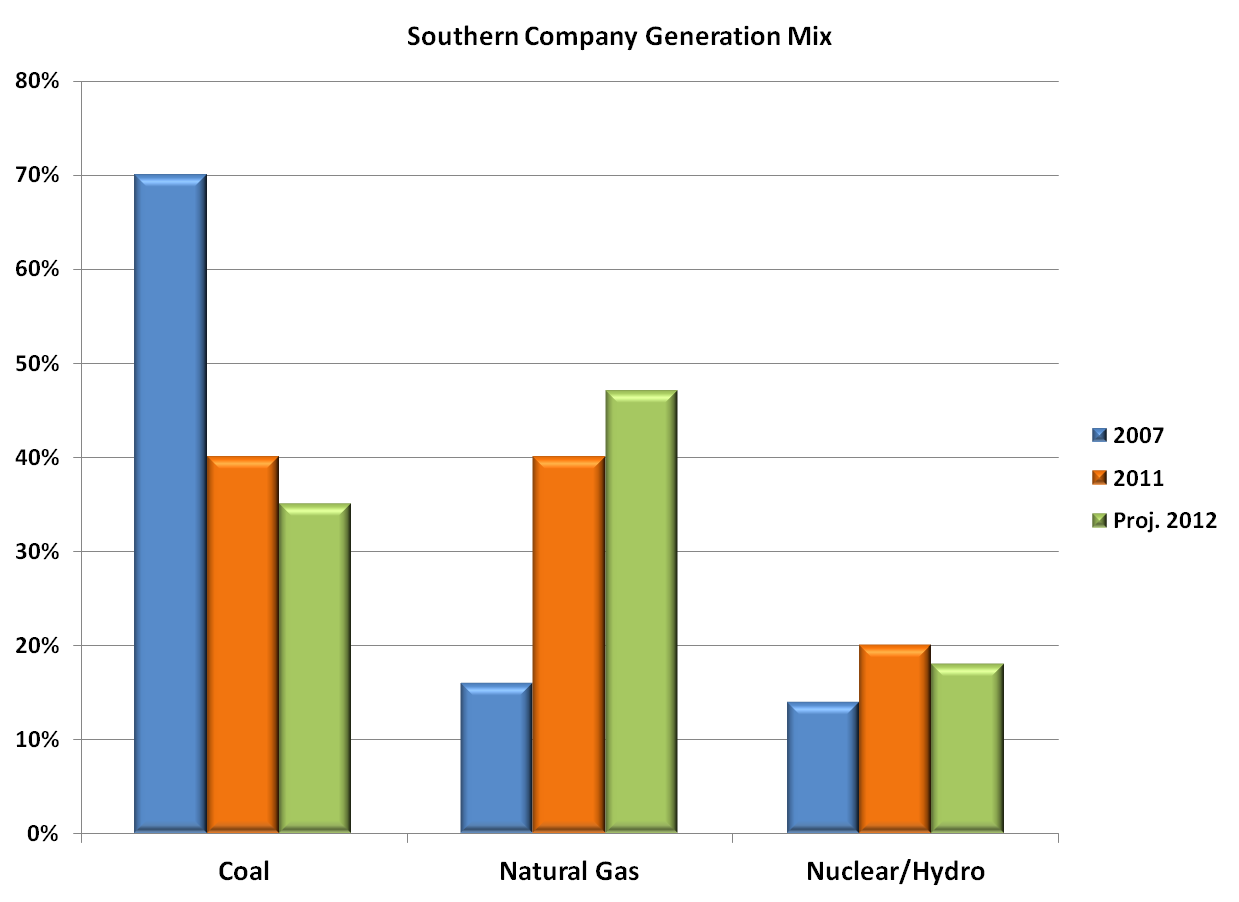
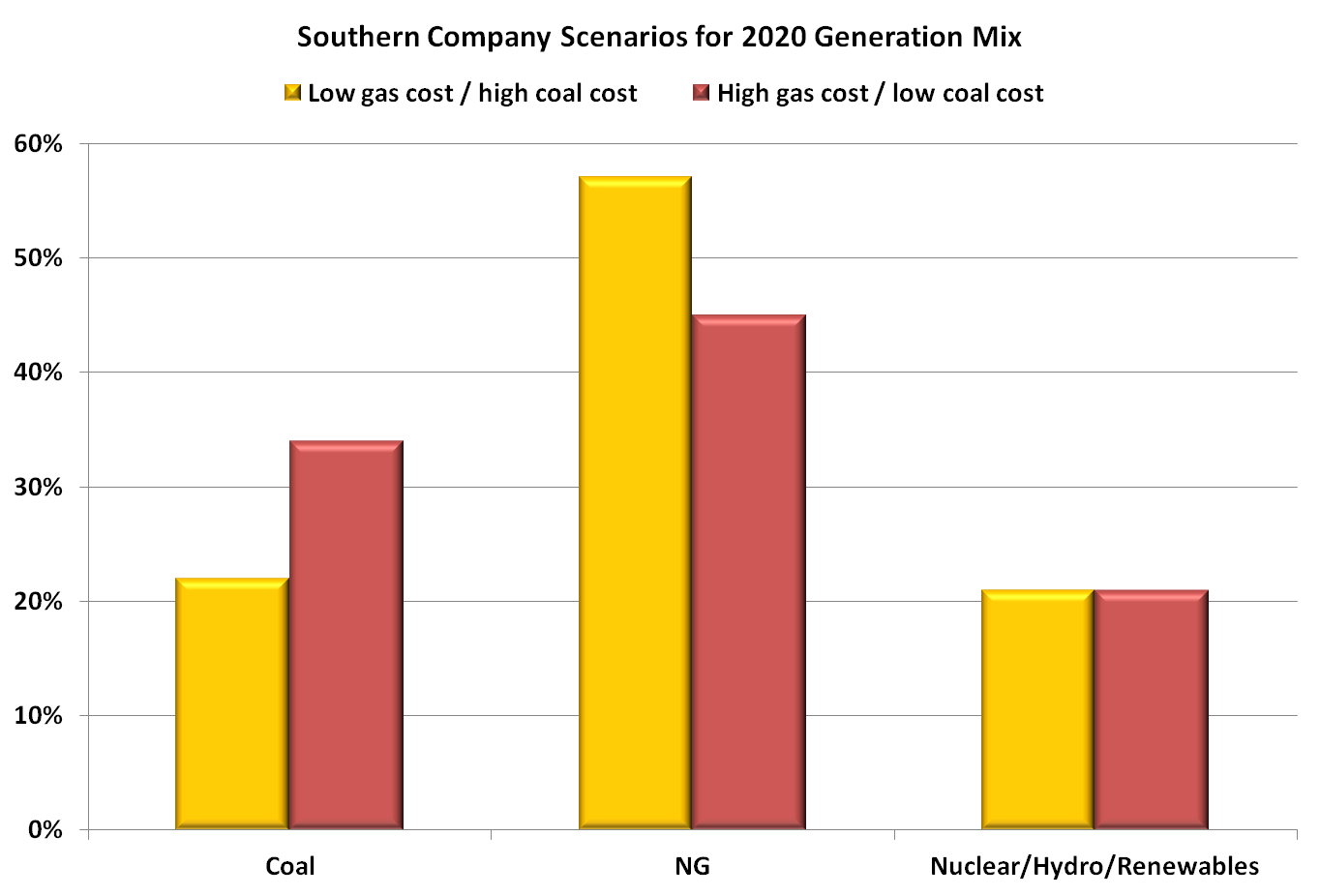
Southern Company executives discussed the company’s fuel mix and future generation plans in Southern’s First Quarter Earnings Call on April 25 (listen to the webcast at http://investor.southerncompany.com/events.cfm).  Southern traditionally has been a coal-dominated company.  In 2007, Southern, as is typical of historical fuel mixes, generated 70% of its power from coal and 16% from natural gas. The remainder came from nuclear and hydro.  By 2011, Southern’s mix was 40% coal and 40% natural gas. Southern projects its 2012 mix to be 35% coal and 47% natural gas.

The shift to gas coupled with low gas prices has a strong benefit for electric customers.  For example, Southern’s Georgia Power utility has reduced average fuel prices by 19% resulting in a recent filing asking for a reduction in residential rates of 6%.

But is this a temporary phenomenon driven by a short-term gas boom, or is it a permanent change?  Southern clearly believes that gas prices could stay low. Southern is building new gas-fired generation in Georgia and is working to reduce to its exposure to long-term inflexible coal fuel supply and rail transport agreements.  But according to one executive, it is an “all arrows in the quiver strategy,” meaning that as it heads into the future, Southern wants to maintain a portfolio approach that provides for optionality in future fuel choices.  Southern is currently building the first two nuclear units licensed in the U.S. in 30 years. Additionally, it is building a coal-integrated gas combined-cycle unit in Mississippi and the country’s largest biomass facility in Texas.  Southern’s goal is to be able to switch based on the best prices. Future generation mix projections depend on the relative cost of gas versus coal generation.  Southern presented two scenarios for 2020, one with natural gas rising to 57% of generation and another with gas falling to 34%.  But even with the most favorable projection for coal, coal is at 45% of generation – well below its 2007 peak.

Numerous other companies around the U.S. are going through analyses similar to Southern’s – and often coming to similar conclusions.  In addition to low gas prices, coal generation is facing the headwind of uncertain but expectedly more stringent environmental regulations (see New Environmental Rules and the Electricity Industry — Lots of Fuss or Real Impacts? ). So while gas prices have proven volatile in the past, it appears that a significant and dramatic shift in generation mix is occurring and may last for a long time.

Posted in Electricity, Natural Gas | Tagged , , , , , , , , , | 1 Comment

Enerdynamics’ Online Energy Training: Your Questions Answered

by John Ferrare, Enerdynamics CEO

As online training becomes increasingly popular – and more effective – there are several questions I’m often asked about Enerdynamics’ online training program. So I thought I’d take this opportunity to answer some FAQs. As always, if you have specific questions you can contact me directly at jferrare@enerdynamics.com or 866-765-5432.

How Our Courses Are Structured
Enerdynamics now has seven full-length online courses available to its customers. These courses are:

We’ve learned a lot about online training since our first effort, and I’m proud to say that each course is better than the last. Each full-length course comprises multiple modules with each module taking between 30 and 75 minutes to complete. Each module concludes with a quiz that has a passing score of 70%. Once a participant has viewed each module and passed each quiz, he or she is able to download a certificate of completion for that course. Administrators are able to track progress throughout a course and can see what modules have been completed and passed.

To make our courseware even more flexible, each course’s individual modules are also available as short courses. These short courses, which address a particular topic such as “the electric delivery system” or “solar power,”  are becoming more and more popular with many clients.

How Our Courses Are Delivered
If your organization has its own Learning Management System (LMS) you can load Enerdynamics’ courses and deliver them as you would any of your own. Each of our courses is SCORM-compliant, and so far each has worked with every client-based LMS we’ve attempted.

If your company does not have its own LMS, a simple and cost-effective solution is to run the courses through Enerdynamics’ LMS. You will be provided a username and password for each subscription purchased. You will also be assigned administrator access to your purchased subscriptions and can  use our LMS to assign them  to your employees. If you choose, an automated e-mail will be sent to each employee notifying him or her of the course registration and providing instructions on how to log in. Once an employee logs in and activates a course, he or she has 45 days to complete a full-length course or 15 days to complete a short course. The administrator can also use our LMS to view employee progress and download a variety of usage reports.

How Our Courses Are Priced
There are two ways to purchase Enerdynamics’ courses: subscription-based or site license. Subscription-based means you purchase bulk subscriptions that are then assigned to your employees.  As with any bulk purchase, the more you buy the lower the cost per subscription. Discounts can be significant for companies buying large numbers of subscriptions, which can make online training even more of a bargain. You can take advantage of subscription-based pricing using our LMS or your own. If you run the courses on your own LMS you just need to provide Enerdynamics a usage report on a monthly or quarterly basis.

You may also purchase a site license, which gives your employees full access to a given course or courses for a specific length of time, typically one to three years. Site license prices are determined according to the number of employees who have access to a course, and this pricing model takes into account that only a small percentage of any employee population is likely to view a specific course.  There are discounts for purchasing multiple courses and/or multiple years.  A site license purchase can only be run on your company’s own LMS.

How Our Courses Are Different
As mentioned above, I truly believe each course we produce is better than the last. All courses are interactive, interesting, professionally narrated, and include trackable assessments – all the elements that are essential to a quality online product. Training professionals are welcome to a complimentary preview of any of our online courses. Please contact me to set this up or for more information about our online training program. And my personal thanks to those who have made this curriculum so successful!

Posted in Electricity, Natural Gas, Renewables | Tagged , , , , , , , , , , | Leave a comment

Net Zero: Will Future Buildings Consume Significantly Less Energy or Even None at All?

By Bob Shively, Enerdynamics’ President and Lead Instructor

When we hit the economic downturn of the late 2000s, electric usage declined in most developed regions such as Europe, Japan, and the U.S. One of the big debates in today’s electric business is what to expect for future load growth. Historically, electric usage has been closely tied to economic growth and lifestyle gains. As gross domestic product grows, so does electric usage, and people’s lives are assumed to be better off. So the assumption is that as economic activity picks up, so will electric demand. But lately, forecasters have questioned whether it is time to reconsider that assumption.

The Concept of Net Zero Buildings
What factors could break the link between economic growth and energy usage? One is a shift  from a more intensive electric use from industrial activity to a less intensive use from the services sector. The second is a shift to a more efficient use of electricity. One area with significant potential for more efficient use is the building sector. Indeed, it is now not only possible but in some cases economically practicable to build homes and businesses with net zero energy use. What does net zero mean? Simply that the building produces at least as much energy as it consumes. There are two steps to accomplishing this goal:

  1. Incorporate as much energy efficiency into the building as possible so that the energy needed to attain expected comfort levels is as low as possible.
  2. Incorporate renewable energy so that the building produces energy as well as consuming it.

Net Zero is Being Done Today
The question by most people when they first hear of this concept is “Isn’t this really expensive?” Innovative builders are proving it doesn’t have to be. The developer New Town recently built a $424,000 net-zero home in Denver, Colorado. The developer’s price is $26,900 higher than the same home without net-zero features [1]. Considering that a typical energy bill in Colorado is more than $200/month and that the incremental amount financed in a 30-year mortgage would only cost about $130/month at current interest rates, it actually might be cost beneficial to go with the net-zero option assuming financing is available.

The concept is now moving from individual homes to whole neighborhoods. University of California – Davis is now building West Village, which will be the largest net-zero energy community in the U.S. with the intention of demonstrating that the concept of net zero is practicable on a large scale [2]. The first phase of the project was completed in 2011 when about 800 students, faculty, and staff moved into new apartments. Using the principles of net-zero construction, energy efficiency was designed into the buildings from Day One. Features include solar reflective roofing; radiant barrier roof sheathing; extra insulation; high-efficiency lighting, air-conditioning, and appliances; roof overhangs; and window sunshades. The buildings use approximately 50% of the energy that would be utilized if they had been constructed to California’s current building codes (which are some of the strictest in the nation from the standpoint of requiring energy efficiency). To achieve the net-zero goal, the development contracted with solar developer SunPower to install a 4 MW photovoltaic solar system.

Can Net Zero Be Extended to Commercial Buildings?
So if net-zero buildings are feasible for residential construction, are they also feasible for commercial buildings? California certainly thinks so.  The California Public Utilities Commission (CPUC) established a strategic energy plan in 2008 that included strategies to make all new residential construction in the state   net-zero by 2020 and  all new commercial construction net-zero by 2030. Rather than just sitting back after releasing these optimistic strategies, the state developed specific action plans through a collaborative process called Engage 360 [3]. The task force already lists a number of successful net-zero commercial buildings in California including IDeAs Z Squared Design Facility in SanJose, Audubon Center at Debs Park in Los Angeles, the Challengers Tennis Club in Los Angeles, the Environmental Technology Center in Rohnert Park, and Packard Foundation Headquarters in Los Altos. Elsewhere, large net-zero commercial buildings have been built or are being planned including the Oregon Sustainability Center in Portland, Oregon [4], which will begin construction in late 2012; National Renewable Energy Lab buildings in Golden, Colorado [5], completed in 2010 and 2011; the Elithis Tower in Dijon, France, which makes the claim to be the world’s first energy-positive office tower [6]; and the National Institute of Environmental Research building in Incheon, South Korea, which claims not only to be net-zero energy but also to be net-zero carbon [7].

The Research Support Facility (RSF) in Golden, Colorado, is NREL’s
newest sustainable green building and was completed in October 2011.
(Photo courtesy of NREL’s Photographic Information Exchange).


What Impact Could Net Zero Have?
It will take time and many more successful projects before net-zero buildings can prove themselves as the prevailing paradigm, but the current research and knowledge being gained opens the door for a potential future of dramatically lower net energy usage by residential and commercial buildings.  The Rocky Mountain Institute suggests by 2050 the average building could use ½ to ¾ less energy than today [8]. What impact might this have on the overall energy picture?  Studies show that over 40% of the energy consumed in the U.S. is consumed by residential and commercial buildings. So, if Net Zero allows us to reduce demand by 50%, we would drop our energy consumption by 20%. This scenario introduces a whole new concept: economic growth coupled with reductions in energy usage.


References and resources:

[1] See: http://www.denverpost.com/search/ci_19763273#ixzz1oIBPhgkJ
[2] See:  http://westvillage.ucdavis.edu/
[3]  See: http://www.cpuc.ca.gov/NR/rdonlyres/6C2310FE-AFE0-48E4-AF03-530A99D28FCE/0/ZNEActionPlanFINAL83110.pdf and http://www.engage360.com/index.php?option=com_content&view=article&id=365&Itemid=318&lang=en
[4] See: http://www.oregonsustainabilitycenter.org
[5]  See: http://www.greenbiz.com/news/2010/07/08/nrel-opens-state-art-net-zero-energy-facility
[6]  See: http://inhabitat.com/elithis-tower-the-first-energy-positive-office-building/
[7]  See: http://inhabitat.com/south-korea-claims-it-has-the-first-carbon-neutral-office-building-in-the-world/
[8]  See: http://rmi.org/ReinventingFireinfographic

Posted in Electricity, Renewables | Tagged , , , , , , , , | 2 Comments