Why FERC Order 1000 is a Big Deal in the Electric Industry

by Greg Stark, Enerdynamics Instructor

High-voltage lines for the long distance trans...
High-voltage lines for the long distance transportation of electrical energy (Photo credit: Wikipedia)

Many of our readers may have noticed at their companies a considerable effort expended on FERC Order 1000 compliance in the last year. The Federal Energy Regulatory Commission (FERC) introduced Order 1000 in July 2011 and re-affirmed it in May and October 2012 with Orders 1000-A and 1000-B. Order 1000 is seen by many as landmark energy legislation addressing both the transmission-planning process and cost-allocation procedures for new electrical transmission lines.

Its goal is to ensure collaboration among market participants so as to encourage a more coordinated build out of the US transmission grid in the future while encouraging equitable and economical cost allocations for any new regional transmission lines. The order focuses on three key areas:

  • requirements for regional and inter-regional transmission planning
  • cost allocation
  • the removal of the federal right of first refusal (ROFR) for incumbent utilities

The planning process
Historically, most transmission planning has been a bottom up process, although the emergence of RTOs where they exist has helped facilitate and resulted in more regional and inter-regional transmission planning.  The incumbent utility periodically evaluated its need for new transmission based primarily on reliability criteria and economic access to power for its native load.  The incumbent generally had little incentive to build new transmission lines to renewable projects owned by others or far away unless the incumbent needed that power to comply with renewable portfolio standards.

Order 1000 now requires that all transmission providers participate in a regional and inter-regional transmission planning process of some type of a more “top-down approach” that is required to recognize public policy mandates. Some have described this as the difference between utilities in one state participating in a state planning process as opposed to now participating in a multi-state or multi RTO planning processes.

Removal of federal right of first refusal
One of the contentious requirements of Order 1000 for many public utilities was the removal of the long-standing federal ROFR for transmission projects identified in a regional plan for the purposes of cost allocation.  The incumbent utilities no longer maintain the ROFR to build, own, and operate large-scale transmission projects located within their service territory.

Traditionally, outside transmission developers in many parts of the country were hesitant to commit resources to evaluation of new transmission lines when they knew the incumbent utility could decide at the last minute to take control of the project away from the developer and build it themselves.  As a result, many transmission projects that have traditionally been built by incumbent utilities based on geographic location and service territory may now be open to competition.  The ROFR removal has the potential to significantly change the way large transmission projects are identified and awarded in many parts of the country.  While FERC has indicated there is no requirement for competitive bidding for every transmission line, it appears that transmission lines meeting certain criteria would most likely be awarded and built under a competitive bid process.

Cost allocation — who pays?
Part of Order 1000 mandates public utilities to participate in a regional transmission planning entity that has an established cost-allocation methodology for new transmission lines as well as inter-regional lines.  This may ultimately be the most challenging and controversial part of the order.  Before Order 1000, a public utility that owned and operated a transmission line rolled its power and reliability costs into its ratebase, and the native load customers paid the costs.

Order 1000 recognizes that large regional and inter-regional transmission lines (particularly those connecting to renewables) may benefit customers over a much wider geographic area than one or two incumbent utilities in terms of both price and reliability.  The order mandates some form of cost allocation to those who benefit from the project.  As you would expect, finding equitable and economical cost-allocation solutions in a complex physical system like the grid will be a contentious matter. FERC has provided a list of six regional cost-allocation principles that must be met by any project.

FERC’s hope is that the top-down approach will result in more efficiencies, more clarity, and less risk to participants that want to build large regional and multi-regional transmission lines.  As you would expect, certain sectors of the industry including renewables and transmission construction companies hail Order 1000 as long overdue and a step in the right direction; many incumbent utilities see it as FERC over-reaching its regulatory authority and trying to not only tell states what transmission lines to build but how to allocate the costs.

Like most new FERC rules, people inside and outside the industry have all types of opinions on what they think the new rules mean and what the impacts will be.  As is often the case, the devil is in the details and we won’t really know the rule details and interpretations until the utilities and RTOs have made their initial compliance filings, FERC has analyzed the filings, and FREC has communicated its evaluations of compliance or lack-thereof.

When will it all be clear?
The initial compliance filings related to Order 1000 from regional transmission groups were due at FERC in October 2012.  The bulk of the filings from the RTOs so far have indicated they believe their current cost-allocation methodologies meet Order 1000 compliance without needing substantive changes.  PJM and ISO-NE are proposing changes to their existing cost-allocation methodologies related to cost allocation of new transmission driven by public policy requirements at the individual state level.

While the PJM and ISO-NE proposals vary, the general idea is to allocate costs of new transmission lines necessitated by individual state policy mandates to the electrical customers in those states.  Compliance filings from inter-regional transmission groups are due at FERC in April 2012.  Once these initial compliance filings have gone through FERC scrutiny and there has been a chance for public comment, the details of complying with the order will be much clearer.

Posted in Electricity, Energy Training | Tagged , , , , , , , , , , | 2 Comments

An Inside Look at One Utility’s Response to Hurricane Sandy

English: Hurricane Irene over North Carolina, ...

I think most of us in the Philadelphia area feel fortunate. We felt the storm’s impact: the local flooding, soggy basements, fallen trees, and downed power lines. At some point during the storm, the local electric utility PECO Energy lost power to more than half of its 1.6 million customers across a wide swath of its service territory. One would have to consider the situation to be a monumental customer service nightmare. Still hearing about the greater destruction along the Jersey shore and into New York made it difficult for widespread complaint or anger.

Most of my township, located just outside the Philadelphia city limits, was without power for three to four days, and, in some isolated spots, even longer. The biggest contributors were the large number of older, mature trees that parallel the utility right-of-ways and overhead power lines. As trees toppled in the 60-plus MPH gusts, they often crossed power lines, thus shorting out the lines, or simply fell and took the power lines down with them.

In addition, many of the distribution feeder lines that traverse the older suburban communities are located behind housing tracts and in back and side yards in areas difficult to attend. Although PECO was able to restore power to many customers thanks to automated systems re-routing power, it was still overwhelmed with the size and
magnitude of the storm damage.

In addition to being an instructor with Enerdynamics, I am also a project contractor at PECO. This afforded me the ability to witness the utility’s formal planning and response to the storm. Well before the storm arrived, PECO called an “all hands” event with all staff assigned to various call centers and locations throughout the service territory. PECO also immediately reached out to its sister Exelon companies, Baltimore Gas and Electric
and Commonwealth Edison, to provide field support.

As the path of the storm gained in stature, PECO secured additional line help from other utilities from Florida, Kentucky, Tennessee, and Louisiana. At the height of the
restoration process, PECO had more than 4,500 people working to return power.

In terms of numbers, PECO indicated they had to replace more than 220 miles of wire, nearly 700 poles, and 400 transformers. PECO claimed to have booked over 15,000 repair jobs. These estimates far exceed any prior storm damage including last year’s damage
from Hurricane Irene.

A quick scan of the public reaction to PECO’s restoration efforts has generally been positive. Most customers understood the monumental task the utility faced and were patient in their wait for power. There were exceptions of course, especially in remote locations where some customers were at the end of the repair queue. Interestingly enough, those that did lodge complaints seemed to vent primarily about the difficulty in getting timely and local restoration information. Apparently, customers were not as critical about their loss of power but rather a lack of utility communications. This frustration included mention of the need to better exploit the use and reach of social media and giving customers an accurate sense of when their power may be restored.

Of course if this doesn’t work, customers could always fall back on my neighbor’s strategy: flagging the utility trucks as they drove down the road with the hope of directing them back to the neighborhood!

Posted in Electricity | Tagged , , , , | Leave a comment

Will Europe Walk Away from Its Shale Gas Reserves? Part II

by Christina Nagy-McKenna, Enerdynamics Instructor

In last week’s post I discussed the state of Europe’s natural gas markets and cited some reasons why, despite a growing need for natural gas, many European markets are electing to dismiss the potential of plentiful shale gas reserves. Reasons include:

  • environmental concerns
  • population density
  • inadequate pipeline capacity to move the gas to consumers

But not every European country is on board with ignoring its shale resources. Poland and Ukraine are two countries that have been hit harder by the global recession than their Western European cousins and are thus very motivated to find new revenue streams. Both countries are also interested in gaining energy independence from their neighbor, Russia, from whom they import large amounts of natural gas but with whom they share a historically tenuous relationship.

Poland is taking a very proactive stance, telling the E.U. that shale gas development will create jobs and spur the economic recovery that the Eurozone so desperately needs. Poland’s government has publicly stated that in its testing there were no environmental issues with fracking. And although ExxonMobile returned their development licenses because they do not believe the Polish gas fields to be robust enough, Chevron, Conoco Phillips, Talisman Energy, and Marathon Oil are still active in the market. Poland’s challenge will be to have sufficient pipeline capacity to export gas to markets in the West.

The Ukraine is several years behind Poland and is just now getting ready to drill exploratory wells. In May 2012 Royal Dutch Shell, Plc. won a license to produce shale gas in the Yuzivska field in eastern Ukraine, and the company is very bullish on its potential. Shell has stated that it believes it will be able to double or triple production in the Ukraine in a decade. Ukraine also holds a strategic advantage regarding pipeline capacity as it owns the natural gas pipeline that Gazprom, the natural gas supplier half owned by the Russian government, uses to transport natural gas to Western Europe.

So, clearly the question of European participation in shale gas production is not easily or fully answered at this time. If Poland and the Ukraine enjoy the type of success that U.S. producers have enjoyed, it’s hard to imagine the rest of Europe sitting by and watching. If ground water contamination is suspected, then environmentalists will call for the shuttering of the projects. At this point it is too early to accurately predict what will happen, but one thing is for certain: In Europe as in the U.S., shale gas has the potential to be a game changer.


References:

“Ukraine Looks to Texas for an Energy Path,” Andrew E. Kramer, The New York Times, May 4, 2011.

“Ukraine to Potentially Triple Shale Output in Decade, Shell Says,” Kateryna Choursina and Daryna Krasnolurska, Bloomberg News, September 19, 2012.

“Polish Environment Minister:  EU Needs Shale Gas,” Reuters, September 22, 2012.

“Polish Shale Gas Has a Future Despite Exxon Exit,” Jon Mainwaring, E&P News, August 9, 2012.

“The War Against European Fracking Gets Dirty,” Wolf Richter, Business Insider, September 1, 2012.

“German Government to Oppose Fracking,” Der Spiegel, Spiegel Online International, May 7, 2012.

“Bulgaria Becomes Second State to Impose Ban on Shale-Gas Exploration,” Mirel Braun, The Guardian UK, February 14, 2012.

“World Shale Gas Resources: An Initial Assessment of 14 Regions Outside the United States,” U.S. Energy Information Administration, April 5, 2011.

Posted in Natural Gas | Tagged , , , , , , , , | Leave a comment

Will Europe Walk Away from Its Shale Gas Reserves? Part I

by Christina Nagy-McKenna, Enerdynamics Instructor

U.S. producers have enjoyed great success using hydraulic fracturing (fracking) to extract natural gas from shale formations. Fracking is a game changer that has swelled domestic gas supplies and sent U.S. gas prices falling even as they climb in other markets worldwide. The U.S. Energy Information Administration (EIA) forecasts that by 2035 shale gas production will account for 46 percent of U.S. natural gas production.

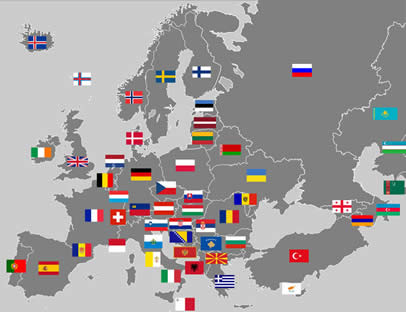
A logical next question: Who else is ready Imageto join the U.S. as a supplier of natural gas produced through fracking? Surprisingly not Europe, even though the EIA estimates it is sitting on an estimated 639 Tcf of shale gas resources, and despite Europe’s growing need for additional natural gas.

The European natural gas market is growing in demand, in part due to the continent’s preference for a cleaner-burning alternative to coal, and in part due to its changing relationship with nuclear power. Europe has a long history of burning coal for heat and power, but well-documented environmental issues resulting from the use of coal have pushed the continent towards natural gas and nuclear energy.

The three largest gas users have very different philosophies regarding the future of energy resources:

  • Germany’s government is bullish on renewable energy;
  • the French government continues to be the largest cheerleader for nuclear power;
  • and the Italian government is encouraging the use of more natural gas.

Supplies come from a myriad of sources: the U.K., Norway, the Netherlands, Russia, Libya, Algeria, and an ever-increasing amount of imported LNG.  Some of these sources are less than perfect, however. Transportation of gas from Libya to Italy was suspended last year during its civil war; Russia has shown a propensity to interrupt deliveries for days at a time to other nations, putting into question its reliability; and U.K. supplies that originally were destined for export to other parts of Europe are now being consumed in the U.K.

Europe is also wrestling with how to adjust its nuclear power industry in the aftermath of the Japanese earthquake and tsunami of March 2011 that caused a large atomic accident at the Fukushima nuclear power plant. Germany has announced that it will exit nuclear power production entirely by 2022. France has taken the opposite tact, and is unwavering in its support of its nuclear industry.

Indirect effects of Fukishima are already hitting the continent. LNG imports were down 34 percent in the first quarter of 2012. Tankers scheduled for Europe were diverted to Japan, where the market for natural gas is more robust and the need very great as a significant amount of nuclear power is simply not returning to the grid.

Why not shale? So, with growing demand and the uncertainty about domestic and imported gas supplies, why is Europe unwilling to embrace shale gas produced by hydraulic fracturing?

The easy answer is that three large obstacles stand in the way of shale gas production in Europe:

  • environmental concerns
  • population density
  • inadequate pipeline capacity to move the gas to consumers

The more complete answer is that it depends on which part of Europe you are talking about.  The UK, France, Germany, Bulgaria, Poland, and the Ukraine house the largest potential shale gas reserves.  But:

  • Environmental concerns have temporarily shut down production in the U.K. after a series of earthquakes was linked to hydraulic fracturing.
  • France outlawed fracking in July 2012 after wine makers and other environmentalists strongly protested the practice  due to concerns over possible ground water contamination.
  • In Germany, ExxonMobile is eager to proceed with test drilling in the states of North Rhine-Westphalia and Lower Saxony, however residents are opposed. According to German news magazine der Spiegel, German Economic Minister Philipp Rosler and Environmental Minister Norbert Rottgen, both oppose hydraulic fracturing.  It would not surprise anyone if Germany also banned fracking.
  • In Bulgaria, citizens replied with a curt “no thank you.”  In January of this year, the Bulgarian parliament withdrew the permit they had issued in 2011 to Chevron to begin development of a shale gas reserve.  Later the parliament went a step further and banned exploration of shale-gas reverses using hydraulic fracturing.

This isn’t to say that shale is completely obsolete in Europe. Next week’s post we will  take a closer look at the European markets that are tapping this resource and why.

Posted in Natural Gas | Tagged , , , , , , , , , | 1 Comment

Why Low Natural Gas Prices Matter A Lot

by Bob Shively, Enerdynamics President and Lead Instructor

U.S. natural gas prices have fallen to lows not seen in a decade and have stayed at the lowest levels we’ve seen in a decade.

As I write this in late October 2012, the Henry Hub price is $3.43, which is at least half what was considered “normal” fall pricing in the last 10 years.  Expectations are that prices will stay well below recent levels for a number of years due to the huge amount of supply that has been made available through exploitation of shale gas and other non-traditional sources of supply.

We have discussed many of these impacts in earlier writing on our blog, Energy Currents.

In May we wrote about how U.S. chemical companies are being buoyed by low prices. And in April we wrote about how the U.S. electric generation mix has dramatically changed and also how the much lower prices in the U.S. relative to the rest of the world may lead to LNG exports.

But, of course, we aren’t the only ones noticing this.  On Oct. 25, the Wall Street Journal published a front-page article titled “Cheap Natural Gas Gives New Hope to the Rust Belt.” The articles discusses how low natural gas prices in the U.S. as compared to other key manufacturing areas in the world (prices in Europe are at least two times higher than in the U.S., and in Japan are threefold), are resulting in significant U.S. expansion of natural gas-intensive industries.  These include chemical, fertilizer, aluminum, steel, and glass industries.  In some regions that assumed manufacturing jobs were gone forever, new facilities are being constructed to take advantage of low natural gas prices.

In case you missed the article, it’s worth passing on a few key quotes from industry personnel:

  • “I never would have expected that as a region we’d have a second chance to be a real leader in American manufacturing.  Suddenly we’re back in the game.” – Bill Flanagan of the Allegheny Conference on Community Development
  •  “The U.S. is now going to be the low-cost industrialized country for energy.” – Philip Verleger, energy economist[1]
  • “It has been a complete 180-degree change in our thought process.” – Steve Wilson, CEO of CF Industries
  • “We convinced ourselves that this is not a temporary thing.  This is a real, durable phenomenon, a potential competitive advantage for the United States.” – Peter Cella, CEO of Chevron Phillips Chemical Company

No doubt we’ve seen low natural gas prices before, followed by price rises.  But many in the energy industry now believe that prices may stay low for a number of years, allowing investments in natural-gas consuming facilities to really pay off.


[1] To hear more of Verleger’s views on how he believes the U.S. can become energy independent, see the YouTube video of a recent presentation at: http://www.youtube.com/watch?v=CTYP14RRfGs

Posted in Natural Gas | Tagged , , , , , , | 1 Comment

How Did U.S. Greenhouse Gas Emissions Hit a 20-year Low?

By Bob Shively, Enerdynamics President and Lead Instructor

Over the last 10 years, we have seen arguments ebb and flow over greenhouse gas emissions and global warming. Not too long ago, federal legislation limiting carbon emissions seemed imminent. Then the economic recession, a move to the right in the House of Representatives, and intensive lobbying and public relations efforts by certain interest groups altered public perceptions, and it appeared the U.S. would not act to reduce carbon output.

But stunningly, the U.S. Energy Information Administration recently released data indicating that carbon emissions have fallen so dramatically over the last few years that emissions in the first few months of 2012 hit levels approximately equivalent to 1992 emissions. This surpasses the dreams of even the most optimistic policy writers who hoped to reduce carbon emissions through legislation.

So has everyone just simply decided on their own to be better environmental stewards? Not likely.  Rather, key contributing factors include:

  • reduced demand due to the economic downturn
  • renewable portfolio standards that have fostered increased renewable electric generation
  • increased energy efficiency efforts
  • replacement of coal-fired electricity generation by gas-fired generation

To know where we stand today, it is important to understand which of the factors are most important and whether they produce long-term or short-term effects. With the following graph we can clearly see the economic downturn is not the primary factor — economic activity measured as Gross Domestic Product (GDP) has grown significantly since 1992 while carbon emissions have returned to the 1992 level.

Using a method called “Kaya Identity” the EIA looks at causes of changes in carbon output:

Here we see a significant impact of the economic downturn in 2009, but emissions have fallen in 2011 (and as current data cited above shows they are continuing to fall in 2012) even as the economic output recovers. The largest bar for factors reducing carbon emissions in 2011 is green, indicating energy intensity. This means we are continuing to produce more economic output using less energy to do it. This is partly due to structural changes where services replace manufacturing in our economy and party due to increased energy efficiency.

We continue this discussion in our Q3 2012 issue of Energy Insider. Read the full article here: http://marketing.enerdynamics.com/Energy-Insider/2012/Q3Electricity.html.

.

Posted in Electricity, Renewables | Tagged , , , , , , | Leave a comment

Costa Rica’s Commitment to a Renewable Energy Future

Inside a wind turbine in Costa Rica

by John Ferrare, Enerdynamics CEO

With more than 90% of its electricity generated from renewable energy sources and goals to reach 95% by 2014, Costa Rica is certainly one of the greenest countries on the planet. It also is on track to become the world’s first carbon-free economy.

I recently returned from a 12-day tour sponsored by Global Renewable Energy Education Network (GREEN) and showcasing renewable and sustainable energy in Costa Rica.With this experience fresh in my mind, I thought I’d take this opportunity to share some of the educational highlights with Energy Currents readers.

Costa Rica: A renewables paradise
Mother Nature has greatly influenced Costa Rica’s commitment to renewable energy. The country is blessed by copious amounts of rainfall – most of the country receives more than 100 inches of rain per year. Thus, it’s no surprise that over 80% of Costa Rica’s electricity is generated by hydro facilities. The country also boasts considerable geothermal power as well as growing wind assets, solar, and biomass facilities.

ICE’s role in renewables
The Instituto Costarricense de Electricidad or ICE (pronounced ee-say) of Costa Rica is the state-owned electric monopoly that provides power to over 98% of Costa Rican homes. While many of the facilities that produce this power are ICE-owned, a small percentage is owned privately under rather non-traditional contracts. In many cases, these facilities are privately owned for a period of 15 years and are then handed over to ICE, which then owns and operates them. After a decade-long break from allowing such projects, ICE recently announced a plan to again accept bids for privately owned renewable projects (100 MW of hydro and 40 MW of wind). The plan intentionally aligns with Costa Rica’s goal of becoming a carbon-free economy.

ICE also implemented a net metering program in 2010 whose goals were, again, to increase renewable energy production and thus the country’s energy independence. The pilot program also allows ICE to study the effects of distributed generation on its grid as well as to promote new renewable technologies.

A countrywide commitment
Costa Ricans are very proud of their renewable and sustainable efforts, which come at a premium price. Average residential rates are over 30 cents per kWh, and this may soon increase. Yet oddly, citizens are not likely to complain. The dedication to a renewable/sustainable society seems to be a shared goal, and the monetary cost of this commitment is widely accepted as are the variables that can affect it.

For example, with such a large portion of electricity needs met by hydroelectric power, the country is hugely dependent upon rain. And in dryer years, as 2012 has so far been, ICE is concerned that it cannot generate enough supply to match demand. Less water means less  hydro power is available. This means costs increase (since power must be purchased from other sources) and so does the amount of power generated from fossil fuels.

The GREEN tour afforded unprecedented access to renewable facilities in Costa Rica. My group and I enjoyed guided tours of hydro facilities, a biomass plant/sugar cane refinery, a geothermal plant, and a wind farm. Not only were we inches from the equipment housed in these facilities (imagine access like this in the U.S.!), but also heard first-hand accounts of how such equipment is run and ICE’s unique perspectives on electricity production.

While GREEN is currently focused on providing this experience to college-level audiences, Enerdynamics and GREEN are discussing a partnership where this unique opportunity could be available to business professionals. For more information, please contact me at jferrare@enerdynamics.com.

Posted in Electricity, Energy Training, Renewables | Tagged , | Leave a comment

Electric Business Understanding: Your Questions Answered

By John Ferrare, Enerdynamics’ CEO

Electric Business Understanding is undoubtedly Enerdynamics’ most popular instructor-led course. (We also offer a similar seminar for natural gas called Gas Business Understanding and another that combines both industries called Gas and Electric Business Understanding). Electric Business Understanding is a two-day seminar that provides participants a big-picture perspective of the business aspects of the electric industry. Topics covered include:

  • Customers
  • The physical system
  • Operations
  • Regulation
  • Restructuring
  • Market dynamics
  • Making money and managing risk

Following are some of the most frequently asked questions we get about this seminar and their answers:

When and where is Electric Business Understanding offered?
Electric Business Understanding is October 15-16, 2012, at the Omni Chicago Hotel in Chicago, and December 5-6, 2012, at the Dupont Circle Hotel in Washington D.C. Enerdynamics’ 2013 seminar schedule will be announced this December and will feature multiple dates/cities in which Electric Business Understanding will be offered in a public setting. We also offer this class customized for companies on site at their locations of choice.

Who is the intended audience for this class?
I’m continually amazed at the diversity among attendees at the public sessions of Electric Business Understanding. Types of companies represented include utilities, marketers, IPPs, financial services, regulators, technology companies, transcos, legal professionals, and co-ops among others. In short, anyone in the electric industry or selling services to the electric industry can greatly benefit from this seminar.

When is the best point in an employee’s career to attend this class?
The range of prior experience we see in this class is vast. In the same session I met someone who was in her second week on the job and a utility person who has worked for the company for 10 years. Ideally this class is for those with six months to a year of industry experience, though we often see industry veterans who take this course as a refresher or to get current on industry trends. Those with less than six months of experience can still benefit but tend to be a bit overwhelmed as they have yet to learn what they don’t know! I’ve also seen people attend this class twice, once when relatively new and again after a few years. They consistently tell me it was worth their while to attend again, and that they got different things out of the course a second time.

Why is it important for employees to understand the big picture?
Many industry employees have had long and successful careers while never understanding the big picture. But when they attend a class like Electric Business Understanding, all of a sudden things that never made sense suddenly do. And, more importantly, these people understand how they fit in and how what they do affects other areas of the business. I can’t count the number of times I’ve heard an attendee say “I wish I’d had this when I started at my company.” So while it’s possible to be effective without the perspective a class like this can provide, it’s likely that employees will be even more effective when they understand the big picture. And that makes employees considerably more valuable.

Don’t most companies offer this type of training internally?
Surprisingly, no! We work with some of the biggest utilities in the U.S. and not one of them offers a business acumen class like Electric Business Understanding. When they hire us to teach it at their facility, the course is more often than not full with a substantial waiting list. Perhaps in the past utilities and other electric business companies have expected that employees will pick this knowledge up on the job. However, with the lightning-fast pace of today’s electric industry and the huge turnovers happening now and in the future, I think this expectation is no longer practical. So for many companies it makes sense to hire out to a company such as Enerdynamics to handle this important educational component.

More questions about this or other classes we offer? Email me at jferrare@enerdynamics.com. Or you can call our office at 866-765-5432.

Posted in Electricity, Energy Training | Tagged , , , , , | Leave a comment

Energy Management Applications Any Organization Can Afford

By Ashley Halligan, an analyst at Software Advice and
guest blogger for Energy Currents

As consumers seek awareness in terms of their energy consumption — both residential and commercial — new technologies are showing up across the market to perform a wide variety of energy-related functions.

Measuring usage, identifying inefficiencies, suggesting upgrades, benchmarking overall performance, and even gamifying consumption habits to encourage more responsible behaviors — these functions provide a vast insight to environmental performance. Some software companies offer suites including functions for all sorts of metrics. Application developers are creating applications to meet very specific needs, and some are quite affordable. Here are three that any organization could benefit from:

Melon Power is an application recently awarded second-place in the EPA’s Apps for Energy contest designed to address the White House’s recent Call to Action deemed “Green Button.” Green Button encourages energy suppliers to make consumption data more accessible to its customers, and with 12-month benchmarking data, the app allows users to input that data and then calculates and reports an ENERGY STAR score.

Another app, HVAC ASHRAE 62.1-2012, performs an entirely different function: It measures air quality and determines whether a commercial building is operating within minimum ventilation standards determined by ASHRAE.

Lastly, ecoInsight Mobile Audit for iPad acts as an energy audit tool capturing user-inputted performance data while doing a building walkthrough. Once the data is uploaded to
ecoInsight’s site, the application analyzes it and provides feedback and upgrade suggestions to its users.

Apps like these, ranging from $19.99 to $500 — or in some cases free altogether — demonstrate that any organization, with or without investment capital to commit to energy management tools, can implement some form of technology.

Read more about these applications and the White House’s Call to Action on the Software Advice blog: 3 Energy Management & Environmental Performance Apps Any Organization Can Afford.

Posted in Electricity, Energy Training, Renewables | Tagged , , , | 1 Comment

Is Solar Power (Once Again) Really On Its Death Bed?

by Bob Shively, Enerdynamics President and Lead Instructor

To hear some folks talk, solar power is a dying industry.  We’ve seen this story before, they say: Remember the Jimmy Carter administration?  And how Ronald Reagan took the solar panels off the White House?  And after the 1970s how solar was only a demonstration technology for the next 40 years?  To back this argument, they point to numerous bankruptcies and closures of solar manufacturers.  Indeed the Wall Street Journal recently reported that “since August 2011, at least 30 North American and European solar manufacturers have run into trouble, taking more than 2,700 MW of capacity offline.”[1]

But it may be a bit premature to plan on solar’s demise.  A big part of the current difficulties is simply the growing pains of any industry in its infancy.  How many computer manufacturers have come and gone in the last 20 years? And the same Wall Street Journal article referenced above states that even if every North American and European manufacturer of solar panels shut down, there would still be more manufacturing capacity in the world than last year’s worldwide demand of 27,000 MW due to robust manufacturing capabilities in Asia.

The result is severe price competition, which makes it tough for manufacturers but drives down prices for consumers.  Rather than stifling demand, it grows it.  Following is a graph showing how quickly photovoltaic solar costs have fallen:

       Source:  Presentation by U.S. Secretary of Energy Steven Chu[2]

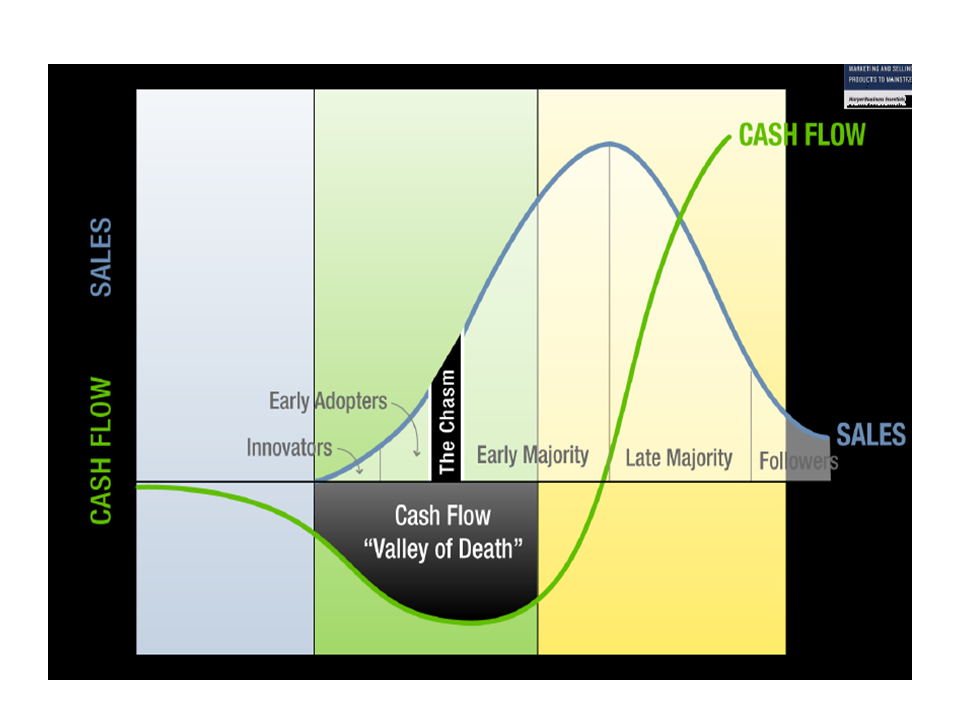
Secretary of Energy Steven Chu, admittedly a supporter of renewables, believes that solar photovoltaics are currently crossing the chasm as described in Geoffry Moore’s popular business book of that exact title, “Crossing the Chasm”:


        Source:  Presentation by Steven Chu previously cited 

But other more hard-nosed businesses are joining the solar bandwagon.  The largest private installer of solar power in the U.S. is none other than Wal-Mart.  The profit-minded retailer expects to have more than 90 MW of solar capacity installed by the end of 2012.  According to Marty Gilbert, Wal-Mart’s Director of Energy: “We are trying to show folks that you can not only pursue these sustainability initiatives, they also make business sense.”[1]

In these times of potential rapid change, no one can predict the future.  But Chu likes to quote the one-time President of Michigan Savings Bank who told Henry Ford’s lawyer that “The horse is here to stay, but the automobile is only a novelty – a fad.”   Only the future will tell us who is right! 


[1] August 16, 2012 in the Overheard column of the Wall Street Journal

[2] Energizing American Competitiveness in Solar Technologies, presented by Steven Chu June 13, 2012 available at: http://www1.eere.energy.gov/solar/pdfs/sssummit2012_plenary_chu.pdf

[3] Bloomberg: Wal-Mart Beats Apple, Ikea in U.S. Solar Installations, available at: http://www.bloomberg.com/news/2012-07-30/wal-mart-beats-apple-ikea-in-u-s-solar-installations.html

Posted in Renewables | Tagged , , , , , , , | 2 Comments