Renewables Drive Western Electricity Markets to Real-time Competition

by Bob Shively, Enerdynamics President and Lead Instructor

Quietly, but seemingly inexorably, U.S. wholesale markets continue to march toward higher levels of competition. Later road with solar and windthis year, Entergy will bring its 35,000 MW of load into the Midwest ISO (MISO).  And an announcement last week indicated that years of discussion are culminating with the beginning of integrating California’s ISO into broader western markets. The joint announcement[1] between the California ISO (CAISO) and PacifiCorp, the Oregon-based utility company with a footprint covering parts of six western states, said that PacifiCorp and CAISO will work together to create a real-time energy imbalance market that will be facilitated by CAISO.

Why real-time market is needed
The need for an integrated real-time market is driven by development of renewable electric supply sources. Rapidly developing wind and solar resources are variable (meaning their output varies depending on meteorological conditions), not fully predictable (meaning that actual output is uncertain, even looking forward in as short a time frame as 15 minutes), and not fully dispatchable (meaning that the system operator may not be able to control a unit’s output).  These characteristics make wind and solar more difficult for system operators to integrate onto the grid than most traditional generation because as output from wind and solar varies, supply must be provided from other flexible units such as hydro, natural gas turbines, or partially loaded coal plants.

If you look at statistics for growth of renewables, you will see that most has occurred in regions with an ISO[2].  Key reasons for this include larger balancing areas that allow variability to be balanced over a larger footprint and the existence of real-time markets.  The large exception to ISO-based development is the portion of the Western Electric Coordinating Council (WECC) that is not covered by the CAISO.  Such development has caused problems for system operators because absent a real-time market, generator schedules are set hourly.

Generators who vary from their hourly schedule are required to pay often significant balancing charges.  These charges ostensibly cover the cost of the system operator dispatching its own units to balance during the hour, but do not provide any opportunity for other market participants to provide the service at a lower cost.  And absent a market that allows other generators to participate, system operators who find themselves without enough flexibility must depend on generator curtailments to balance the system. This has resulted in significant curtailment of wind power in the Bonneville Power Administration (BPA) area that is the current subject of a FERC complaint as well as lawsuits[3].

These problems do not occur where there is an ISO because ISOs run real-time markets with dispatch signals based on market prices sent to willing market participants every five minutes.  The result is that as renewable supply varies, generators correct the problem by ramping up or down in response to market price signals.  Wind and solar generators benefit because they don’t have to pay high costs of inflexible hourly scheduling rules. Consumers benefit because they can obtain low variable cost renewable power whenever it is available.

The Western Energy Imbalance Market
Various western system operators have been discussing how to handle real-time variability for years.  Since the west is broken up into many different system operators, real-time balancing has been an issue.  Last week, the discussions resulted in a memorandum of understanding between PacificCorp and CAISO to implement an Energy Imbalance Market (EIM) that will allow generators on the 10,600 MW PacifiCorp system to directly participate in expanded CAISO real-time markets. The result will be real-time optimization of generation dispatch across both organizations regions using a market pricing.  The expected result is lower balancing costs for all market participants including wind and solar.

What does this mean for the future?
Inevitably, such an agreement raises the question: Will we see movement to a larger ISO in the west much as MISO and PJM grew in the Midwest and East?

Both PacifiCorp and CAISO were quick to say they weren’t forming a larger ISO, simply integrating real-time markets. But certainly this could be a first step. Reportedly there are ongoing discussions with NVEnergy for Nevada to also join the EIM, and, if the initial steps prove successful, BPA will feel strong pressure to also join. Will this eventually result in integration of other markets such as day-ahead energy and ancillary services? That remains to be seen, but it certainly could be a long-term outcome.  In the meantime, both renewable generators and consumers in PacifiCorp’s region should benefit.


References

Posted in Renewables | Tagged , , , , , , , , | 2 Comments

How Could the Lights Go Out at the Super Bowl?

Louisiana Superdome by night

Louisiana Superdome by night (Photo credit: Wikipedia)

by Bob Shively, Enerdynamics President and Lead Instructor

When I worked for Pacific Gas and Electric Company (PG&E) in the late 1980s, the San Francisco area hosted a classic World Series in which the San Francisco Giants played against their cross-bay rivals the Oakland A’s.  Going into the Series, PG&E spent significant time and energy ensuring reliable power to both stadiums.  My friend and co-worker Bill (whose last name shall remain anonymous), was the account representative for the Giants’ stadium, Candlestick Park. Just before the series began, he was quoted in the company newspaper saying it was virtually impossible for the stadium to lose power.

Sadly, the Loma Prieta Earthquake struck just prior to Game 3, and power at the stadium immediately went out due to loss of transmission into the area.  In the following days as PG&E struggled to restore power throughout the area, we were all reminded that power supply is never 100% reliable no matter how much time and money is spent on engineering and infrastructure.

Flash forward 23 years, and half of New Orleans’ Superdome lost power just after halftime of the Super Bowl. Players were forced to wait on the sidelines for 35 minutes before power could be restored. As the root-cause investigations go forward, we are beginning to learn what caused the outage. According the local utility Entergy’s press release:

Entergy New Orleans, Inc. announced today that it has traced the cause of Sunday’s outage to an electrical relay device.

The device was specifically installed to protect the Mercedes-Benz Superdome equipment in the event of a cable failure between the switchgear and the stadium.

While the relay functioned without issue during a number of high-profile events – including the New Orleans Bowl, the New Orleans Saints-Carolina Panthers game, and the Sugar Bowl – during Sunday’s game, the relay device triggered, signaling a switch to open when it should not have, causing the partial outage.

This device has since been removed from service and new replacement equipment is being evaluated.[1]

So what is a relay, and how could it cause an outage?  A relay is a device that automatically signals a breaker to open when the relay senses an unsafe power condition such as too high a current, too high a voltage, reverse power flow, too high a frequency, or too low a frequency.  Breakers interrupt the flow of power to prevent potentially harmful problems from occurring in electrical systems. Relays are used to protect equipment within a premise and/or to protect the utility lines serving a premise.  Modern protective relays such as the one at the Superdome are microprocessor-based digital relays, meaning that software within the processor on the relay is used to determine when to open the breaker.

This raises the question of whether the protective relay opened when it shouldn’t have due to a manufacturing defect, incorrectly programmed software, an external hack of the software or whether there was indeed a power condition that resulted in the relay properly opening the breaker.

The answer to this question has not yet been definitively announced. But the manufacturer of the relay, S&C Electric Company, stated on Friday that the relay opened the breaker as “a result of the electric load current exceeding the trip setting for the switchgear relay as set by the system operators. Based on the onsite testing, we have determined that if higher settings had been applied, the equipment would not have disconnected the power.” [2]

Assuming the relay functioned properly, what could have caused the outage? One answer is simply that the relay was programmed with a wrong tolerance that was set too low. Loads in the stadium were apparently well below the capacity of the circuits since the circuits are designed to carry heavy air conditioning loads in the summer. The Beyonce halftime show was apparently powered primarily by standby generators within the stadium.  But at least one unofficial comment has suggested that some such outside power sources may have been connected into the stadium electrical system.  We don’t know if this is true, but if so, this certainly could have caused a power condition that propagated itself back to the relay, in which case the relay would have properly opened based on what appeared to be a fault or other problem with the internal system. So a second explanation could be power quality issues occurring inside the stadium.  And although there has been nothing to suggest that this occurred, microprocessors do have the potential of being hacked if they are connected to the internet.  This means that a third explanation could be that someone accessed the software on the relay remotely and maliciously changed the settings. This seems unlikely, but not impossible.

We’ll have to wait for more analysis to find out why the relay acted.  In the meantime, we are reminded again that no power supply can ever be expected to have 100% reliability.

Posted in Electricity | Tagged , , , , , , , | 1 Comment

Natural Gas Pipeline Safety: A Crisis or a Manageable Issue?

by Bob Shively, Enerdynamics President and Lead Instructor

San Bruno, Calif.; Allentown, Pa.; Sissonville, W.V.; Cleburne, Texas. Listening to the gas pipe signmedia coverage on towns impacted by natural gas disasters, it seems believable that the 230,000 miles of gathering lines, 300,000 miles of transmission lines, and 2 million miles of distribution lines that comprise the U.S. natural gas pipeline system are an underground menace waiting to explode.

Government reports indicate that more than half of our nation’s pipelines are over 50 years old.  And under quirks of federal safety regulations, these pipes are not subject to as stringent testing and monitoring as newer pipelines.  This brings to mind certain questions:

  • Should we all be living in fear of getting caught in the next explosion?
  • What can be done about the risks?
  • Assuming something can be done about risks, what barriers are keeping steps from being taken?

A deeper look at answers to these important questions follows.

Should we all live in fear?
In short, no. Statistically, pipeline transportation is significantly safer than either automobile travel or air travel. Annual deaths due to pipeline explosions are dramatically lower than deaths due to other common transport accidents including automobile, rail, and air.  Data collected by ProPublica indicate that pipeline incidents have decreased in the last decade[1].  Regardless, even a few deaths a year are too many, and operators of pipelines must grapple with how to make their infrastructure safer. Executives of these companies have heard the news; in recent surveys of what worries natural gas executives the most, safety always comes at or near the top.

So what can be done about pipeline accidents?
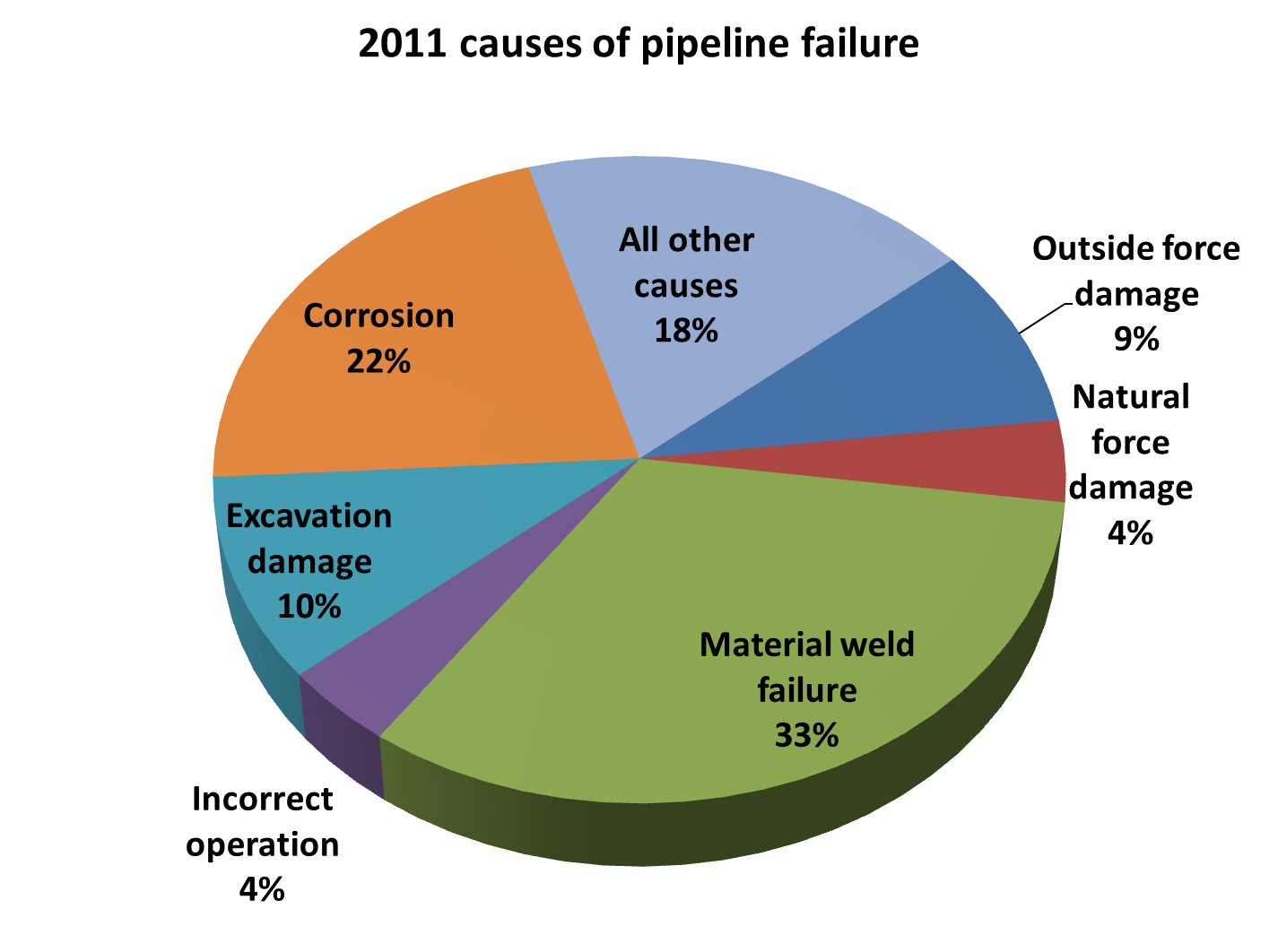
First we must understand why pipeline accidents occur.  Key factors resulting in pipeline accidents include weld failures, corrosion, excavation damage, and outside force damage.

pipeline failure pie chartSource: http://projects.propublica.org/pipelines/

Excavation and outside force damage will never be 100% preventable, but it can be reduced through clearly marking pipelines as well as through educating the public and those involved in the construction trades. Greater difficulty is involved in reducing incidents due to pipe corrosion and historic bad welds long-buried underground and left unidentified until pipes fail. These require expensive testing, and when a problem is identified they require expensive pipeline replacement.

Many older pipes were not built to allow for in-pipe testing through use of a device called a pig.  This means that if testing is to occur, pipes must be excavated or expensive retrofitting or other specialized techniques must be used[2].  And testing often requires a large segment of customers be taken out of service while testing occurs.

An additional or alternative strategy is to make pipelines more resilient when accidents do occur.  Examples include:

  • installing more remote data communication between pipelines and their operators to inform operators more quickly when something goes wrong
  • installing more remote controlled valves that allow operators to quickly shut-down flows if needed

In many cases today, operators receive only limited operational data from their pipelines and require field crews to be dispatched to operate valves and other equipment.

What is impeding rapid implementation of safety improvements?
From an operational standpoint pipelines need first to improve data and information on exactly what they have in the field.  It sounds strange to the general public, but since many pipelines have been in the ground for 50 years or more, data on pipeline conditions and even exactly what was exists underground may be lacking.  So before major improvement initiatives can be planned, pipelines must work to improve their asset knowledge. This takes time and is expensive, so pipelines prioritize and first inventory pipe in high-consequence areas.

Testing of pipelines also takes lots of time, is expensive, and can result in customer outages. Simply upgrading asset knowledge and testing can run in the hundreds of millions of dollars for a pipeline system. Lastly, once conditions are known, pipelines must decide where to best spend dollars to upgrade pipeline safety characteristics.  Pipelines use analysis of conditions, threats, and potential consequences to evaluate risks for specific sections of their system. Then pipelines must develop mitigation strategies to address the high-risk areas. This too is expensive. PG&E, for instance, has spent $2 billion+ in safety upgrades to its system since the San Bruno incident.

One last obstacle is the lack of trained personnel available to handle the projects identified and approved. In fact, almost all pipelines are staffed by numerous employees reaching retirement age.  Most pipelines are destined to lose over half their experienced workforce in the next five to 10 years. Pipeline companies must hire and train numerous new employees at the same time that major new safety initiatives need  implemented[3].

So while pipeline risk cannot be fully eliminated, it can be mitigated.  This takes a lot of money, which leads to the question: Who pays for this?  Often the media and public blame the pipeline companies and suggest their shareholders must carry the burden. But this answer does not reflect the reality of how the pipeline business is regulated and how costs are borne. As long as pipeline owners have prudently followed their regulatory mandates, the form of regulation used in the U.S. says that pipelines are allowed to pass their costs of doing business on to customers.

In fact, most pipelines’ and utilities’ profits are not tied to cutting costs but rather are based on a return on investment in capital facilities. So unless the pipelines can be proven negligent or imprudent, new pipelines’ expenses to cover safety upgrades are going to be paid by consumers not shareholders.  This leaves regulators with an uncomfortable decision to make: They get to decide just how much of consumers’ money should be used for safety upgrades. This is a question that regulators across the U.S. will deal with in the coming years.  In the meantime, the gas pipeline owners will be working diligently to implement improved safety measures while hoping their systems are not the next to make the news.

References:

[2] For an example of some of these techniques, see the video at: http://www.pge.com/myhome/edusafety/systemworks/gas/pipelinesafety/camerainspection/index.shtm

[3] Enerdynamics has recently partnered with a major gas pipeline/utility company to develop Gas System Fundamentals training programs to facilitate rapid in-boarding of new field force and engineering employees. If you are interested in learning more about what we’ve developed, please contact us at 1-866-765-5432.

Posted in Natural Gas | Tagged , , , , , , , | 1 Comment

Will the United States’ Romance with Natural Gas Continue in 2013? Part II

by Bob Shively, Enerdynamics President and Lead Instructor

In last week’s post we discussed natural gas supply and demand as well as pricing, all factors that must be considered when examining whether natural gas will continue the popularity it enjoyed in 2012. This week we continue the discussion by looking at how exports, the environment,  infrastructure, and global perspectives affect the rise or fall of natural gas in the U.S. in 2013.

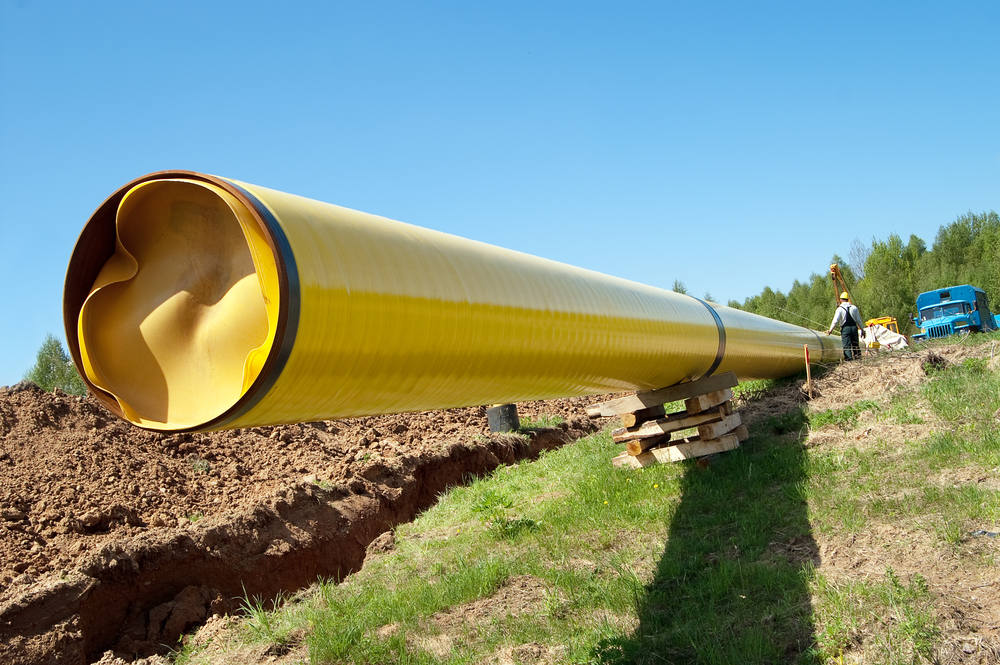
Installation of a gas pipeline

Installation of a gas pipeline

Exports
While gas prices in the U.S. have hovered below $4/MMBtu lately, prices in Europe are typically above $10 and in Asia above $12. This price difference, coupled with robust U.S. supply and a fleet of unused import LNG terminals, has become a clear recipe for natural gas exports. The U.S. Department of Energy recently released a report that concluded that exporting LNG would have broad benefits for the U.S. and would only minimally impact domestic natural gas prices [1]. Although the report’s conclusions are being disputed by industrial consumers who fear higher prices, it appears likely that the U.S. will approve numerous projects to convert LNG terminals for export capability. Most projects won’t be ready for exporting in 2013, but this will result in significant infrastructure spending next year.

Environmental issues
While natural gas has provided significant environmental benefits in shifting generation from coal to gas, and has the potential to do the same for shifting oil consumption to natural gas in transportation, the industry has failed to get the support of many environmental organizations and much of the public. Likely 2013 will be a year where concerns over fracking come to a head. Expect to hear a well-orchestrated campaign against fracking coming from some interest groups along with strong public concerns. More stringent regulation is likely, but it appears highly unlikely that concerns will lead to much slowdown in fracking activity. The benefits for the economy and the environment appear too great for fracking to be shut down.

Infrastructure
Additionally, 2013 will be a year for billions of dollars of infrastructure investment. We have already discussed LNG export facilities. But even more money will go into pipeline expansions to move new shale gas production to markets and for safety upgrades in the transmission and distribution network. For example, the local distribution company in northern California, PG&E, is in the middle of a three-year, $2.2 billion pipeline enhancement project [2]. Indeed, a Black and Veatch study on the natural gas industry showed that safety is the most important long-term issue across all sectors of the industry [3]. The need for such significant infrastructure will also lead to a need for workforce development as many of the experienced workers who built the last wave of infrastructure have now hit retirement age.

The global outlook
The future of gas is not only rosy in the U.S. Economies throughout the world are looking to gas to provide low-cost and clean fuel to drive hopeful future economic growth. Indeed, Exxon Mobil has forecast that natural gas consumption will overtake coal as the No. 2 fuel in the world by 2025, a mere 12 years from now [4]. Gas’ growth internationally has been held down by two factors. Significant gas reserves are not located near the large economies of Asia and Western Europe, requiring expensive infrastructure investments for multi-national long-haul pipelines or LNG projects. This has led to the second key factor, which is producers’ ability to insist on long-term contracts with prices pegged to oil prices. The result is natural gas prices being significantly higher than in the U.S. and less competitive with other fuels. Whether this will change remains to be seen.

Conclusions
Amazingly for an often pessimistic industry, the aforementioned Black and Veatch survey found that 92% of respondents were optimistic or very optimistic about the industry’s future growth. Yes, it appears that natural gas is likely to bloom at least in the near future. But as with all relationships, history tells us nothing is certain!

References:

1.  http://www.fe.doe.gov/programs/gasregulation/reports/nera_lng_report.pdf

2. PG&E Files Milestone Plan to Modernize, Improve Safety of Gas Pipeline System: http://www.pgecurrents.com/2011/08/26/pge-files-milestone-plan-to-modernize-improve-safety-of-gas-pipeline-system

3. 2012 Strategic Directions in the U.S. Natural Gas Industry http://bv.com/survey/2012-natural-gas-report

4. The Outlook for Energy, a View to 2040 http://www.exxonmobil.com/Corporate/files/news_pub_eo.pdf

Posted in Natural Gas | Tagged , , , , , , | Leave a comment

Will the United States’ Romance with Natural Gas Continue in 2013? Part I

by Bob Shively, Enerdynamics President and Lead Instructor

Last year — 2012 — was the year that the U.S. fell back in love with natural gas. Prices stayed below a very reasonable $4/MMBtu even as demand grew.  Power  producers switched from coal to gas so rapidly that the percent of U.S. power  generated by coal fell from 44% to 37% while gas generation rose from  25% to 30% in just one year.

Numerous  large industrial gas consumers made long-term commitments to new facilities in  the U.S. based on belief in long-term reasonable gas prices.  And although it received relatively little  fanfare during a news cycle dominated by the presidential election campaign,  gas was largely responsible for the fact that U.S. energy-related greenhouse gas emissions are now at the lowest level since the mid-1990s.

So how does the future look for 2013? Will the romance continue, or will the  blossom start to fade as the relationship deepens?  Several factors must be considered as we attempt  to address these questions. This week I’ll look at issues of supply and demand as well as price. Next week I’ll conclude this discussion by examining  exports, the environment,  infrastructure, and global perspectives.

Supply and demand
Natural gas production in the U.S. is at an all-time high.  And current projections from the U.S. Energy  Information Administration are that natural gas production will continue to  grow significantly.  Often in the past,  production has fallen in periods of ongoing low prices as producers reduce  drilling.  Is it different this time?  Many observers say maybe yes.  Factors include improved drilling and  production techniques that allow gas to be produced at lower costs, investment  in production by consumers, the production of gas as a by-product of drilling  motivated by oil or natural gas liquids production, and the potential for growing domestic and export demand.

Source: AEO 2013 Early Release Overview (http://www.eia.gov/forecasts/aeo/er/early_production.cfm)

Demand is also expected to grow. While residential and commercial demand may be relatively static, industrial and power plant demand should be robust as long as price levels remain reasonable. Manufacturers of steel, machinery, chemicals, and fertilizers now have energy costs in the U.S. that are dramatically lower than costs in the other developed economies. According to the Wall Street Journal, Dow Chemical has compiled a list of 102 big new manufacturing investments in the  U.S. that are due in part to low natural gas prices [1].  And many coal generating units, which have traditionally bumped gas generation  out of the market, are going to be permanently closed. This will result in a  permanent shift to gas generation even if prices rise. And lastly, there is the  possibility of growing use of natural gas for transportation including fleet vehicles and long-distance trucking [2].

Price
Natural  gas prices in the U.S. have remained at low levels for the last three years.

Source: http://www.eia.gov/dnav/ng/hist/rngwhhdw.htm

Given the current robust supply, futures prices reflect a market expectation that  prices will remain low.  In fact, futures prices currently remain below $5/MMBtu until December 2018. But could we be fooled? It has happened before. Already contrarian investor’s websites can be  found saying a cold winter and reduction in drilling rigs could result in a  significant price rise. But given the  current dynamics of the market this seems unlikely. Energy expert Daniel Yergin was recently quoted as saying that both demand and supply can grow for at least a couple of  decades before we see significant gas price increases [3].

Look for next week’s post to continue the conversation as it relates to exports, the environment,  infrastructure, and global perspectives.

References
1. Export U.S. Gas, Yes or No?, Wall Street Journal, November 15, 2012 http://online.wsj.com/article/SB10001424127887324595904578121242654761004.html

2. See All Roads Lead to Natural Gas-Fueled Cars and Trucks, Forbes, December 15,  2012 http://www.forbes.com/sites/kensilverstein/2012/12/15/all-roads-lead-to-natural-gas-fueled-cars-and-trucks

3. See same WSJ article cited above

Posted in Natural Gas | Tagged , , , , , , , | 1 Comment

Electricity Holds the Key to U.S. Energy’s Future

By Bob Shively, Enerdynamics President and Lead Instructor

As we enter 2013, it is clear that  electricity is becoming the dominant form of energy that will drive society’s  future. Exxon forecasts that between now  and 2040, electricity will account for more than half of the growth of global  energy demand [1].  And in the U.S., the Energy Information Administration (EIA) forecasts that electricity use  will grow by 24% in that same period. Natural gas also is forecast  to grow significantly, but much of this is due to growth of natural gas as a  fuel for electric generation.

                  Source:  EIA Annual Energy Outlook 2013 Early Release Reference Case

So with electricity destined to increase in importance, what can we expect to see in the electricity industry in 2013? We’ll explore various issues including the  generation mix, energy efficiency and demand side management, infrastructure,  the environment, and the slow but seemingly inexorable movement to more  competitive markets.

Generation
The pace of change in the U.S. generation mix in 2012 was  stunning. Coal generation dropped  significantly to just 37% while natural gas generation increased to 30%. Renewables also continued growth driven by state renewable portfolio standards and decent economics for wind power.

              Source:  EIA Short-term Energy Outlook December 2012

Given this information, what should we expect in 2013? Much of the natural gas generation increase  was due to low natural gas prices which pushed the variable cost of gas units  below that of coal. So whether this  trend entirely continues depends on the price of natural gas. As discussed in our companion natural gas Energy Insider article, current futures prices for gas indicate a market expectation of  continued low prices. Also a factor will  be permanent retirement of numerous coal units, a trend that is expected to  continue in 2013 [2]. Despite the current uncertainty of whether  production tax credits will be extended for wind power and the possible  reduction in new projects, actual output for renewables will continue to  increase as projects completed in 2012 come online.

And although newer technologies won’t have  much effect on the overall generation mix, 2013 will be a good time to learn  more about possible future electric supply options. Two IGCC (integrated gasification combined-cycle) units are slated to come online in 2013 [3],  construction will continue on five new nuclear units, and numerous  demonstration projects will test storage technologies.

Energy efficiency and demand side management
Energy efficiency (reducing demand across all usage) and  load management (reducing demand during peak times) are increasingly  important in the U.S. The result is that efforts on the demand side reduce the  amount of generation that must be built.  EIA data shows that by 2010, over 33,000 MW of generation construction  was avoided due to energy efficiency and load management.

Source: U.S. Energy Information Administration, Form EIA-861, “Annual Electric Power Industry Report.”

Data from the North American Electric Reliability Corporation (NERC) indicates that this trend will continue in 2013 and beyond with just load  management growing to almost 50,000 MW by 2017 (that means at least 250 peaking units do not have to built due to this resource). We expect that more and more utilities  and ISOs around the U.S. will decide to  rely on this low-cost resource especially as new technologies make it easier to implement programs and access controllable loads [4].

  Source: NERC 2011 Long-term Assessment

Infrastructure
Infrastructure spending will continue at a high pace in 2013, with a focus on transmission expansion and distribution upgrades. Hopefully 2013 will  be the year in which the term smart grid can be retired and we will simply begin talking about equipment upgrades (just like everyone talks about upgrading their cell phones!). Smart meter deployments will continue with  the number of smart meters likely rising beyond 30% of all consumers.

Source: U.S. Energy Information Administration, Annual  Electric Power Industry Report

But perhaps more important in the shorter term is the  deployment of modern technologies in transmission, substation, and distribution  facilities. While little noticed by the  public, deployment of technologies such as Phasor Measurement Units (PMUs), Flexible AC Transmission Systems (FACTs),  various transmission and distribution automation devices, and systems providing  volt/var optimization, feeder load balancing, and dynamic outage response will  fundamentally improve the efficiency and reliability of the electric grid.

Environment
With the re-election of President Obama and other “green” candidates in state races, we can expect that protection of the environment  to continue as a key issue in 2013.   We have already explored many of the key points in recent blog posts on Energy Currents [5],  so won’t repeat the discussion here. But  our expectation is that virtually all decisions in the electricity industry  will be made in the context of how they impact environmental impacts and  environmental regulation obligations.

Competitive markets
While certain areas of the country seem content continuing  with the monopoly utility model, the role of competitive markets in electricity  quietly grows. The amount of  power trading in wholesale markets  under an ISO — currently about two-thirds of U.S. power — will swell at the end of 2013 as the 35,000 MW of Entergy loads joins the  Midwest ISO [6]. And although not an implementation of an ISO,  the Western Energy Coordinating Council (WECC), which coordinates the western  grid, is moving forwards with implementation of a competitive real-time  balancing market [7].

Meanwhile on the retail side, markets in  specific states continue to grow with significant activity in Texas, Maine,  Pennsylvania, Illinois, Maryland, Connecticut, Massachusetts, New Jersey,  Delaware, New York, and Ohio.  And as  reported by the Distributed Energy Financial Group (DEFG) [8],  retail services have shifted focus from just providing the lowest possible rate to providing the most innovative services. As  stated by DEFG in a recent e-mail, these include “fixed-price contracts,  month-to-month pricing, time-of-use pricing with no-cost hours (or days),  prepaid energy with daily notifications about usage, green power for electric  vehicle charging, mobile applications to control thermostat settings, and  advanced analysis of personal usage with customized suggestions about reducing  electric bills.”

Conclusion
As we enter 2013, we can conclude that the electricity  industry will continue to grow and evolve in interesting ways. And as we commonly remind our audiences, much of the future change will be driven by a new workforce as  industry veterans hit retirement age. This means that for those of you on the younger side of the industry,  there will be plenty of opportunity to help drive the retooling of a critical societal  resource.


References

1. The Outlook for Energy, a View to 2040 http://www.exxonmobil.com/Corporate/files/news_pub_eo.pdf

2. For more information, see: http://www.eia.gov/todayinenergy/detail.cfm?id=7330

3. See: http://www.mississippipower.com/kemper/home.asp and http://www.duke-energy.com/about-us/edwardsport-overview.asp

4. See our earlier Insider, The Impact of Demand Side Management on Wholesale  Electricity Markets http://marketing.enerdynamics.com/Energy-Insider/2012/Q2Electricity.html

5. See Climate Change and Greenhouse Gas Emissions Back on Agenda in the U.S. https://blog.enerdynamics.com/2012/12/07/climate-change-and-greenhouse-gas-emissions-back-on-agenda-in-u-s

and Uncertainty in Clear Air Rules Continues to Impede  Planning  https://blog.enerdynamics.com/2012/09/05/uncertainty-in-clean-air-rules-continues-to-impede-planning

6. See: https://www.midwestiso.org/WhatWeDo/StrategicInitiatives/Pages/EntergyInitiative.aspx

7. See: http://www.wapa.gov/rm/PMcontractRM/Meeting%20Transmission%20Challenges/11%20-%20Xcel%20Proposed%20West-Wide%20Energy%20Imbalance%20Market%20-%20Joe%20Taylor.pdf

8. See: http://www.defgllc.com/Assets/downloads/abaccus-2012-executive-summary.pdf

Posted in Electricity | Tagged , , , , , , , | Leave a comment

Renewables Development in the Emerging World May Lead to a New Energy Paradigm

By Bob Shively, Enerdynamics President and Lead Instructor

Do a Google search for renewable power and you will find thousands of links to sites covering renewable power development in the U.S. and in Europe. But outside of China and maybe India, you solar panels in Egyptwon’t find much about renewables development elsewhere. Interestingly, recent years have seen significant renewables development in other parts of the world, and there is no reason to believe the trend won’t continue in 2013.

According to CleanTechnica, more new wind and solar projects were installed in the developing world in 2011 than in the developed economies [1]. And over time, the developing world may become the leader in driving renewables forward. As we enter 2013, let’s turn our attention away from the U.S., Europe, China, and India to take a look at how renewables are developing in some other key countries.

According to Ernst and Young’s Renewables Energy Attractiveness Indices [2] emerging economies in the top 40 include Brazil, Romania, Poland, South Africa, Mexico, Morocco, Turkey, Ukraine, Egypt, Tunisia, Israel, Argentina, and Chile. Let’s take a look at a few developments in emerging countries and see how new ideas may come from seemingly unlikely places.

Morocco
According to a recent report on the CleanTechnica blog, Morocco has more stringent renewables goals than the State of California. Morocco plans to build 2,000 MW of wind and 2,000 MW of solar by 2020. Based on current demands and the current annual 6% growth rate of demand, this will represent about 50% of demand if completed as planned. And if you are wondering if this is just talk, Morocco put out an 850 MW wind power RFP earlier this year and successful bidders are already signing contracts [3].

United Arab Emirates
Many Middle Eastern countries have begun to realize that using their precious petroleum reserves for electricity generation may not be the best strategy. An example is the United Arab Emirates, where the emirate of Abu Dubai has set a goal to produce 7% of its electric supply from renewables 2020. But more interesting is Abu Dubai’s plans to develop Masdar City as the world’s first zero carbon community. Plans also call for making the city a global hub for renewable energy and clean technologies [4].

The Mediterranean Solar Plan and DESERTEC
In addition to renewables development focused on serving domestic electric needs, emerging economies may also find renewables development for export a fruitful area. The European Union in 2008 launched the Mediterranean Solar Plan [5] with the goal of developing 20 GW of solar power in countries such as Algeria, Egypt, Libya, Morocco, and Tunisia. Even longer-running have been the efforts of the DESERTEC Foundation dedicated to finding the best locations for developing renewables [6]. DESERTEC preaches that the world’s deserts can create solar power greater than 160 times the current world demand. Coupled with a transmission grid built to move the power to load centers, they believe the world’s energy sources could be transformed.

The future will be interesting
These are just a few examples of interesting efforts going on around the world. Will all of them come to fruition? Certainly not. But it is hard to believe that somewhere there isn’t the gist of a whole new way of thinking that will completely change the way the world looks at energy. And implementation of those ideas may not come from the U.S., Europe, or the rapidly developing Asian countries.


References:

1. See: http://cleantechnica.com/2012/01/10/california-outdone-in-33-renewable-target-by-morocco

2. See: http://www.ey.com/GL/en/Industries/Cleantech/RECAI-May-2012—All-Renewables-Index

3. For a video on Morocco’s Renewable Energy, see: http://www.youtube.com/watch?v=bkb08POcdhs

4. See: http://www.masdarcity.ae/en/27/what-is-masdar-city- or the video at http://www.youtube.com/watch?v=FyghLnbp20U

5. See: http://ec.europa.eu/energy/international/euromed_en.htm

6. See: http://www.desertec.org/en/organization or the video at: http://www.youtube.com/watch?v=QXx02iMsDqI

Posted in Renewables | Tagged , , , , | Leave a comment

Enerdynamics Announces 2013 Schedule of Public Seminars for Energy Professionals

Enerdynamics is proud to announce its line-up  of 2013 public seminars aimed at helping energy industry professionals enhance  their knowledge of the business aspects of electricity and natural gas. Our  skilled instructors – each a subject matter expert in the electricity and/or  natural gas fields – will present nine two-day seminars in four major U.S. cities throughout 2013 (see line-up below).

Each seminar  offers the opportunity for employees in all areas of the energy industry – legal, finance, marketing, IT, system operations, and more – to learn the  business of electricity or natural gas in an interactive, easy-to-understand format. Seminars typically are limited to 30 attendees to allow for class participation and  in-depth question-and-answer sessions.

Those in the  ever-evolving electric business can learn about how deregulation, advancements  in smart grid technology, and new infrastructure investment have led to  unprecedented industry opportunities. The natural gas business is rapidly  changing as well, and with climate change issues at the forefront of both  national and international agendas, natural gas is poised to increase in both  market share and importance. Enerdynamics’ public seminars will help you, your  staff, or your colleagues gain a true understanding of industry fundamentals, markets, the physical system, and how they all tie together to affect the  business environment in which you work every day.

Below is a list of  2013 seminars. Click on the seminar title for a detailed outline of course  content.

Electric  Business Understanding
Gain a  comprehensive understanding of the business of electricity and how you and your  company fit into the big picture. If you are new to the electricity industry, or even a veteran wanting more details on how all the pieces fit together, Electric Business Understanding helps you connect the dots to make sense out of  this complex and rapidly changing business.

Dates and locations:
March 25-26, Chicago (Omni  Chicago Hotel)
May 15-16, Houston (Magnolia Hotel)
October 30-31, Chicago (Omni Chicago Hotel)
December 4-5, Washington, DC (Dupont Circle Hotel)

Electric  Market Dynamics
Explore the intricacies of U.S.  electric markets; how services are bought, sold, and priced in ISO and utility  markets; the opportunities and risks that market participants encounter; and  the strategies they employ to manage risk and achieve success.

Dates and locations:
March 27-28, Chicago (Omni  Chicago Hotel)

Gas and Electric Business Understanding
Delve into the business of natural gas and electricity, how the physical systems are designed and operated, the relationship between the two industries, the market players and how they  are regulated, how you and your company fit into the big picture, and the  trends that will change the industries as you progress in your career.

Dates and locations:
March 6-7, New York City  (The Roosevelt Hotel)

Gas  Business Understanding
Learn about the various types of gas customers and how their needs are  served, sources of natural gas, the physical system and how it’s operated, why and how the industry is regulated and how restructuring of the industry has affected the marketplace, what types of risks energy companies encounter and  how they mitigate them, how natural gas markets work and prices are set, and  much more.

Dates and locations:
May 13-14, Houston  (Magnolia Hotel)
October 28-29, Chicago (Omni Chicago Hotel)

Gas  Market Dynamics
Gain an in-depth understanding of  today’s natural markets. You will also learn the basics of wholesale trading  and retail marketing, the supply and demand situation in North America, how gas  services are priced and sold, as well as the risks that market participants  encounter and the strategies they employ to manage risk and achieve success.

Dates and locations:
October 16-17, Houston  (Magnolia Hotel)

All two-day seminars are $1,490 per attendee but a $200 earlybird discount is offered to those who register at least three weeks prior to a  seminar’s start date. Seminars include breakfast, lunch and an afternoon snack  each day as well as an evening networking social/reception on the first day.

Groups are encouraged to attend. For every three people who attend from the same company, a fourth person’s registration is free! We also offer special pre-paid voucher pricing for 10 or more seats that are then valid for any  future Enerdynamics seminar.

For more details on Enerdynamics’ public seminar offerings, visit our website or call John Ferrare at 866-765-5432. All seminars are also available  at your company site. Contact us for more information on this option.

Posted in Electricity, Energy Training, Natural Gas | Tagged , , , , | 1 Comment

Suggested Reading on Electric Market Dynamics

We often are asked about recommendations for books on the natural gas and electricity business.  Over the next few months we will share lists of some of our favorite energy industry books.  Today we’re offering our top picks that discuss electric markets.  Below is the list (note that the books are listed in order of how advanced your understanding needs to be to follow the discussion, starting with books that are easier to understand):

Understanding Today’s Electricity Business,
by Bob Shively and John FerrareEnerdynamics_EB_Cover
Although not as advanced as the Electric Market Dynamics (EMD) class, this book provides the industry background to have a solid foundation in understanding the topics we discuss in EMD. Written in plain language.  Available at www.enerdynamics.com.

Fundamentals of Power System Economics,
by D.S. Kirschen
Very readable basic overview of principles of electric markets including modeling, how markets function, and how market participants do business. Available on www.amazon.com.

Energy Risk Management, Hedging Strategies and Instruments for the International Energy Markets, edited by Peter Fusaro
Explains many aspects of energy risk management in fairly clear language.  No math knowledge required to read this book. Getting to be a little bit dated since it was written in 1998.  Available at http://www.global-change.com.

Energy Risk Management, A Non-Technical Introduction to Energy Derivatives,
by Steve Leppard
Explains the basics of risk management techniques and instruments used in the energy industry in language that is understandable to professionals that have spent some time in the energy industry. The book does not require advanced mathematical knowledge to understand. Available at www.riskbooks.com.

Risk and Flexibility in Electricity, Introduction to the Fundamentals and Techniques, edited by Anne Ku
A more advanced book that discusses a variety of topics concerning electricity markets and risk techniques.  Although the discussion is at a higher level, the book does not require advanced mathematical knowledge to understand. Available at www.riskbooks.com.

Energy Modelling, Advances in the Management of Uncertainty,
edited by Vincent Kaminski
Similar to the above book edited by Ku, but starts to get a bit into the mathematical equations used to describe markets.  Available at www.riskbooks.com.

Energy Risk, Valuing and Managing Energy Derivatives, by Dragana Pilipovic
This is for those of you that want to delve into the mathematical equations that underlie the principles we discuss in EMD.  Bring an understanding of advanced mathematical concepts if you want to understand this book.  Available from Amazon.com.

Posted in Electricity, Energy Training | Tagged , , , , , , | 1 Comment

Climate Change and Greenhouse Gas Emissions Back on Agenda in U.S.

global warmingby Bob Shively, Enerdynamics President and Lead Instructor

During the recent campaign season, it was rare to hear a candidate utter the words “climate change” or “greenhouse gasses.” Democrats didn’t want to open themselves up to accusations of planning to harm the economy, and Republicans didn’t want to be seen as apathetic about the future of our planet.  Even when Superstorm Sandy hit and Bloomburg Business released its cover with the title “It’s Global Warming Stupid,” politicians were unwilling to take the bait.  But now that the elections are past us, we are beginning to hear the words again.

On Dec. 3 I attended “An Evening with Bill Clinton,” and among the many topics he addressed, he spent as much time on global warming as any other.  His comments included the observation that Washington, D.C., is the only major capital in the world where the existence of global warming is still in debate. His point? It is time to focus on the future, and part of that focus must be on how to reduce global warming.  Interestingly, the Wall Street Journal recently reported that President Obama has three key domestic agendas he would like to further in the next four years:

  1. growing the economy
  2. reforming immigration law
  3. addressing global warming

Though not highly likely in the immediate future, there’s talk of a carbon tax bill. While that remains to be seen, there’s current legislation taking shape both at the state and at the federal levels aimed at combatting global warming.  Most dramatic is in California which, barring a court challenge, will begin enforcing its Greenhouse Gas Cap and Trade program in 2013. But numerous other states have taken action to support movement to gas-fired generation, renewables, and energy efficiency as has the U.S. Department of Energy. Meanwhile the EPA is continuing with proposed new rules that make it tougher for coal units. On the transportation side, new automotive mileage standards set by the Obama Administration will significantly increase the efficiency of the U.S. vehicle fleet thus also reducing future emissions (see http://online.wsj.com/article/SB10000872396390444327204577617352693933194.html).

According to a recent Huffington Post article, among the world’s largest emitters of greenhouse gases, only the U.S. and Germany have reduced greenhouse gas emissions over the last year. Of course, it’s not a problem the U.S. can solve alone considering the U.S. makes up only 16% of global emissions with rapidly growing China making up 28% (for a summary of various statistics summarizing the global issue see http://www.globalcarbonproject.org/carbonbudget/12/files/CarbonBudget2012.pdf ).

So what can we expect to see in 2013?  Don’t look for comprehensive legislation from Washington or for new global agreements.  Instead expect to see continued quiet incremental movement from various states and from ongoing policy implementation by the Obama Administration.  And although it may be even more subtle, look for behind-the-scenes efforts to encourage China and others to rein in their explosive emission growth.  As U.S. Energy Secretary Chu said in an interview with Wired Magazine in 2010, the key to fixing global warming lies in cooperation between the U.S. and China. I suspect this belief still underlies the Administration’s approach.

Posted in Electricity, Energy Training | Tagged , , , | 2 Comments