How will utilities cope with shrinking electric demand growth? Part I

by Matthew Rose, Enerdynamics Instructor

The electric industry has long been blessed with electricity demand growth. Starting back in the 1950s, the industry benefited from the growing penetration of electric technologies such as air conditioning and various appliances. The commercial market for electricity also grew due to the increased number of shopping centers and malls that required air-conditioned space and lighting. The electric utilities had their mandate: make sure there was enough power to keep up with demand.

Some 50 years later, the question is “what happens now?” Demand is barely growing with some companies even seeing a forecasted loss in their demand requirements.  How do utilities remain viable, competitive businesses attracting investors with demand shrinking? The end result is a needed examination of the way the industry is regulated and compensated while allowing companies the ability to map out a sustainable and meaningful future.

Evidence of the situation
There are a number of possible explanations for the notable drop in electricity demand. While the factors behind the trend seem varied, demand requirements across the country have steadily declined over recent decades. Although there are exceptions with some utilities still experiencing notable demand growth, the overall trend shows a stark reality for most electric utilities: Source: Energy Information Administration as presented in paper by F. Sioshansi. Why the Time has come to Rethink the Electric Business Model. The Electricity Journal, August/September 2012.

Reasons behind this decline are varied, inter-related, and wide-ranging. For some companies, customer growth has simply stagnated, and loss of a large industrial customer load has impacted demand. For others there are notable, longer-term drivers directly impacting customer demand.

Key drivers impacting demand requirements
Key factors driving the decline in customer demand include the impact of emerging technology advancements and policy directives at both the federal and state levels.  Although these are not the sole contributors, these considerations result in notable changes in the utility-customer relationship. The key considerations include:

  1. growth in distributed generation and renewable assets
  2. expanded state directives advancing energy efficiency
  3. the impact of federal and state building codes and equipment standards
  4. robust demand response markets

These drivers differ from other issues that traditionally impacted utility operations such as extended weather and temperature patterns, uncertain energy usage patterns of large customers, or the overall health of the economy – issues that tend to be of shorter duration and offer opportunities for risk management. In contrast, the above-noted drivers reflect fundamental changes over the long term, including shifting the production and management of electricity to consumers.

A more detailed discussion of the above-mentioned key drivers is available in our Q2 issue of Energy Insider.

Next week’s post will continue this discussion and will focus on the implications and  future risks and challenges that utilities face in years to come.

References

1. Navigant Research, Distributed Solar Energy Generation. April 2013.

2. American Council for Energy Efficient Economy, Three Decades and Counting: A Historical Review and Current Assessment of Electric Utility Energy Efficiency Activity in the StatesJune 27, 2012. 

3. Lawrence Berkeley Laboratory, The Future of Utility Customer-Funded Energy Efficiency Programs in the United States: Projected Spending and Savings to 2025. January 2013.

4. EnerNOC Utility Solutions Consulting, Factors Affecting Electricity Consumption in the U.S. (2010-2035). March 2013.

5. FERC2012 Demand Response and Advanced Metering Survey. December 2012.

Posted in Electricity | Tagged , , , , , , , | 1 Comment

Xcel Energy Tackles Beetle-Kill Trees in Colorado With Biogas Generation

We are excited to feature the following post from the blog team at SolarReviews.com. Read more of its insightful articles at http://www.solarreviews.com/blog.

by Chris Meehan

Colorado’s pine and spruce forests are being devastated by beetles that bore under their bark, reproducing and spreading tree-killing fungi. As the world gets warmer the problem gets worse. Spurred by warmer temperatures and longer growing seasons, mountain pine beetles are now reproducing twice annually, compounding the problem. These assaults are leaving wide swaths of tree carcasses throughout the evergreen stands that are among the magnificent hallmarks of the Rockies, offering ready fuel for wildfires —or perhaps electricity. That’s the aim of a new pilot project announced by Xcel Energy in Colorado. Beetle kill in Colorado. Courtesy Wikimedia Commons.

The world can’t go solar and use renewable energy fast enough to reduce the pollution creating climate change, alone, so it needs more solutions like using biomass in a clean-burning system. Operating as Public Service Co. of Colorado, The utility, the largest in the state, filed with the Colorado Public Utilities Commission (CPUC) on May 20 to pilot a biogas generation project that uses beetle-kill trees as fuel. “Some of these affected areas are close to Xcel Energy’s service territory in Colorado, and could have future impact on company infrastructure and service reliability, which makes the project of interest to the company,” the company says. The demonstration project could help thin beetle kill in such devastated regions, while producing clean, renewable energy for Xcel’s customers.

At this point, which technology used to create the biogas has not been established. However, creating biogas from waste material like woody biomass often requires torrefaction or pyrolysis. Both processes use heat to convert the biomass to a gas that can be used by a generator. The way the woody biomass is converted to biogas can produce additional benefits, like process heat and a carbon sink, locking carbon in a nutrient-rich soil amendment called biochar. Such systems, like the one being developed by Biochar Solutions of Colorado, are still in pilot stages. But they could be a potential replacement for conventional biomass generation power plants.tion creating climate change, alone, so it needs more solutions like using biomass in a clean-burning system. Operating as Public Service Co. of Colorado, the utility, the largest in the state, filed with the Colorado Public Utilities Commission (CPUC) on May 20 to pilot a biogas generation project that uses beetle-kill trees as fuel. “Some of these affected areas are close to Xcel Energy’s service territory in Colorado, and could have future impact on company infrastructure and service reliability, which makes the project of interest to the company,” the company says. The demonstration project could help thin beetle kill in such devastated regions, while producing clean, renewable energy for Xcel’s customers.

If the proposal is accepted, Xcel Energy will seek bids for a 10-year power purchase agreement (PPA) for up to 2 megawatts of biogas generation from an independent power producer. “So our primary involvement would be the purchase of generating capacity from the future facility,” explains Xcel spokesperson Mark Stutz. “We have proposed to put some, but few conditions on the facility at this point: it would be two megawatts, and as mentioned we would want the process to be production of a low Btu biogas. Otherwise, the successful bidder would make all of the decisions as to location, permitting, construction and operation of the facility.”

Xcel Energy has been investigating small, forest biomass project opportunities since 2007. “Because the overall health of Colorado forests has degraded due to drought and infestation, there has been increasing interest among various stakeholders to pursue this type of demonstration project,” explains Xcel’s Colorado CEO David Eves.

One of these key stakeholders is the U.S. Forest Service. Eves adds, “Xcel Energy would gain valuable experience concerning the potential use of biomass for future electricity generation, and we would be able to determine whether this type of technology is a reasonable and promising way to address the health of our Colorado forests.”

“The Forest Service supports the use of biomass for energy,” says Daniel Jirón, regional forester for the Rocky Mountain Region of the U.S. Forest Service. “Expanding this opportunity carries out our priority to accelerate the pace of forest restoration, to contribute to job creation, and to create healthier and more resilient forests for the future. Reducing the risk of wildfire protects vital infrastructure on the landscape,” he explains.

If the plan is approved, Xcel will report back to CPUC about project proposals in October 2013 and will seek approval of its recommendation so it can move forward with the project, Stutz says. “The in-service date for the facility would be determined based on the RFP process.”

Posted in Electricity, Renewables | Tagged , , , , | Leave a comment

What are the impacts of carbon pricing in California?

by Bob Shively, Enerdynamics President and Lead Instructor

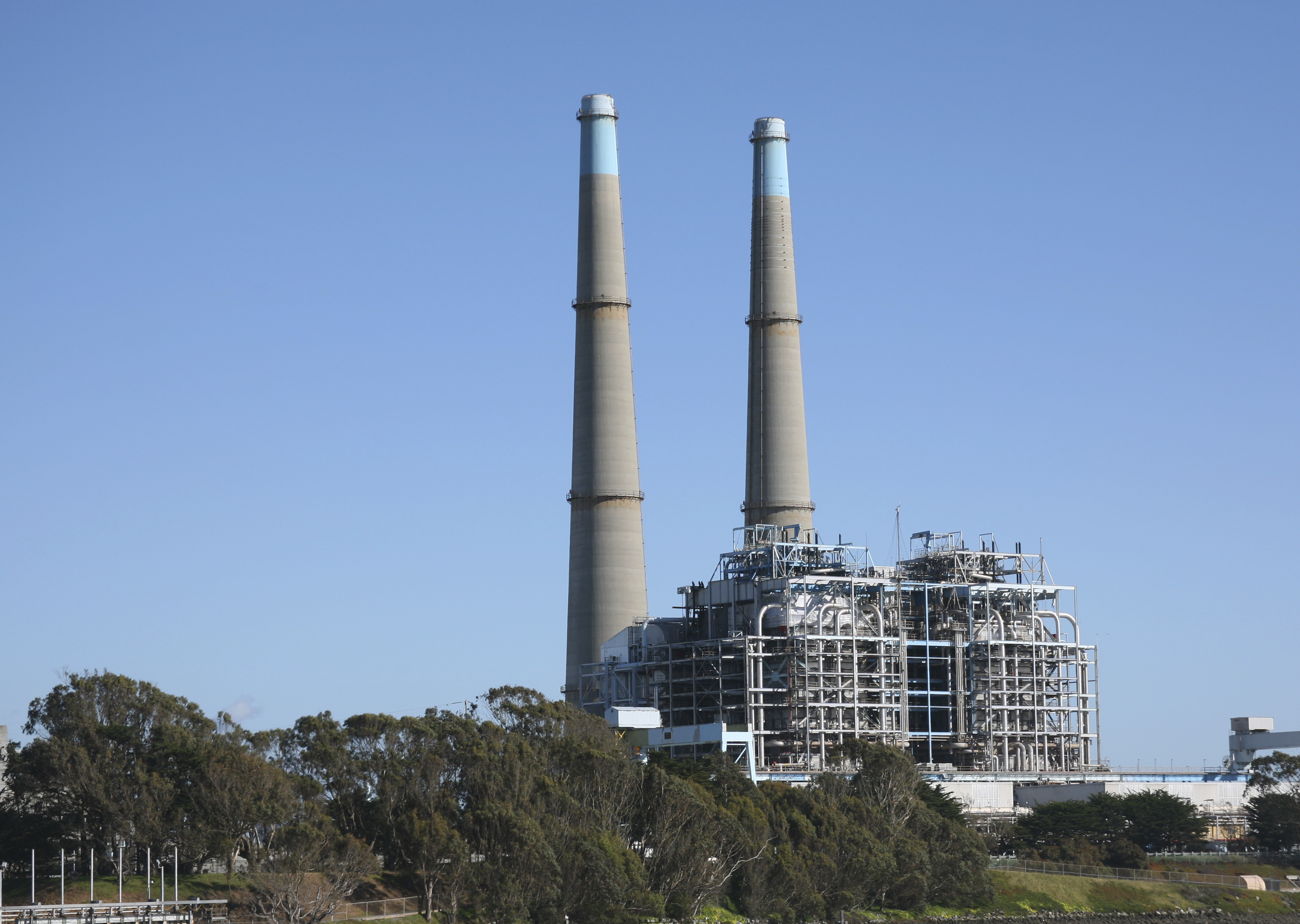
President Obama recently announced that he will request the EPA to develop greenhouse gas (GHG) regulations designed to reduce GHG emissions from existing power plants. In Moss Landing Power Plantlight of this development, we can again consider the possibility of a carbon price in the U.S.  If this happens, what will he impact be on electric markets?  For some insight we can look to California, which through Assembly Bill 32 implemented a carbon cap-and-trade mechanism beginning Jan. 1, 2013.

The California ISO (CAISO) recently issued its first analysis on the initial effects of California’s program[1].  The initial market price for GHG allowances has ranged from $13.50 to $16.50 over the first three months of 2013.  This is equivalent to a cost of approximately $6 to $10/MWh for gas-fired generation depending on the efficiency of the power plant.

CAISO’s study found that on average, wholesale electric prices increased by about $6.20/MWh due to the cap-and-trade program[2].  With average peak prices around $47/MWh and off-peak prices around $39/MWh during this period, this resulted in a wholesale power price increase on the order of 15%.

So does this means consumers electric rates are in for a significant rise? If all this were passed directly through the end-use consumers, this would cause their overall average cost of electricity to go up by approximately 5%.  But this may not occur.

The design of the California program gives a large number of allowances to the California utilities for free with the requirement that the utilities auction the allowances and use the revenue to reduce customers’ cost of power. So although data is not yet available to know for certain, it appears that much of this increase will be offset by allowance revenues, and that the total cost to the consumer may be very small.

A second question: Is the program producing a high enough price to affect the generation mix resulting in lower carbon emissions?  California is an interesting test case because the bulk of its generation is gas-fired, hydro, or renewable meaning there isn’t much coal power to be pushed out. 

California power sources

The portion of California’s generation attributed to coal is mostly import power, although this too will be required to acquire allowances. Detailed generation data is not yet available, but it appears the amount of gas generation has yet to be affected.  This is probably because, at least in the short-term, there just isn’t any generation alternative for California (especially with the closing of one of the two nuclear units, San Onofre).

Some anecdotal information in the report, which states that certain municipal customers brought in fewer imports, does suggest that these munis may have cut back on coal imports as expected. So far there has been no dramatic impact in California either through changes in generation mix or in greatly increased consumer prices.  We will need to keep watching as the cap-and-trade program goes forward to see what happens over a longer time period.

References:

[1] See CAISO Quarter 1 2013 Quarterly Report on Market Issues and Performance available here: http://www.caiso.com/Documents/2013FirstQuarterReport-MarketIssues_Performance-May2013.pdf

[2] This price increase is because gas units are usually on the margin in California and gas units typically increased their bids by the amount of equivalent $/MWh cost of allowances.

Posted in Electricity | Tagged , , , | Leave a comment

Should Utilities Consider Small Modular Nuclear Reactors?

by Bob Shively, Enerdynamics President and Lead Instructor

President Obama has announced that the EPA will move forward with developing greenhouse gas regulation for existing power plants, with a goal of implementing nuclear symbol  on keyboardregulations by mid-2014.  Natural gas prices have risen 42% in the last year.  And Bill Gates says our future needs nuclear power[1]. With multiple U.S. manufacturers[2] in the process of developing small modular reactor (SMR) technologies and with U.S. government support in sharing the costs of such development, has the time come for utilities to consider including SMR in their future generation planning?

MidAmerican Energy Company, the Iowa utility owned by Warren Buffet’s Berkshire Hathaway, recently studied this question at the direction of the Iowa State Utilities Board.  The conclusion? Maybe in the future, but not yet.[3] We’ll discuss how they got to this conclusion, but first, what is SMR for?

SMR is generally defined as a nuclear unit with capacities of 300 MW or less.  This is in contrast to the current commercial nuclear units which are typically 1000 MW or more.  SMR is intended to be constructed mostly in manufacturing with limited on-site work required.  According to the MidAmerican report, SMRs have advantages over existing nuclear designs used for power generation including improved safety, smaller required investment, and the ability to incrementally match load growth due to the smaller feasible minimum size of an SMR.

The MidAmerican study compared the economics of an SMR versus natural gas combined-cycle power plants. This choice was based on two assumptions:

  • new coal power plants will not be possible to build under air emissions regulation until such time as carbon capture and sequestration technology is available
  • although renewables will continue to grow significantly there will still be need for non-renewable baseload power

The study concluded that under certain scenarios, included scenarios the consultant running the study (NERA Economic Consulting) believed to be most likely, the cost of power over a period from the year 2020 to 2080 would be lower for SMR than for natural gas.

Key inputs that drive the conclusion include:

  • future domestic natural gas supply and resulting gas prices
  • the level of future economic growth and how that results in electric demand growth
  • carbon pricing policy
  • the ultimate capital costs of SMR engineering

Results are very sensitive to gas costs and SMR capital costs since the cost of gas generation is largely driven by fuel costs (75-82% of the revenue requirement for gas-fired power) and SMR is driven by capital costs (73% of the revenue requirement for SMR).  Herein lies the difficulty: No one knows the future of gas prices and, since no SMR has ever been built, no one knows the true capital cost of building one.

Since much of the costs for SMR is upfront, and since current gas prices are low, the study concluded it simply makes sense to wait awhile and take advantage of low gas costs.  This shows the difficulty for any new highly capital-intensive technology in today’s energy world.  It’s a lot easier to just wait than to take the plunge and go first despite some appealing features of SMR.

One way of looking at SMR is that it is a hedge against future gas-price and carbon-price volatility.  The key questions are: When will the hedge be developed enough to be viable? How much should a utility pay for the hedge? And when should the hedge be put in place?

Unfortunately not enough is known yet to answer those questions with the certainty required for a utility to move forward.  This then leaves it up to the U.S. government to foster development until more questions can be answered.

References:


[1] See our earlier blog, Why Bill Gates Still Believes in Nuclear Power, available at: https://blog.enerdynamics.com/2011/08/10/why-bill-gates-still-believes-in-nuclear-power/

[2] These include Generation mPower (Babcock and Wilcox),  NuScale Power, SMR (Holtec Inernational) Westinghouse Electric Company

[3] For a summary of the study and links to the complete analysis see:   http://www.midamerican.com/common/newsroom/pdf/060413_nuclear_feasibility_study.pdf

Posted in Electricity | Tagged , , , , , , , , , | 1 Comment

Gas Industry Overview is Enerdynamics’ latest online course to benefit from update and revamp

By John Ferrare, Enerdynamics CEO

Enerdynamics recently released an updated version of its popular online course Gas Industry Overview. I’m often asked about how we handle updates to our online curriculum. Following is a brief discussion on the behind-the-scenes process of ensuring our online courses are timely, accurate, and effective training tools.

Our online courses are updated about every three years. As anyone working in the industry knows, a lot can change in three years! For instance, the previous version of Gas Industry Overview showed government projections that increasing amounts of natural gas – including some LNG – would need to be imported to cover U.S. demand. Of course things have changed dramatically since then, and government projections now show the U.S. could soon become a new exporter of natural gas. This is reflected in the new Gas Industry Overview course. Additionally, customer data has been updated, and the course also addresses the increasing use of natural gas as a fuel for electricity.

Above and beyond updating content, a course revision also entails updating the technology used to deliver the course, and, in this case, the actual look of the course. The evolution of our online courses in the last 10 years has been significant. Our original “online” offerings were actually recordings of live courses we offered. We’ve learned a lot about eLearning since then – first and foremost that successful online training is its own medium and thus requires its own approach.

As evidenced by the latest release of Gas Industry Overview, our online courses today offer a user-friendly, interactive experience designed specifically for the online environment. Today, our Gas Industry Overview subscribers enjoy a fluid and easy-to-navigate tour of the natural gas business including:

  • Natural gas consumers and their needs
  • The components of the physical system and how it is designed to deliver gas to end users
  • How the physical system is operated for maximum efficiency and safety
  • How and why the gas industry is regulated
  • What areas of the industry are deregulated and how this affects markets and pricing
  • How markets function and the wholesale and retail services offered in them

We also recently updated the online training “skin,” which is the online player from which a learner navigates the course, advances to other parts of the course, uses the search feature, accesses the glossary/acronyms, and participates in course exercises and quizzes. This update makes Gas Industry Overview more navigable and aesthetically pleasing.

Our other training products are updated with similar goals in mind. Our live instructor-led courses are updated every time they are delivered. And books are revised on a schedule similar to our online courses – not an easy task, but we believe that keeping our curriculum current and relevant is crucial to the efficacy of the learning.

For a free online demo of the new Gas Industry Overview, go to http://www.enerdynamics.com/cbtms/GIOn_Demo/01_Course/player.html.

The recently launched version of Gas Industry Overview is available in two versions: the U.S. version and the Canadian version, which expands on the U.S. version to include an examination of Canada’s role in North America’s natural gas industry. Each version is $295 per subscriber. Through the month of July, enjoy a 50% discount when you use coupon code GIO50 at checkout!

Companies seeking to purchase bulk subscriptions enjoy discounts when purchasing as few as 10 subscriptions.

For more information on any of our training products, please contact me directly at jferrare@enerdynamics.com or 866-765-5432 ext. 700.

Posted in Energy Training, Natural Gas | Tagged , , , , , , , | Leave a comment

Will Renewables Finally Drive a Distributed Generation Revolution?

by Bob Shively, Enerdynamics President and Lead Instructor

My first job in the utility industry was as a cogeneration engineer with Pacific Gas and Electric Company (PG&E). PG&E was years behind schedule in getting its nuclear power plant Diablo Canyon online and needed new generation capacity quickly. My team’s job was to find good candidates for installing cogeneration[1] and demonstrate to the customer the economics associated with making the investment.


A number of larger customers installed cogeneration units, and, by the late 1980s, PG&E was buying power from more than 2,500 MW of cogenerators — more capacity than Diablo Canyon! Many old timers were cynical, but the younger members on our team were optimistic that a distributed generation (DG) revolution was underway and would rapidly change the industry paradigm of centralized generation.

It didn’t happen. Low variable-cost nuclear power soon became available as Diablo Canyon came online, and PG&E’s interest in encouraging cogeneration waned. I moved on to a number of other jobs, and when I later heard a utility executive say that “distributed generation is always the next big thing, decade after decade” I chuckled and thought maybe he’s right.

The problem was that utilities built their systems with centralized generation for a reason – the principle of economies of scale. With the technologies available, it didn’t make sense for every customer to have its own power plant except when the customer’s heat loads were very closely matched to generation needs. Stand-alone DG without cogeneration typically had heat rates of 12,000 Btu/kWh or higher while centralized gas combined-cycle generators could get heat rates down to 8,000 Btu/kWh or lower.

A higher heat rate means you have to burn more fuel to get the same amount of power, so this placed DG at a big disadvantage to the larger utility power plants. And fuel costs for DG were higher too since owners of DG have to pay for the cost of gas distribution unlike utility power plants that typically take gas off a high-pressure transmission line, or, even worse, have to compete with coal units that have an even lower cost of fuel.

Only recently has the dynamic potentially changed thanks to the significant reduction in costs for distributed solar photovoltaic (PV) generation[2]. Now in regions with good sunlight, high utility rates, and government incentives, PV installations can be funded through customer savings relative to the cost of utility power. And in some regions PV manufacturers are promising to be economic even without incentives[3]. In California, overall distributed PV generation is about 2,000 MW[4] or the equivalent of another Diablo Canyon.

Current distributed generation in the U.S. is approximately 5% of total generation. In a recent survey by Black and Veatch[5], utilities were asked the amount of distributed generation they expected to see by year 2020. About one-third of respondents expected 5% or less; over 40% expected 5 to 10%; just over 15% expected more than 10%; and 8% responded they didn’t know. So clearly utilities aren’t sold on the idea that change is coming quickly. But, had utilities been asked 10 years ago whether gas generation would surpass coal generation, most would have said no. And, as we’ve discussed elsewhere, that transformation is occurring.

So, besides the price tag, what are the barriers to more DG? The largest barriers involve regulatory and technical issues. The current electric distribution system is not designed for much DG, so grids will need to be redesigned and upgraded if DG is going to grow. And until that occurs, utilities may restrict the amount of DG connected to their systems[6].  Other key issues include the price that customers are paid for power that flows back onto the grid and the price for stand-by service that customers pay so that the utility is able to serve the customer’s load when the DG system is down.

So whether we will see significant growth in DG in the near feature is debatable. In addition to the PV “wildcard”, numerous entrepreneurs are trying to create cost-effective DG using other technologies. Two interesting examples include the fuel-cell-based Bloom Box[7] and design guru Dean Kamen’s Stirling Engine generator[8].

One thing we can say is that those closest to the industry often fail to see big changes until they are obvious, so while there is a lot of installed infrastructure that suggests our electric grid will stay mostly centralized, it is not implausible that a rapid DG revolution could occur.

References:

1. Cogeneration is the production of electricity using steam created from waste heat from an industrial process or the use of steam from electric power generation as a source of heat.  It is also often called Combined Heat and Power or CHP

2. For a discussion of PV cost reduction, see Enerdynamics’ Insider “Is the Photovoltaic Industry Living Up to Its Hype?”  available at http://marketing.enerdynamics.com/Energy-Insider/2011/Q4Renewables.htm

3. See for instance: http://www.businessinsider.com/citi-the-solar-age-is-dawning-2013-5

4. See Black and Veatch 2013 Strategic Directions in the U.S. Electric Utility Industry, p. 44 available at: http://bv.com/reports/2013-electric-utility-report

5. See ibid, p. 44

6. See: http://www.mnn.com/earth-matters/energy/stories/hawaii-california-removing-barrier-limiting-rooftop-solar-projects

7. See: http://www.bloomenergy.com

8. See: http://www.oninnovation.com/videos/detail.aspx?video=1900&title=Stirling%20Engine%20Demo%20

Posted in Electricity, Renewables | Tagged , , , , | Leave a comment

Is the World Entering the Age of Long-term Natural Gas Prosperity?

by Bob Shively, Enerdynamics President and Lead Instructor

Sometimes in life, we find out that what we thought we knew to be true actually isn’t.  Saturday’s Wall Street Journal ran a review of Mario Livio’s book titled Brilliant Blunders134031979 The book describes how theories by various brilliant scientists including Linus Pauling, Charles Darwin, Lord Kelvin, and even Albert Einstein were once assumed to be clearly true yet were later found to be wrong.  In any field of endeavor, it is wise to look for commonly accepted “facts” that may prove to be wrong.

Elsewhere in the same issue was an article about natural gas titled  “We May Live On a Natural Gas Machine.”  This article stated that “there’s increasing doubt about whether all natural gas…comes from fermented fossil microbes.”  The alternate theory is that at least some of the world’s natural gas has been formed by “outgassing” (the more scientific term is abiogenic deep origin[1]).

The theory of outgassing is that carbon contained within rocks bubbles out over time as simple hydrocarbons such as methane (which is the primary component of natural gas).   These hydrocarbons are formed when carbonate rock, pushed deep underground by geologic forces, gets heated and pressurized in the earth’s molten mantle.  And where do carbonate rocks come from?  They come from absorption of carbon dioxide.  So, the theory says, the earth may be recycling carbon dioxide back into methane over time.

The point of this is the earth may contain a lot more natural gas than we think, since to date almost everyone has focused on fossil deposits.  According to the article, a new paper by Vladimir Kircherov of the Royal Institute of Stockholm suggests that the outgassing theory may explain huge deposits of methane hydrates found under the ocean floor.  Research on methane hydrates in the U.S. and Japan, among elsewhere, suggests that over time these deposits may become new economic sources of natural gas.

While the outcome of such research and theories such as outgassing won’t change the price of natural gas this summer, the research bears watching as we contemplate the energy future over our children’s lifetimes.

Posted in Natural Gas | Tagged , , , , , , | Leave a comment

Demand Response Need Not Cause Customer Pain

bulb vs money

by Bob Shively, Enerdynamics President and Lead Instructor

At least in some parts of the U.S., demand response has been an important factor in energy planning since the 1980s.  When I was an account representative in Northern California in the mid-1980s, we signed up numerous industrial customers to interruptible rate schedules that allowed the utility to interrupt the customer multiple times each year in return for a rate discount of about 30%.  This allowed the utility to avoid building peak generation to cover the industrial customers’ loads.

The only problem was, no customer really wanted to have all their power shut off, and, when our utility occasionally did it on a hot summer day, I could brace myself for angry calls from my customers.  They would shut down their processes because they were obligated to, but customers weren’t happy about it and wanted to let me know.  As utility representatives, we all knew that demand response would remain a limited resource as long as it caused customers pain.

Fast forward to 2013: We are starting to see a new type of demand response that doesn’t negatively impact customers’ comfort or ability to do work.  The IEEE Spectrum magazine recently detailed a cold storage warehouse in Neuendorf, Switzerland, that represents the future[1].  The warehouse is operated by Migros, Switzerland’s largest supermarket chain, and stores food for 630 stores in a 2 million-square-foot facility.  Clearly such a facility is not willing to let power interruptions negatively impact the temperature within the warehouse (imagine explaining to your boss why you ruined 2 million square feet of groceries to get a bill discount!).  Yet the warehouse, working with software provided by IBM, is now able to offer Swissgrid up to 900 kW of demand response for limited periods of an hour or so.

How do they do this?  By closely monitoring temperature tolerances within their facility and forecasting how much flexibility they have to reduce power usage on any given hour.  This flexibility is the difference between the maximum amount of power the facility would use if power is cheap and the minimum amount necessary to maintain adequate temperatures.  As long as the facility stays within these bounds, everyone at Migros is happy and no work processes are interrupted.  And Swissgrid is happy to pay for the electricity “storage” whenever it is cheaper than running a peaking unit or buying peak power off the European grid.

Will such “smart” demand response come to dominate the future?  I believe so. Otherwise most consumers just won’t do it. Data for U.S. peak load reduction over the last decade show that the amount of peak load reduced by energy efficiency more than doubled, while peak load reduced by demand response only increased by 30%. A key reason is the energy efficiency allows you to get the same level of comfort or productivity while using less power.

Historically demand response didn’t offer this lack of pain.  Most people don’t want to come home to a hot house on a peak day.  Numerous researchers spread around labs and universities are working on software packages to bring concepts such as that being used by Migros into our homes. Perhaps in 20 years or so, this will all sound like the way the world works, and no one will find it at all unusual.  And we’ll need a lot fewer peaker units relative to our based energy usage.

Posted in Uncategorized | Tagged , , , , , , | Leave a comment

Gas Utilities Caught Between Safety Upgrades and Rate Cases

by Bob Shively, Enerdynamics President and Lead Instructor

In the wake of recent tragic natural gas pipeline incidents, federal safety regulators have 145122298 (2)pushed gas distribution utilities and pipelines to thoroughly survey their systems to identify infrastructure that should be overhauled.  And given that more than half the 300,000 miles of transmission lines and 2 million miles of distribution lines in the U.S. is more than 50 years old, gas companies are finding lots of infrastructure that needs to be upgraded[1].  But the problem is that while everyone is in favor of safety, it costs money to achieve.  In many cases, lots of money.  And spending money means consumer rates must go up.

For example, Xcel Energy projects spending $1.5 billion in pipeline overhaul costs for its Colorado gas system over the next decade. Xcel has identified over 250 miles of pipelines that it believes should be replaced in the next few years.  To accomplish this, Xcel has filed a rate case request for a mix of base rate increases plus a Pipeline System Integrity Adjustment (PSIA) rider that would add additional costs. Normally rate cases are used to review more routine changes in utility costs.

As quoted in the Denver Post[2], the director of the Colorado consumer’s counsel’s office stated “This is the most sweeping rate case I’ve seen.”  The Colorado PUC staff has recommended that the request for the PSIA be split into a separate proceeding. And Xcel is already getting push back on spending the money.  The Denver Post[3] represented typical consumer viewpoints with the quote: “Xcel is asking time and time again for rate increases. It’s time for the public to stand up and say enough is enough.”

The problem is that, to upgrade safety, the money has to be spent.  And under the utility rate-making methodology, utilities who spend money without getting it into rates have reduced profits. Reduced profits make utilities a less attractive investment, which means they have trouble raising money to make system improvements and then have to borrow capital at higher interest costs.

Those higher borrowing costs mean a different component of rates goes up.  So regulators are caught in a bind – they want to keep rates low, but they also want a safe system.  It is up to the gas utilities to make the case that they are running a safe system while spending the least amount of money possible but still need approval for expenditures.

Xcel’s rate case appears to be on the edge of contentious, and numerous other gas rate cases around the country are likely to follow suit.  The outcomes will strongly influence the amount consumers will pay for natural gas service and the ability of gas utilities to create profits for investors.

 References:

[1] For discussion of recent gas pipeline incidents, their causes and what can be done to enhance safety, see our blog “Natural Gas Pipeline Safety: A Crisis or a Manageable Issue?” https://blog.enerdynamics.com/2013/02/03/natural-gas-pipeline-safety-a-crisis-or-a-manageable-issue/

Posted in Natural Gas | Tagged , , , , , , , | Leave a comment

Will China transform the world of energy?

by Bob Shively, Enerdynamics President and Lead Instructor

When I started in the energy business back in the early 1980’s, the utility paradigm was topower plants in Hong Kong continually build more power plants to serve growing customer loads.  This lead to environmental and economic difficulties, especially as the cost of completing planned nuclear power plants skyrocketed.

At the utility where I worked, Pacific Gas and Electric, an outside scientist named Amory Lovins gained notoriety by forcefully suggesting an alternative path that included energy efficiency and renewable power.  As the story went around the company (and I don’t know if it is actually true), PG&E executives would hide when Lovins came in the building so they wouldn’t have to listen to him telling them over and over that they needed to change their business model.  Ultimately the California regulators did listen, and both California and PG&E have transformed their energy systems into one of the more efficient and renewable-based markets in the world. And in most U.S. states, at least energy efficiency has become a key focus of electric utilities [1].

But in the U.S. the debate still rages on concerning the right energy future.  Should other states follow California’s lead with use of renewables, or is it better to focus on more traditional energy sources?  Is climate change real, and should we change our energy mix to reduce carbon emissions?  It seems that in Washington, we just aren’t capable of consensus for action at this point.  Instead it’s possible the impetus for change will come from outside.

As we suggested in a recent blog post, behind-the-scenes efforts to work with China may result in that country leading significant movement toward a cleaner energy mix. [2]  One such effort is being led by Amory Lovins’ Rocky Mountain Institute (RMI).  Lovins recent book, Reinventing Fire, laid out RMI’s views on how the U.S. could transform its energy mix.  RMI is now working with high-level officials and organizations in China to develop a blueprint for how China might lead the clean energy future.

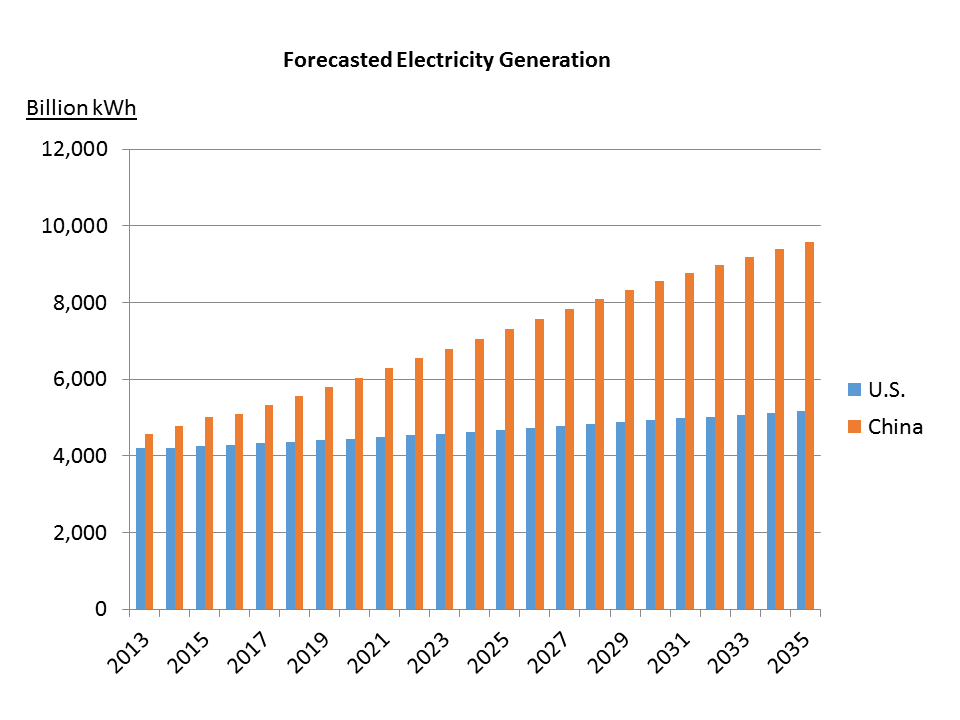
According to Lovins, it could result in change that is “one of the most transformative that’s ever happened in global energy.” [3] When a lot of folks talk that way, it just sounds like hype.  Especially when China is the world’s largest coal generator, and electric output in China is expected to more than double by 2035.  But then again, 30 years ago who ever thought that electric utilities throughout the U.S. would be trying to convince consumers to buy less of their product?

Forecasted Electricity GenerationSource: U.S. Energy Information Administration International Energy Outlook 2011


[1] See for instance, the U.S. Energy Information Administrations Today in Energy report U.S. Energy Intensity Expected to Continue Its Steady Decline Through 2040  http://www.eia.gov/todayinenergy/detail.cfm?id=10191

[3] From the Google Hangout talk Reinventing Fire China: http://blog.rmi.org/blog_2013_05_10_Reinventing_Energy_China

Posted in Electricity, Renewables | Tagged , , , , , , | Leave a comment