An In-depth Look at the EPA’s Clean Power Plan, Part III

by Matthew Rose, Enerdynamics Instructor

The last couple of weeks I’ve delved into the particulars of the Environmental Protection Agency’s (EPA) proposed Clean Power Plan including the plan’s purpose and objectives as well as how the EPA foresees its Red question mark puzzleimplementation. This week I conclude this discussion by looking at some areas of the plan that require further clarification and at some possible implications if the Clean Power Plan comes to fruition.

Issues needing clarification

A review of the plan’s draft rules points to a number of issues that seem ambiguous and need greater clarification. These issues are not exhaustive but reflect some of the immediate concerns arising from the rules.

  • Enforceable authority: There is some uncertainty regarding the enforceable authority under the “Clean Air Act” especially for renewables and energy efficiency strategies. If a state elects to use renewable energy or a state energy efficiency portfolio standard as part of its compliance plan, does the strategy become subject to EPA’s authority? There is some ambiguity that the rules may potentially extend to federal oversight in these instances.

  • Historical contributions: A key element of the approach is that EPA incorporated the relevant generation and energy efficiency accomplishments within each state in their goal-making process. As a result, any efficiency reduction prior to 2012 is not eligible to meet the savings targets. Only reductions from 2012 and forward can be applied against savings targets. Related questions: How do the rules address load growth or the need for new generation? Do emission targets change to accommodate new generation?

  • Generator incentives and cost recovery: What are the incentives to utilities (generators) to participate in a statewide strategy? This issue becomes more complex in states that have restructured and include merchant (IPP) generation, and it extends to the idea that some strategies may result in increased costs requiring regulatory approval and cost recovery. The process for this set of activities is not detailed.
  • Roles and responsibilities of ISO/RTOs: The rules have limited discussion of how things would work in an organized transmission organization (ISO/RTO) where the generators have limited control over their dispatch. The conflicting obligations of the ISO/RTO may not be aligned with intended state-level compliance requirements. Will states have the authority to control generation dispatch to address emission goals?

  • State regulatory authority: The rules are unclear in defining what state organization will be responsible for organizing and submitting compliance plans. Compliance with the rules will require an in-state authority capable of executing the plan development and compliance.

Implications

The proposed rules involve significant implications. Although there are disagreements on the rules’ impacts on prices and jobs, there is consensus that the rules serve to decrease the role and contributions of the country’s aging coal-fired generation. Many of the older plants will never find an economic path of compliance and will be forced to retire (although there may be some opportunities to convert existing coal plants to natural gas).

Many experts point to impacts ranging from higher electricity prices, fewer jobs, grid reliability concerns, and greater reliance on natural gas as a fuel choice for future generations. Other analysts suggest that impacts will be minimal. And some even suggest that consumers will benefit through significantly increased use of low-cost energy efficiency and demand side management solutions. Of course, the real impacts will be discernible only when the final rules are revised and approved and markets have a chance to respond.  

As of early August 2014, a number of states have filed suits against the EPA to block the proposed rule in the U.S. Court of Appeals in the District of Columbia. These include Alabama, Indiana, Kansas, Kentucky, Louisiana, Nebraska, Ohio, Oklahoma, South Dakota, South Carolina, West Virginia, and Wyoming. It seems the process may entail legal and political battles resulting in an evolving landscape that takes time to settle and means implementation may be delayed beyond the EPA-proposed dates.

Posted in Electricity, Renewables | Tagged , , | Leave a comment

An In-depth Look at the EPA’s Clean Power Plan, Part II

by Matthew Rose, Enerdynamics Instructor

Last week I gave a brief overview of what the EPA’s proposed Clean Power Plan is and the objectives guiding it. Now for a little more detail on the EPA’s approach toward 452180751implementation…

The plan’s proposed rules reflect a focused modeling exercise conducted by the EPA to:

  • characterize the status and environmental efficiency of fossil-fuel generation assets in 2012
  • apply predetermined supply-and-demand efficiency improvements to establish state-level targets

These estimates were allocated across all states with fossil-fuel generation and result in a target goal for emissions reductions. The key analytical steps include:

  1. Calculating each state’s “emissions rate”: The EPA sets a baseline estimate of the carbon intensity of each state’s electricity sector. The carbon intensity is a product of dividing the total carbon dioxide emissions from a state’s power plants by the total amount of electricity generated (with a few adjustments for renewables and nuclear). Different states start out with different emissions rates. Washington, for instance, has a relatively low emissions rate — just 763 pounds of carbon dioxide per MWh of electricity produced. That’s a result of having only one coal plant. Indiana, by contrast, relies far more heavily on coal, so it has a much higher emissions rate of around 1,923 pounds of carbon-dioxide per MWh.
  2. EPA examines what emissions reductions are reasonable for each state to achieve:  The EPA sets goals for reducing those emissions rates based on what the agency deems reasonable for each state to cut by 2030. The EPA assumes that each state will be able to take a series of steps using existing technology or policies to lower emissions.
  3. Extend reduction options to a series of four building blocks: The proposed rule sets out a series of four building blocks (or pathways) that states can employ to reach reduction targets. These are illustrated in the following table:

The end result is a specific carbon reduction target for each state that in aggregate provides a total reduction of 30% for the country by 2030. As a result, each state has a specific target that varies greatly by state depending on various characteristics and opportunities. The application of the reductions plays out differently in each state.

For example, Michigan has a lot of coal plants and spare gas capacity so the opportunity of coal-to-gas switching is assumed as a key option in determining Michigan’s goal. By contrast, the EPA assumed that growth in wind and solar could play a relatively bigger role in helping New Hampshire and Maine cut emissions based on renewable policies that are already in place.

The EPA draft plan and associated modelling expects 2012-20 reductions to comprise 39% from combined-cycle gas turbines (CCGT) re-dispatch, 10% from heat rate improvements at coal plants, 23% from renewables, 3% from nuclear build, and 25% from energy efficiency. This will vary by state depending on a state’s fuel mix and program history.

It’s important to note that states don’t have to follow any of the above pathways and may seek approval from EPA for a unique path to achieving the designated savings goal— this is just how the EPA calculates what it deems a reasonable goal for each state. (In the proposed rules, the technical term for this is “best system of emissions reductions”. For a complete graphic depiction of the assigned targets for each state, click here.

State compliance plans

Once the EPA sets its final targets, states will have to submit compliance plans to meet the targets. EPA’s rules reflect a purposeful attempt to provide states with extensive flexibility in meeting emission reduction targets. Compliance plans could include an array of different strategies. For example, states could:

  • ramp up renewable energy
  • shut down their coal plants and/or build new natural gas plants
  • build nuclear plants or get credit for prolonging the life of their nuclear plants
  • advance more stringent energy efficiency codes and standards as part of a statewide energy efficiency portfolio
  • propose implementation of a carbon tax or join “cap and trade systems”[2]

The one condition is the need for EPA review and approval. The agency will have to decide whether a given state’s implementation plan will actually help the state meet its emissions goal. States that refuse to submit compliance plans would be subject to the EPA crafting its own plan for regulating a state’s emissions. It’s likely that any federal plan would be less flexible and possibly more costly.

Next week I’ll wrap up this series by looking at some possible holes in the plan that many feel require further clarification, and I’ll look at the implications if and when the plan comes to fruition.

Posted in Electricity, Renewables | Tagged , , , , | Leave a comment

An In-depth Look at the EPA’s Clean Power Plan, Part I

by Matthew Rose, Enerdynamics Instructor

This week and in the weeks ahead, Energy Currents is taking a close look at the Environmental Protection Agency‘s (EPA) Clean Power Plan proposal that was released on June 2, 2014. This week’s post looks at the plan’s main objectives and the process it faces in the months (or years) ahead. In future posts, we’ll look at the specific approach the EPA is proposing to meet such objectives; some vague areas within the current plan that need further clarification; and the implications  if and when the plan comes to fruition.

If implemented, the Clean Power Plan will, for the first time ever, federally regulate carbon dioxide (CO2) emissions from existing power plants. The plan is designed to cut carbon pollution from power plants nationwide by 30 percent from 2005 levels.

More specifically, the proposed plan is designed to address the following:

  1. Create state-by-state carbon emissions goals: These goals are defined in terms of pounds of emissions per MWh of output and are based on each state’s historic generation mix. Thus goals for states with higher historic levels of carbon-based generation are set at less stringent levels than those for other states.
  2. Define a “pathway” for each state to develop plans to achieve the goals: Rather than defining power plant-specific regulations or mandating how states must achieve their goals, the EPA-proposed process is designed to be flexible to allow each state to develop its own program. States may develop their own individual plans or may work together to develop regional multi-state plans.

A 120-day public comment period began once the plan’s rules were published, and EPA began holding public hearings in Atlanta, Ga., Denver, Colo., Pittsburgh, Pa., and Washington, D.C. Affected parties are expected to submit comments to the plan during this period in order to preserve arguments for potential litigation.

The plan is expected to be finalized by June 1, 2015. This date assumes there are no challenges associated with its rules. Note that any legal challenges can only be advanced after the ruling is finalized, suggesting there may be a protracted process before any plan is finalized and implemented.

Posted in Electricity, Energy Training | Tagged , , , , | 3 Comments

Customizing E-learning to Meet Energy Companies’ Training Goals and Budgets

By John Ferrare, Enerdynamics CEO

There is no doubt that e-learning (online training) has found a permanent home in the corporate training arena. We’ve seen a phenomenal jump in sales of our online courses in the past year. And, not surprisingly, that jump has correlated with a drop in the number of live seminars Enerdynamics has been contracted to teach. E-learning is displacing the traditional classroom experience for certain types of training.

It makes sense for many reasons: E-learning is cheaper, employees learn at their own pace, and it eliminates the logistical issues of getting people together in the same place at the same time for joint training.

Of course, there are tradeoffs. For example, live seminars are more conducive to customization. We can (and almost always do) customize content, learning style, etc., to match a live seminar’s audience. This is trickier with “off-the-shelf” e-learning. Or is it?

Enerdynamics has recently and successfully been experimenting with combining e-learning modules into custom courses. Those familiar with our online training know that we have quite a few “full-length” courses. Each comprises modules that are combined in a logical manner to bring learners up to speed on a general area of the business.

For instance, our Electric Industry Overview is a four-hour course designed to present a big-picture introduction to the electric business. The course comprises seven modules, each of which can be taken on its own or as part of the full-length course. This gives Enerdynamics’ clients the opportunity to literally build their own courses that include the individual modules they want or need.

We recently worked with a municipal utility that wanted six modules from various courses combined into a custom course for a small work group. The Enerdynamics team combined these six modules and added a company-specific landing page explaining the course to the client’s employees. Each module includes a quiz that must be passed with 70% accuracy, and when the employee passes each quiz, he or she passes the course.

Additionally, we can supplement the e-learning with reading assignments from our book, Understanding Today’s Electricity Business, and even custom webinars that might focus on company-specific information. Such flexibility allows us to create a custom course for a group of less than a dozen at a small muni or a group of 200+ at a large utility.

With a variety of learning components already produced and the option to add custom content for each client, the possibilities are endless. And very exciting. Contact me at jferrare@enerdynamics.com or 866-765-5432 ext. 700 about how Enerdynamics can help you put together custom e-learning courses for your employees.

Posted in Energy Training | Tagged , , | Leave a comment

Initial Research Shows Fracking Well Contamination Is Due To Poor Completion Techniques

by Bob Shively, Enerdynamics President and Lead Instructor 

A major concern of the United States’ current fracking boom is if and how fracking is negatively impacting the environment[1].  One key concern is that fracking may tap watercontaminate drinking water since elevated levels of methane in drinking water has been noted in locations near fracking sites. But the science of figuring out exactly what’s going on takes time, and meanwhile energy companies continue their fracking operations in and around communities across the nation.

Data from studies on fracking sites and water contamination is just now coming in. Several scientists who initially started work at Duke and are now at various universities have been studying natural gas contamination of wells in Pennsylvania and Texas and recently published their findings in the Proceedings of the Natural Academy of Sciences[2].

The group’s conclusion? Well contamination is occurring through poor well completion techniques, not from the migration of natural gas from deep underground induced by hydraulic fracturing techniques. This is good news for the industry and for the environment, since this type of well contamination should be controllable through use of proper well completion processes.

What was studied?

The scientists looked at two questions:

  • Are elevated levels of hydrocarbon gas in drinking-water aquifers near gas wells derived from natural or man-made sources?
  • If gas contamination exists due to man-made activities, what is causing the contamination?

To answer these questions, the scientists used a technique called noble gas and hydrocarbon tracers, which allows them to track the source of hydrocarbon gas.

Were elevated levels due to human activities?

The scientists use the term “fugitive gas” to describe gas that migrated into drinking water sources from other locations due to human activities. They documented fugitive gases in eight clusters of domestic water wells in Pennsylvania and Texas. The Texas wells showed declining water quality over time indicating recent activities have caused the contamination.

What caused the contamination?

The scientists theorized that man-made contamination could occur due to multiple causes. For the eight cases of contamination they were able to identify the cause:

  • Four cases were due to leaks through the annulus cement
  • Three cases were due to leaks through the production casings
  • One case was due to underground well failure

well diagram

In no case was the mechanism of contamination gas migration induced by hydraulic fracturing deep underground.

What does this mean?

Certainly study is needed for more than just eight cases of contamination. But the data received to date suggests that energy companies and their regulators should focus on procedures and rules to ensure the integrity of the wells themselves rather than stopping fracking over concerns of migration of gas from deep underground. The scientists suggested that further work should evaluate whether large volumes of highly pressurized fluids used during fracking may affect the integrity of wells. If so, more steps may be required than simply improving well completion procedures.


References:

[1] For a discussion of fracking see: http://marketing.enerdynamics.com/Energy-Insider/2011/Q3NaturalGas.htm

[2] Available at: http://www.pnas.org/content/early/2014/09/12/1322107111.full.pdf+html

Posted in Natural Gas | Tagged , , , | 2 Comments

What You Thought You Knew About the Electricity Business May Not Be True

by Bob Shively, Enerdynamics President and Lead Instructor 

The electric utility system has been relatively stable for a long time – longer than the careers of even the oldest in the business. That means it is easy to think that once you get a bit of experience and learning, you have things figured out. But lately, that assumption482469921 might be getting turned on its head. Here are few things that we’ve always “known” that may no longer be true.

  1. More renewable energy means less reliability
    Perhaps surprising to many, initial sets of data analyzing SAIDI (System Average Interruption Duration Index) indicates that Germany has maintained a high level of performance despite growing to more than 25% renewables in its power mix. More details.
  2. The utility business always changes very slowly

    Those of us who have been in the industry for a long time know that ideas frequently arise many years before they actually get implemented. It is simply part of the regulated way of doing business. So any discussions of the “utility of the future” must be just that, discussions about what might happen in another decade or so.  Except that regulators in Hawaii and New York are already holding proceedings that will likely result in radically different utility business models in the next few years. Listen to this NPR report for an example.

  3. The only way to economically store electricity is through hydro-pumped storage

    Yes, batteries and flywheels and other technologies have been around awhile, but other than for emergency backup, there just isn’t an economic case to be made for installing electric storage. In most cases that is still true today, but again, this might change soon. Tesla Motors is preparing to build a huge lithium ion battery factory in Nevada. Many believe they are significantly overbuilding for what is needed for car batteries (click here for an example). But this could lead to the price of batteries falling significantly as over-capacity floods the market. This is what happened to drive down the cost solar photovoltaic systems. And Tom Werner, CEO of SunPower recently stated “2014 for batteries feels a lot like 2003 in solar.”

There are other assumptions we might tackle in the future but this is a good start for one post. If you’d like to explore these and more, please join me in New York City, October 6-7, 2014,  for our Distributed Energy, Renewables and Microgrids seminar. And if you are interested hurry because the early bird discount that saves you $200 ends September 15.

Posted in Electricity, Renewables | Tagged , , , , | Leave a comment

Supply, Demand, and the Weather: More Reasons for Low Natural Gas Prices

by Christina Nagy-McKenna, Enerdynamics Instructor

Our last post explored the unexpectedly robust increase in natural gas storage inventories after the severe winter of 2013-2014 and aggressive restoration’s roll in tamping down on the forward prices for natural gas.weather forecast

However, the higher-than-expected level of inventories is not the only reason that the market has been cautious about the upcoming fall and winter. Demand is sluggish among end users due to mild summer weather while natural gas supplies are growing with shale production in certain areas hitting all-time highs. This week’s discussion takes a closer look at these factors…

“Weather” or not
As high tech as the natural gas industry has become, there is one aspect of the business that the industry can neither escape nor influence: Customer demand is largely driven by the weather for non-industrial end users. The mild summer in parts of the U.S. this year has meant that power plants are burning less natural gas since end users are not using their air conditioning equipment as often as the industry would expect. For example:

  • For the week of August 13, the Energy Information Administration (EIA) reported that U.S. demand for natural gas had declined by .2% mostly due to the electric power sector decreasing its usage by 6.1% compared to the previous year.
  • The week of August 20, the EIA again reported a .2% decline in usage, as the power sector decreased its usage by 1.3% over the same week in 2013. Ironically, the EIA believes that some customers in the Pacific Northwest may have actually begun heating their homes that week due to the cold temperatures.

Shale leads supply increase
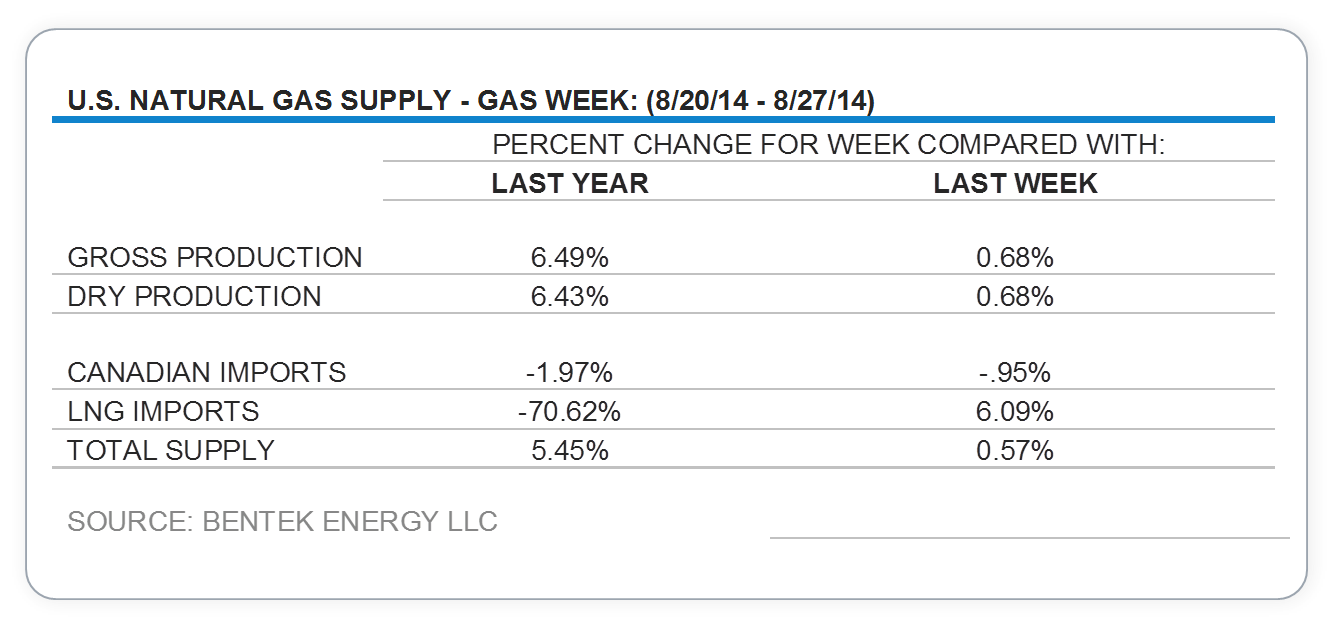
While demand has been stagnant this summer, supplies have grown. The data below shows the percentage changes of this past week as compared to the same week in 2013. While the data only represents one week, the results are consistent with the numbers the industry has seen all summer.

supply chart 1

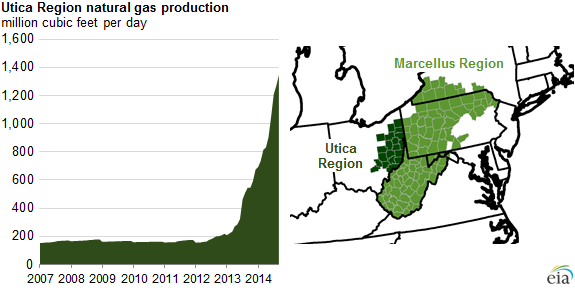
Shale gas production continues to lead the supply increase. Marcellus area production hit an all-time high in July 2014 as it exceeded 15Bcf/d for the first time. Already the largest shale producing region in the U.S. with 40% of all shale production, Marcellus is expected to continue its growth. By September the EIA estimates that Marcellus will produce 15.8Bcf/d. And now, Marcellus has a fast-growing neighbor in eastern Ohio: the Utica Shale.

Utica region               Today in Energy, August 12, 2014, U.S. Energy Information Administration


As of August 12, 2014, EIA now includes Utica’s production in its monthly drilling productivity report. Utica earned this distinction by becoming one of the fastest growing production areas for natural gas in the U.S. The EIA estimates that Utica will produce 1.3Bcf/d of natural gas next month. Current production puts its growth rate on par with the Eagle Ford Region of Texas. Industry experts attribute Utica’s growth to a modest increase in the number of rigs in the area as well as increased production per well as producers have become much more efficient drilling in shale formations.

What it all means…maybe
All of these factors – increased supply, lower-than-expected demand due to cooler weather, and rapidly increasing storage reservoirs – add up to lower spot market and forward-looking prices as compared to what was expected by the industry following the harsh winter of 2013-2014. The table below shows spot market prices for the weeks ending August 6 and August 27, 2014, as well as September and October futures contracts for the same weeks. Even though we are three weeks closer to the beginning of the winter season, the numbers for each category has increased very modestly since the beginning of the month.

spot prices chart 1

Additionally, prices in the northeastern U.S. have traded below Henry Hub prices since the spring. The basis differential between these two regions has historically favored Henry Hub, however, this paradigm is changing as Marcellus shale gas production, increased gas processing, and greater gas transportation have changed the region profoundly. Eventually, as winter demand in the Northeast increases, the basis differential is expected to reverse, at least through the following winter.

As we wait to see how the market responds as the seasons move forward, the great unknown remains the weather. It is possible that despite the herculean effort to restore gas storage inventories, a cold winter could simply draw them down again and gas prices would increase substantially. If the winter is mild, it is possible that spot and forward market gains will be measured, but not grand. Until then, we expect to see more of what we have seen so far this summer – modest gains and losses for the next couple of weeks as long as temperature changes are slight, followed eventually by higher prices as the storage injection season closes and winter shows up on our doorsteps.


References

“Marcellus Shale Gas Production Hits New Milestone,” Cusick, Marie, August 5, 2014, State Impact Pennsylvania.

“Natural Gas Slides in Cool Weather,” Berthelsen, Christian, The Wall Street Journal, August 18, 2014.

“Natural Gas Weekly Update,” August 28, 2014, US Energy Information Administration.

“Natural Gas Weekly Update,” August 21, 2014, US Energy Information Administration.

“Natural Gas Weekly Update,” August 14, 2014, US Energy Information Administration.

“Natural Gas Weekly Update,” August 7, 2014, US Energy Information Administration.

“Natural Gas Weekly Update,” August 22, 2013, US Energy Information Administration.

“Northeast August Basis Cools While Autumn Refuses to Fall,” Bradley, David, NGI Forward Look, July 23, 2014.

“Summertime Living Isn’t Easy for Gas Bulls,” Denning, Liam, The Wall St. Journal, August 18, 2014

“Utica Production Surged in Last Two Years: EIA,” Ritenbaugh, Stephanie, Pittsburgh Post-Gazette.

“Why Natural Gas Was All Over the Place after the EIA Inventory Release,” Parts 1 and 2. Chamberlin, Alex, August 25, 2014, Market Realist.

Posted in Natural Gas | Tagged , , , , | Leave a comment

Mild Weather, Aggressive Storage Injections Keep Natural Gas Prices Low

by Christina Nagy-McKenna, Enerdynamics Instructor

Earlier this year many Americans broadened their vocabulary with a term that flanked the Northeast in record-low temperatures: the ‘polar vortex.’ Gas traders associated the termpolar vortex with higher natural gas prices. Gas storage owners associated the term with greater demand as they watched inventory levels dwindle to 857 Bcf, the lowest level since 2003 and approximately 55% lower than the five-year average.[1] Lastly, gas customers associated the term with bitter-cold conditions that drove them to heat their homes and businesses into April.

The polar vortex itself is a constant circulation of upper-level winds that encircle the North and South Poles. Under normal conditions, frigid air is contained at the poles by the constantly strong winds. If the winds slow down, however, cold air escapes, and in the case of the North Pole, the frosty jet stream heads south. Such distortions of the polar vortex occurred in early December 2013 and the first week of January 2014, and it brought with it arctic air from the North Pole.

For the natural gas industry, the record cold temperatures fanning out from the Northeast across to the Midwest and down to the Southeast brought a boon of price increases, high demand by customers, and a dramatic reduction in gas storage inventories. Reduced storage inventory pays dividends to the market, as the gas must be replaced in preparation for the following winter.

Storage levels were so depleted this past season that the Energy Information Administration forecast that storage customers would be unable to restore their inventories to pre-winter 2013-2014 levels. Thus the market was bullish that natural gas prices and forward-looking financial contracts would all increase strongly this fall and continue their upswing into the winter, especially on the East Coast.

2014 Gas Storage Inventories (Bcf)

2014 gas storage inventories

However, cooler than normal August temperatures, a warmer than normal fall forecast for the East Coast, higher than average storage injections, and robust gas production have conspired to keep both spot and forward-looking natural gas prices for the East Coast lower than expected, while the remainder of the country has seen only small increases. For example, spot prices as reported by NGI at Henry Hub, Chicago, and California were all flat for the past week. However, they were all relatively close to 2013 prices for the same time period.  The New York price, however, is vastly lower, as can be seen below.

 Comparison of 2013 and 2014 August Spot Market Prices

comparison of 2013 to 2014 August spot market prices

In the meantime, natural gas storage is filling up fast. Between the week ending April 25, 2014, and the week ending July 4, 2014, net injections into storage had reached 1.04 Tcf.[1]  Not since 2003 did storage inventories reach the trillion cubic foot level so quickly. The cooler than normal temperatures are making this rapid inventory acceleration possible as gas that normally would be used to generate power and run end-users’ air conditioners is instead flowing into storage fields.

The EIA is currently forecasting 3,463 Bcf as the final gas storage inventory ending October 31, 2014, the terminus of the injection season.[2] Thus, storage inventories will indeed be short of historical levels, but they will just reach 90%. It is also possible for storage injections to continue past November 1 as long as storage customers are not scheduling net withdrawals.

This week the impact of the storage injections on forward prices was very clear, as shortly after the EIA storage report was released for the week ending August 20, 2014, the NYMEX September natural gas futures contract fell to $3.81/MMBtu, a decline of 7 cents.[3]

Next week we will continue our look at the upcoming fall and winter seasons’ natural gas price forecasts with a focus on the impact of increased supply from both dry gas and shale gas.

References

[1] “Natural Gas Injection Season Continues on Pace for Record Refill,” U.S. Energy Information Administration, July 28, 2014.

[2] Ibid

[3] Natural Gas Weekly Update, August 20, 2014, US Energy Information Administration

“Northeast August Basis Cools While Autumn Refuses to Fall,” Bradley, David, NGI         Forward Look, July 23, 2014.

“Summertime Living Isn’t Easy for Gas Bulls,” Denning, Liam, The Wall St. Journal, August 18, 2014

“Natural Gas Slides in Cool Weather,” Berthelsen, Christian, The Wall St. Journal, August 18, 2014

“Frigid Air from the North Pole:  What’s This Polar Vortex?” Duke, Alan, CNN, January, 6, 2014.

“EIA Expects Working Gas Stocks Will Reach 3463 Bcf at the End of October,” Short-Term Energy Outlook Monthly Report, July 2014, US Energy Information Administration.

EIA Weekly Gas Storage Report for the Week Ending August 15, 2014, US Energy Information Administration

Natural Gas Weekly Update, August 21, 2014, US Energy Information Administration

Natural Gas Weekly Update, August 14, 2014, US Energy Information Administration

Natural Gas Weekly Update, August 22, 2013, US Energy Information Administration


Posted in Natural Gas | Tagged , , , , | 1 Comment

Must States Step Up to Keep Demand Response Participating in Wholesale Markets? Part II

By Matthew Rose, Enerdynamics Instructor

In last week’s blog, we discussed the recent U.S. Court of Appeals decision that vacated FERC’s Order 745 concerning participation of demand response (DR) resources in 99681470wholesale markets. In that decision, the Court disagreed with FERC’s justification for compensating DR resources noting that “FERC’s new rule goes too far, encroaching on the state’s exclusive jurisdiction to regulate the retail market.”

This week, we are focusing on the implications to the Court’s decision.

Implications of the decision
The perceived impact of the Court of Appeals’ decision varies by party. FERC claims the ruling, if taken to the extreme, could potentially invalidate all DR participation at any compensation level in any wholesale market. The Maryland Public Service Commission and the Delaware Public Service Commission believe that if the ruling goes into effect it will have “significant adverse consequences” and may impact grid reliability and state statutory goals regarding peak load reduction.

Not all parties share the same dire view. Even some of the DR companies such as EnerNOC believe demand response is not going away and will remain a vital and important part of the country’s energy markets. The value of DR to consumers does not disappear as customers will continue to look for options to reduce energy costs and retain cost effectiveness for their businesses and residences.

What may change, however, are compensation levels, market rules, and regulation. Some experts believe this situation actually serves as an opportunity for all involved to collectively reboot the industry and establish a standardized set of rules that better meets everyone’s needs.

One of the intriguing elements of the Court of Appeals ruling was the determination that regulating DR falls under state purview since it is executed in the retail electric market. This sets up a situation where states can take the lead and establish consistent rules for demand response. This could include the creation of multi-state markets for DR.

Also many of the utilities operating in organized wholesale markets have established demand response tariffs in response to state mandates and other market considerations. There is at least a precedent for electric distribution utilities to step up and expand their existing programs.

Where do we go from here?
The response to the Court of Appeals’ decision has been swift. FERC made an appeal for the case to be re-heard in front of the full judiciary of the court instead of a three-judge panel. FERC is supported by a number of additional organizations requesting a re-hearing including the National Resources Defense Council; the Environmental Defense Fund; regional grid operators PJM and the California ISO; and various utility regulators and demand response aggregators.

PJM has joined FERC in seeking to reinstate FERC Order 745. PJM’s filing expresses its desire to maintain federal jurisdiction of demand response. By appealing for reinstatement, PJM preserves its options regarding relying on DR this summer. The RTO claims it has no practical alternative to replacing DR in the short term. For now, all demand response rules remain unchanged until such time that FERC issues a compliance order reflecting tariff changes. Ironically, PJM opposes FERC 745’s decision to mandate equal compensation for demand response but recognizes its importance to its operations.

It will be several weeks (at least) before the Court of Appeals decides whether to re-hear the case. The Court has a very limited history of agreeing to re-hear cases. If the Court declines, FERC could decide to take the matter to the U.S. Supreme Court.

Given the uncertainty of court appeals, there is a good chance that a final adjudication may be years away. In the meantime, it appears the states may need to step up to ensure that demand response remains a key wholesale supply resource.

References

  1. RTO Insider, PJM to Seek Rehearing on FERC Order 745. July 9, 2014.
  2. Utility Dive. Despite court setback, demand response is here to stay. Claire Cameron. July 17, 2014.
  3. Scott Hempling, Attorney at Law, C. Circuit Kills Demand Response Compensation: Now What? June 2014.
  4. NRDC Switchboard. D.C. Circuit: When It Comes to Demand Response, Please Think Twice, It’s Not Alright. July 9, 2014.
  5. Ener Comments on Circuit Court Decision on FERC Order 745, BOSTON, May 27, 2014.
  6. Forbes The Winners In FERC’s Demand Response Ruling: Batteries and Software, Not Utilities. May 24, 2014 @ 11:56AM.
  7. Pete Yost, Electric Light and Power. Court vacates FERC Order 745. May 27, 2014.
  8. Personal communications. Pete Langbein, PJM Interconnect, July 2014.
Posted in Electricity | Tagged , , | Leave a comment

Must States Step Up to Keep Demand Response Participating in Wholesale Markets? Part I

 By Matthew Rose, Enerdynamics Instructor

It’s been a busy few months in the nation’s capital with a number of notable decisions and policy changes that target the country’s electricity industry.US courthouse

Among the decisions causing great debate is the ruling from the United States Court of Appeals rescinding the Federal Energy Regulatory Commission’s (FERC) rules for demand response programs in organized wholesale markets. The concept of rewarding customers for strategically reducing consumption at various time periods for system reliability and economic benefits remains a work in progress, and it is coming under fire.

The general concept of demand response (DR) empowers customers to consciously reduce or change their consumption habits for reliability and economic benefits. By reducing demand, the grid’s need to secure new generation to meet load requirements is lessened and may provide a more cost-effective way of keeping the system in balance. There isn’t much debate around the general concept – but how demand response resources should be valued, priced, and regulated is controversial.

In this week’s article we discuss the FERC order that was rescinded; next week we will discuss implications of the Court’s decision.

FERC’s Role in Demand Response

FERC has actively promoted DR markets and rules for organized wholesale transmission organizations. Its efforts were initially evident in FERC Order 719, Wholesale Competition in Regions with Organized Electric Markets. The rule, passed in 2008, ordered operators in organized wholesale transmission markets to treat demand response bids from customers or aggregators on a comparable basis with conventional generator bids. It signaled the evolution of demand response as more than just a system reliability tool and began to position the resource as a broader economic option.

In an effort to provide greater detail, FERC issued Order 745 in March 2011. The Order came about after extensive debate and contention from various demand response stakeholders. A key outcome from the FERC order was the determination of how transmission organizations should value DR. The FERC ruled that DR had the same market value as a power plant and deserves to be commensurately compensated. According to FERC, DR resources should be paid the determined locational market price (LMP).

The FERC Order ended up in the U.S. Circuit Court as brought forward by the Electric Power Supply Association (EPSA) as petitioner. EPSA’s involvement reflects the view of many of the conventional generators who were finding it increasingly difficult to compete with demand response.

The U.S. Court of Appeals Decision

On May 23, the U.S. Court of Appeals for the D.C. circuit entirely vacated FERC’s Order 745. In a 2-1 decision, the Court disagreed with FERC’s justification for compensating demand response resources. In its decision, the Court noted that “FERC’s new rule goes too far, encroaching on the state’s exclusive jurisdiction to regulate the retail market.” The Court went on to say that FERC, by ordering compensation from demand response from retail customers, was overstepping its authority by regulating retail markets, (which is a power denied to FERC and reserved for the states).

The Court also argued that demand response is not actually a source of generation; it does not involve a direct sale to the wholesale market from consumers. Consumers participating in demand response were given preferential treatment by FERC, being paid full-market price (LMP) as well as saving the generation component of its retail rate. The Court indicated that this results in overpaying for the resource.

The EPSA position claims that the preferential treatment came at the expense of conventional generators who want to invest in new generation resources but lack the financial rationale or incentive (given the preference for DR resources). EPSA claimed policymakers were sending a signal to investors that you don’t need to build new generation – the load can be balanced using demand response resources.

It is important to note that the Court’s rescinding of FERC Order 745 does not disallow demand response resources from bidding in the market, but successful bidders will not receive the same compensation as resources bid by conventional generators.

Posted in Electricity | Tagged , , , , | 1 Comment