Update on the Clean Power Plan – What Happens Now?

by Matthew Rose, Director EMI Consulting and Enerdynamics Instructor

On Aug. 3, 2015, the Environmental Protection Agency (EPA) revised and released its Clean Power Plan. The 1,560-page document lays out reduction targets for power plant carbon emissions. The Plan revision is based on soliciting and receiving extensive comments to the agency’s initial proposal (issued in Spring 2014)[1]. 

The final rules are slightly stronger in terms of emissions reductions than the draft proposal, targeting a 32% decline in carbon emissions over 2005 levels by 2030, instead of the 30% that was originally planned.

The core pieces of the regulation remain the same:

  • States are assigned individual emissions targets and are given flexibility in deciding how to meet them.
  • If a state refuses to file an emissions reduction plan — or it files an inadequate one — the EPA will assign a federal implementation plan (FIP) that will help the state get to its emissions targets.

It is important to note the Plan as currently configured is a policy directive and is based on a series of modeling forecasts. The 32 percent emissions decrease in the Plan is not an actual requirement. Rather it is a projection reflecting EPA’s modeling efforts using the current best information available. The Plan sets emission rates for 47 states that, based on current information, EPA projects should reduce emissions roughly 20 percent below 2012 levels by 2030 — or about 32 percent below 2005 levels. It is acknowledged that unforeseen changes in the market environment could affect the actual reduction results [2].

What Does The Plan Mean To The Industry?

The legalities and application of EPA’s Clean Power Plan will continue to play out over time. It is likely to receive formal legal challenges once it is published in the federal register, and there will be plenty of political noise. But unless blocked by the courts, it is unlikely that the Plan’s implementation will be blocked. There are more than 1,500 pages of rules and a number of supporting documents to guide the Plan’s execution. This all suggests an evolving process for states to fully understand and determine the best options moving forward.

The initial response from the electric utility industry is mixed. A number of utilities and their trade group, the Edison Electric Institute, have indicated the EPA has worked hard at addressing key issues. A list of utilities that have been complementary of the EPA and the Plan (without necessarily fully endorsing it) include: Pacific Gas and Electric, Xcel Energy, Public Service Electric and Gas, Dominion Resources, National Grid, and Los Angeles Department of Water and Power [3]. A number of states and utilities also have raised concerns and objection to the Plan.

At first glance, there is nothing glaring in the Plan that suggests any significant changes in terms of how utilities operate. With some exceptions, many industry companies have operated in the ‘spirit’ of reducing carbon emissions even as the Clean Power Plan was in revision.

To the extent that renewables and energy efficiency offer utilities a cost-effective strategy to comply with the rules, companies are likely to continue such efforts as part of their relevant state compliance plans. This reflects the fact that energy efficiency has been advanced as a policy providing benefits beyond just carbon reduction. Still, it will be interesting to follow the path of individual states in the months and years ahead.


Footnotes:

[1] According to the EPA, the agency received more than 4 million public comments and conducted hundreds of stakeholder meetings (EPA, The Clean Power Plan, presentation from Joe Goffman, Senior Counsel at EPA, August 12, 2015).

[2] Alaska, Hawaii, Guam and Puerto Rico are excluded from the rule because they are non-contiguous. Vermont and Washington, D.C., are excluded because they don’t have power plants that would be considered under EPA’s framework.

[3] National Resources Defense Council, Power Companies Respond Positively to EPA’s Final Carbon Pollution Standards, Derek Murrow NRDC Blog, August 7, 2015.

Posted in Electricity | Tagged , , , , | Leave a comment

Southern Company/AGL Merger Reflects Trends in the Utility Business

by Bob Shively, Enerdynamics President and Lead Instructor

On August 24, 2015, Southern Company and AGL Resources announced a planned merger whereby AGL will become a new wholly owned subsidiary of Southern. The merger, if approved by regulators, will create the second largest U.S. gas and electric utility as measured by number of customers [1]. The merged company will have a ratebase of $50 billion. The merger is interesting as it reflects key trends in the utility business. 

Value in Consolidation
As we explored in a recent issue of Energy Insider [2], the electric business has been hit with flat load growth. This is a big issue for electric utilities whose earnings models are based on expanding investment in capital assets and growing sales. If you can’t increase top-side revenue through growing sales and/or higher rates based on capital investment, the only other way to maintain or grow earnings is to control expenses. 

We already have seen numerous utility mergers in recent years and expect this to continue as utilities attempt to achieve economies of scale through horizontal mergers. After all, do we really need over 3,000 electric utilities and more than 100 gas utilities in the United States? Mergers should reduce overhead as functions are consolidated and should foster innovation as new ideas are shared quickly between operating units.

Desire to Build Ratebase
Utilities also are working to find creative ways to build capital investment (called ratebase). The key is to find investments that regulators will find in the best interests of customers given that just about any investment in a flat-growth world will result in a rate increase unless it saves an equivalent amount in expenses. Florida Power and Light recently obtained approval to include up to $750 million of investment in gas reserves into its electric ratebase [3].

The argument is that with gas prices at historic lows, this is a way to lock in low gas prices for power generation for the long term. But, of course, it also provides a 10.5% rate of return for utility shareholders for the amount of the investment. Southern Company may or may not have similar ideas, but if they do, owning a company involved in the gas business is a good way to gain the institutional knowledge to make this work. And even absent a play on investing in gas resources, it is expected that gas pipelines, storage, and distribution systems will continue to expand capital investments as growth in the gas business is forecast to be more robust than in electricity.

The Ongoing Convergence Between Gas and Electricity
As has been frequently noted, gas is overtaking coal as the preeminent fuel for electric generation. Only three years ago, the Wall Street Journal featured an interview with the Southern Company CEO titled “Tom Fanning: The Natural Gas Skeptic” [4].  In the article, Fanning discussed the growth of gas but stressed the risks associated with future price volatility. Yet that same year, natural gas surpassed coal as the primary fuel used by Southern Company. Just two years later, the Wall Street Journal article covering the planned merger is titled “Power Giant Buys Into Gas Boom” [5]. In Southern Company’s 2014 Annual Report, the degree of the transition becomes obvious:

merger blog_chart
And while ownership of gas pipeline, storage, and distribution company assets doesn’t provide any direct benefits to Southern power plants due to open access rules, ownership certainly gives the ability to influence management decisions and to know exactly what is happening in the gas business.

Conclusion
So, should we expect to see more gas/electric mergers?  It’s very possible. As Southern has identified, there may well be solid value in reducing costs through consolidation, building ratebase through growth in the gas business, and in gaining the intimate industry knowledge that comes through owning and managing gas assets.


Footnotes:

[1]  Interestingly, just after Southern’s announcement, the DC Public Service Commission rejected the proposed Exelon/Pepco merger.

[2] See Utilities Grapple with a “No Load Growth” Future at http://marketing.enerdynamics.com/Energy-Insider/2015/Q1Electricity.html

[3] http://www.utilitydive.com/news/florida-regulators-approve-fpl-request-to-boost-gas-drilling-investments/401001/

4] http://www.wsj.com/articles/SB10001424052702303448404577410473497091202

[5] See print version of the Wall Street Journal, dated August 25, 2015.

Posted in Electricity, Natural Gas | Tagged , , , , | Leave a comment

Distribution Automation: The Hidden Revolution

by Bob Shively, Enerdynamics President and Lead Instructor

While electric storage, renewables, and the Clean Power Plan have received lots of press lately, a fourth revolutionary change has gone widely unnoticed. At the recent IEEE Power and Energy Society General Meeting, much talk was devoted to distribution automation.

And while it was often discussed by the engineers as simply the next step in modernizing the system, changes to the distribution grid truly are revolutionary.

A few years ago, talk of the Smart Grid was all the rage, and when visible change other than smart meter installations didn’t occur overnight, many decided it was just hype. Now, utilities are taking the lessons from numerous Smart Grid demonstration projects and are quietly modernizing their grids.

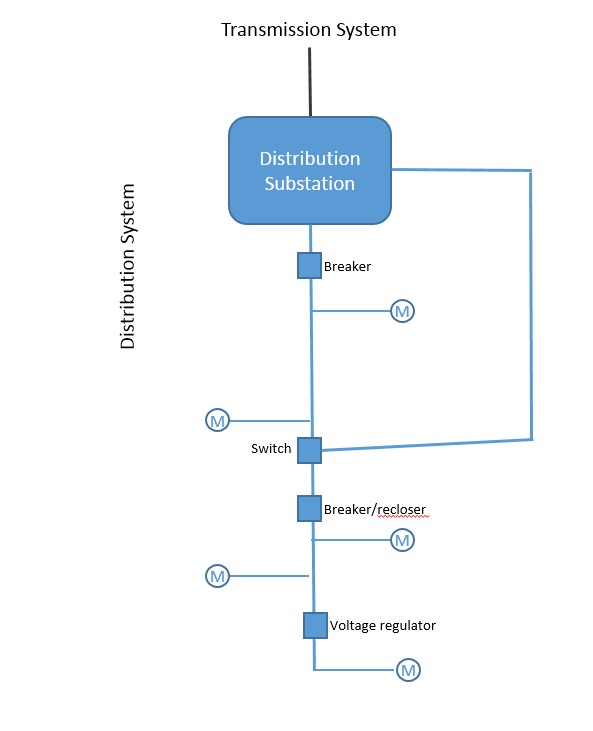
Here we see a very simple distribution circuit:

hidden revolution graphic

Prior to just a few years ago (and still in some areas of the grid) there would be no remote communication with the distribution substation or with the circuits beyond. Utilities would learn about an outage from customers calling in to complain. Then, the utility would send a crew to check the substation, then work its way down the line checking other components manually. If the problem occurred on the section of the circuit below the substation but above the switch, then the circuit would be switched manually to restore service to the customers on the bottom. This would likely take at least a few hours.  

Even on days without an outage, difficulties could occur. The voltage regulator near the end of the circuit, required to ensure sufficient voltage to the last customer, was set in a fixed position.  This means it could not respond to the actions of the customers, and often it would raise voltages higher than optimal simply to ensure this customer got voltage within the tariff requirements.

Today on an upgraded circuit, outages are reported automatically, crews can often be dispatched immediately to the location of the problem, and the grid may switch automatically to restore service to customers when possible.

Here is what has changed:

distribution automation chart

As you can see, grid capability has fundamentally changed. The result is reduced times for outage response (and in some cases, restoration of service automatically), reduced costs for maintaining voltages (utilities can often reduce peak demands by as much as 1%), and reduced maintenance costs through monitoring of conditions (for example, transformer oil can be changed as needed, not on a fixed schedule). 

As sensors, controllers, and monitoring equipment become even less costly, utilities will find more and more ways to efficiently upgrade their distribution systems. This will allow them to prepare for a rapidly approaching world where the distribution system is asked to do many unconventional things such as offer choices for power quality service levels, integrate numerous distributed energy resources, and protect against growing concerns about system security.  

This is a significant jump from the utility of yesteryear, yet today’s modern electric consumer is unlikely to notice a big difference. If you ask your next door neighbor what they think of the utility’s distribution automation program, you most likely will get a blank look!

Posted in Electricity | Tagged , , , | 1 Comment

State of Maine Proposes Alternative to Net Metering of Rooftop Solar

by Bob Shively, Enerdynamics President and Lead Instructor

Suppose you decide to install a solar photovoltaic (PV) system on your home. Unless you decide to also put in a big battery system and maybe a backup generator, you will want to remain connected to your utility so that the utility provides power during the night hours, on cloudy days, and other times when your home usage exceeds the output of your PV system. And, during hours when your PV system output exceeds your usage, you will also want to sell power back into the utility distribution system. 

The key question for you and the utility is what price you should be paid for solar output. How utilities compensate customers for solar power is becoming one of the most contentious energy issues around the nation. So what are the options? 

  1. Net metering: Your solar output over the year is netted against your usage, in essence paying you the retail rate for solar power even if you generate the power at noon and use it at 6 p.m. or in the middle of the night.
  2. Avoided cost: You are charged the retail rate for all power you use and paid the wholesale avoided cost rate for all the power you generate. 
  3. Feed-in-tariff: You are charged the retail rate for all power you use and are paid a price based on some determined value of your solar output for all the power you generate.

In 43 states plus the District of Columbia, net metering is the current policy. But numerous utilities have asked their regulators to look at the issue, and many have suggested either eliminating net metering or continuing it with a significant monthly fixed charge added to solar customers’ bills. 

The State of Maine recently did a net value of solar (VOS) study that came up with a rate as high as $0.33/kWh, much higher than the retail rate of $0.13. A group of Maine legislators proposed an alternative to net metering that would create a centralized standard buyer agency, which would contract to buy the output of roof-top solar. Solar from commercial and industrial customers would be paid an amount set in a competitive reverse auction where customers proposing solar projects would bid against each other, while residential projects would be paid through a declining block methodology.[1]

The standard buyer would then resell the solar power in the competitive wholesale marketplace (selling all products including capacity, energy, renewable credits, etc.) and, by tracking the revenues received, will over time discover the true value of the solar power.  

Whether Maine’s proposition or some other idea will prove acceptable to the various stakeholders around the U.S. remains to be seen. But, if nothing else, Maine is providing an innovative idea to try to break the deadlock.


Footnotes:

[1] For more details, see Maine lawmakers proposed groundbreaking way out of net metering wars, available at:http://www.utilitydive.com/news/maine-lawmakers-propose-groundbreaking-way-out-of-net-metering-wars/400074/

Posted in Electricity, Renewables | Tagged , , , , | 2 Comments

Recent EPA Study Examines Fracking’s Potential Impacts on Water Supplies

by Christina Nagy-McKenna, Enerdynamics Instructor,
and Bob Shively, Enerdynamics President and Lead Instructor

On June 3, 2015, the U.S. Environmental Protection Agency (EPA) released its draft “Assessment of the Potential Impacts of Hydraulic Fracturing for Oil and Gas on Drinking Water Resources.” While it should be noted that the study’s results are still in draft form iStock_000033313732_Mediumand are not yet official agency policy, the study found no evidence that hydraulic fracturing or “fracking” has extensive effects on U.S. drinking water supplies.

Possible impacts of fracking include excessive water consumption and a risk of water contamination. Here’s a quick look at each and what the EPA study concluded:

Water consumption

Fracking is very water intensive, with the average well requiring 1.5 million gallons. This number jumps to 4 million gallons if only horizontal wells are factored into the equation. In its study, the EPA looked closely at how water moved throughout the fracking process. When water is acquired for fracking, it competes with other uses such as municipal water systems and farming. 

The EPA found that, depending on what part of the country the gas well is located, the water source may be surface water, ground water, or reused fracturing wastewater. In western states that have a more arid climate it is more likely the water used for fracking is from the surface and ground waters. In the East, producers usually use surface water. Reused water is found most often in Pennsylvania.

Producers need to be aware of the geologic conditions and climate in which they operate so as to avoid negatively impacting the drinking water. For example, if ground water is drawn down too aggressively, it can take more out of an aquifer than what it can naturally recharge. Also, using too much surface water may alter how a stream flows. In a few locales, competition for water resources may be important, but overall the impacts of water acquisition have not proven significant.

Water contamination

In looking at various stages of the fracking process, factors contributing to possible water contamination include:

  • chemicals that can spill and leech into the soil
  • wastewater if inadequately treated and discharged
  • the movement underground of fluids due to a production well

Controlling these potential hazards is important as the EPA found that between the years 2000 and 2013, close to 9.4 million people lived within a mile of a well that was being fracked. Also, drinking water sources for 6,800 public water systems serving 8.6 million people were also within a mile of a hydraulically fractured well during this time period. 

In preparing the report, the EPA did find some instances where impacts on drinking water occurred but said the number of instances is small relative to the number of fracked wells drilled in recent years. This led the EPA to state that it “did not find evidence that these mechanisms have led to widespread, systemic impacts on drinking water resources in the United States.”

Next steps

The EPA’s draft is out for public review and comment, and we expect many parties on both sides of the fracking debate will participate. Once the report is final, it should provide more knowledge to allow state agencies to develop effective regulation that allows fracking to continue while protecting water resources from potentially negative impacts.


References:

“Assessment of the Potential Impacts of Hydraulic Fracturing for Oil and Gas on Drinking Water Resources,” United States Environmental Protection Agency, Office of Research and Development, Washington D.C., June 2015. 

 “EPA Blesses Fracking,” Silverstein, Ken, Fortnightly’s Spark, 2015.

 “EPA’s Fracking Finding May Prove a Boon for Industry,” Neuhauser, Alan, U.S. News and World Reports, June 5, 2015.

Posted in Natural Gas | Tagged , , | Leave a comment

The Home of the Future: A Profit Center for Residents?

by Bob Shively, Enerdynamics President and Lead Instructor

As the Electric Power Research Institute (EPRI) states in its report titled The Integrated Grid:

“The role and operation of the U.S. electric power system are undergoing profound changes driven by the spread of distributed energy resources (DER).”

Such changes will enable the residential energy consumer to become a “prosumer,” who is both a provider and a consumer of grid services. Enerdynamics’ latest infographic, the House of the Future, shows elements that will likely be integrated into new homes and retrofit into existing homes. (Click on infographic to print and/or download a PDF version.)

Ener_HOF_No_Boxes_v4

Future homes will use energy-efficient technologies that reduce overall energy usage. These include:

  • highly efficient appliances and lighting
  • a super-insulated shell and energy-efficient windows
  • geothermal heating and cooling that use thermal energy from the earth to efficiently heat and cool a home
  • a smart thermostat that keeps a home at an optimum temperature
  • a home combined heat and power (CHP) system that generates electricity and provides heat for hot water and/or space heating

While a single home will likely not include all of these elements, a mix of just some of them will significantly minimize the amount of energy required to meet desired lifestyle demands.

Once one’s needs to buy energy services from the grid are reduced, the next investment may be in technologies that lower energy costs (or even make them go negative so that homeowners are making money!). This may be achieved by shifting electric demand to times when power is the cheapest and/or by selling electricity back to the grid. This is what turns a consumer into a prosumer. Technologies that facilitate this change include:

  • smart appliances; adaptive lighting; a smart thermostat; a controllable water heater; and an electric vehicle with a battery — all of these allow consumers to time shift their electric usage
  • The previously mentioned CHP system, which provides capacity and electricity
  • A solar array that can also provide capacity and electricity
  • A home battery that can provide capacity, electricity, and regulation services and may also allow the homeowner to time-shift use of power bought from the grid or generated by a CHP system or solar array

Those who take advantage of these technologies’ benefits will want to remain connected to the distribution utility to get the economic benefit of selling these services. This requires a smart meter and a smart inverter that converts the power generated or the electricity discharged from batteries to the level of power quality needed for the distribution system.

All these components won’t run and optimize themselves alone, so a home energy management system (HEMS) is required to manage it all. HEMS users will simply use the convenient home energy app provided by their energy services provider (Google, Facebook, cable/internet provider, electric utility or energy retailer?) to set preferences and the system will then run itself.  Such efforts should result in a reduced energy bill at the end of every month.

Sound futuristic? All of these technologies are available today. But to fully integrate them as described above there must be changes to the electric utility model as well as innovative service providers who pull it all together. In some states around the U.S. and countries around the world, this future is not too far away.

Posted in Electricity, Energy Training | Tagged , , , , | 1 Comment

A Quick Look at Services Bought and Sold in an ISO

by Enerdynamics staff

Many who are new to the electric industry share a common question about Independent System Operators (ISOs): What type of services are bought and sold in an ISO?

 A thorough and easy-to-follow answer to this question is contained in the following video clip taken from Enerdynamics’ new online course titled ISO Market Basics. Just click on the following image to begin the video:


Want more insight into how ISOs function? ISO Market Basics, Enerdynamics’ newest full-length online course, is appropriate for those with little or no experience in ISO markets. The course looks at:

  • The role of ISOs and various market participants
  • The various types of electric markets available to market participants
  • The services that are traded in electric markets
  • How the ISO markets work

The course comprises 11 modules that include practical examples and exercises to help learners understand how markets are used in real life by various market participants. For more information or to buy a subscription, click here.

Enerdynamics offers discounts on bulk subscriptions and site licenses. Contact us at 866-765-5432 or info@enerdynamics.com for special pricing on bulk orders.

If you specifically are seeking to learn how the Midcontinent Independent System Operator (MISO) functions, we also have ISO Market Basics — MISO version available.

Posted in Electricity, Energy Training | Tagged , , , , | Leave a comment

Why Would a Commercial or Industrial Electric Customer Want a Battery?

by Bob Shively, Enerdynamics President and Lead Instructor

In a recent two-part series of blog posts, we looked at reasons a residential electric consumer would want a home battery. We concluded that in almost all cases, home battery systems don’t currently make sense for residential consumers other than as a threat to energy collagekeep utilities from creating overly punitive rate designs for those customers installing solar. But we mentioned that batteries may indeed make sense for commercial customers. So let’s explore why…

Walmart Wants Batteries to Manage Utility Bills

In a recent webinar[1], Walmart Director of Energy David Ozment described Walmart’s Vision 2020 energy procurement goals. By 2020 Walmart plans to increase procurement of renewables by 600% over 2010 and to accelerate efficiency so that the energy intensity of its buildings is decreased by 20% over the same time period. As Ozment described, Walmart is on the path to procuring 100% renewable electricity. But as Ozment also noted, this is an economic decision not a “feel good” or marketing strategy. Each project has to make economic sense.

Walmart plan for RE

A piece of this strategy includes using batteries to improve project economics. Walmart began pilot projects in 2013 with small 15-30 kW batteries that are charged at night and discharged during the day. This year, Walmart will pilot larger 200 kW batteries that are designed to be charged by roof-top solar systems. Its pilot partner is, interestingly, Solar City/ Tesla.

The smaller batteries have been used to time shift purchased power to take advantage of Time-of-Use (TOU) rates and to shave overall facility peak demand.  The larger batteries will be used to manage solar output so that it can be used at the time that will best reduce Walmart’s utility bills either through time shifting or peak shaving.  The larger batteries offer much more flexibility to manage bills since they can store an amount of power equal to a typical demand for a Walmart store.

Walmart is Using Batteries to Give Utilities What Utilities Want

Note the key point here – Walmart does not plan to use batteries to disconnect from the utility but simply to manage its utility costs by giving the utility what the utility rate structure tells Walmart it wants: power use at night rather than during the day, and lower monthly peak demands. Down the road, sophisticated commercial and industrial (C&I) customers in certain markets may also be able to increase the economics of batteries through participation in capacity and/or ancillary services markets.

Not too far in the future, it is likely that batteries will become a key asset for C&I customers to manage electricity procurement costs. Successful utilities will recognize this and devise rates and services that reward customers for using their assets to benefit the overall distribution grid.


Footnotes:

[1] See:  “Not Taking No for an Answer” available at  http://info.aee.net/advanced-energy-webinar-archive

Posted in Electricity, Renewables | Tagged , , , , | Leave a comment

Are Capacity Auctions Ensuring Reliability or Just Ensuring Generator Revenues?

by Bob Shively, Enerdynamics President and Lead Instructor

ISO Market Basics demo

ISO Market Basics demo

Enerdynamics recently developed a course titled ISO Market Basics that teaches electric industry newcomers the basics of the various services bought and sold in ISO markets. One of the key questions addressed in the course is “how can markets ensure that enough generation capacity gets built to reliably serve loads on peak days?”

Peaking Resources Rarely Run

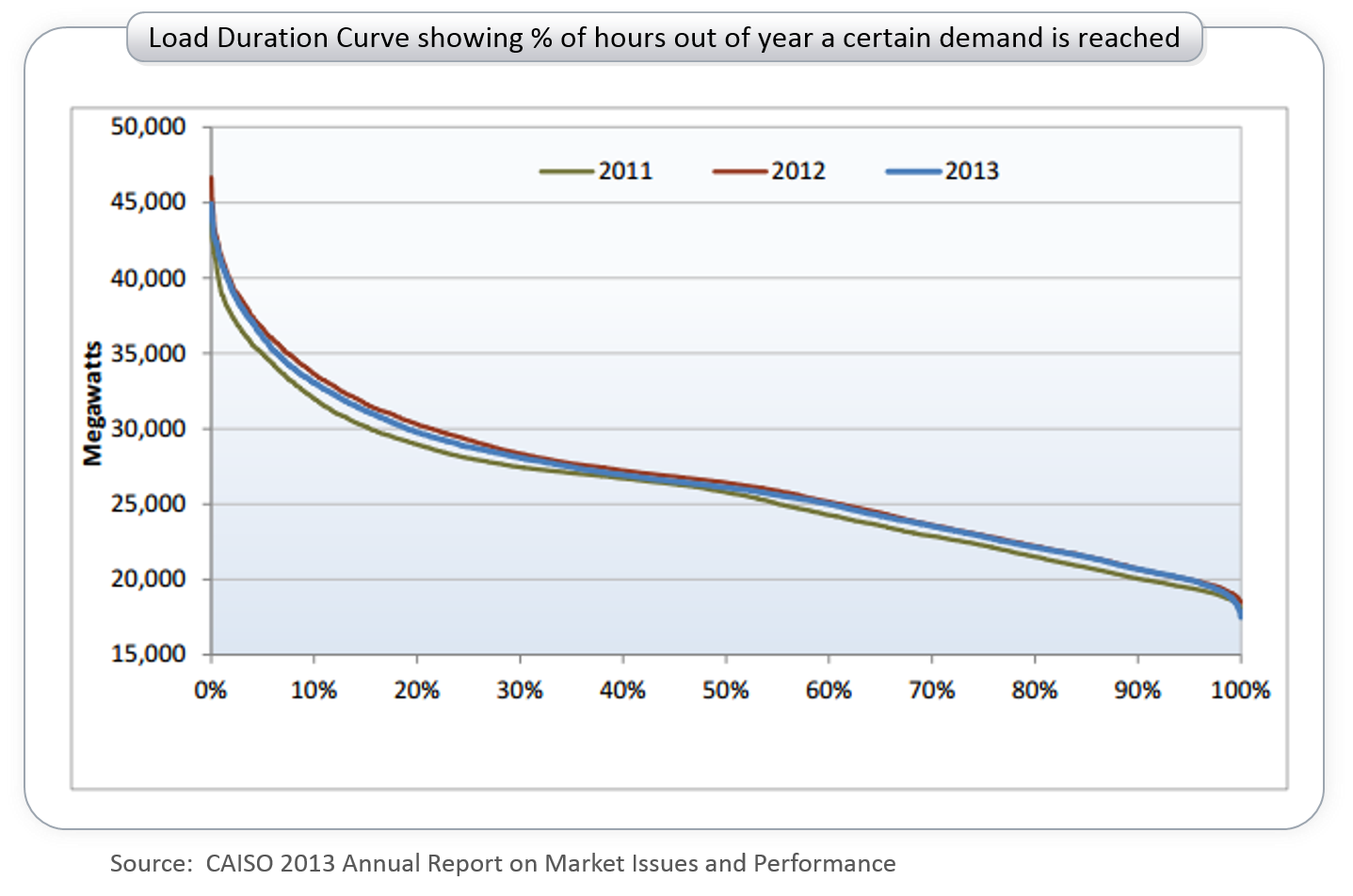
This question is a valid one in competitive wholesale markets because the last few peaking resources only get called upon a few hours out of the year (and some years might not get dispatched at all). In the days of vertically integrated utilities that was OK – utilities collected the fixed cost and rate of return for power plants in ongoing utility rates that were paid whether or not the unit ran.

load duration curve


How Sufficient Peaking Capacity Can Be Assured

Once peaking units are owned by Independent Power Producers (IPPs), their only source of revenue is market payments. This means that for the peaking units to survive in a competitive market, regulators must do one of two things: 1) allow prices to rise to very high levels during peak times so that generators can cover their annual costs and profits during just a few hours; or 2) create a revenue stream that pays generators simply for providing capacity.

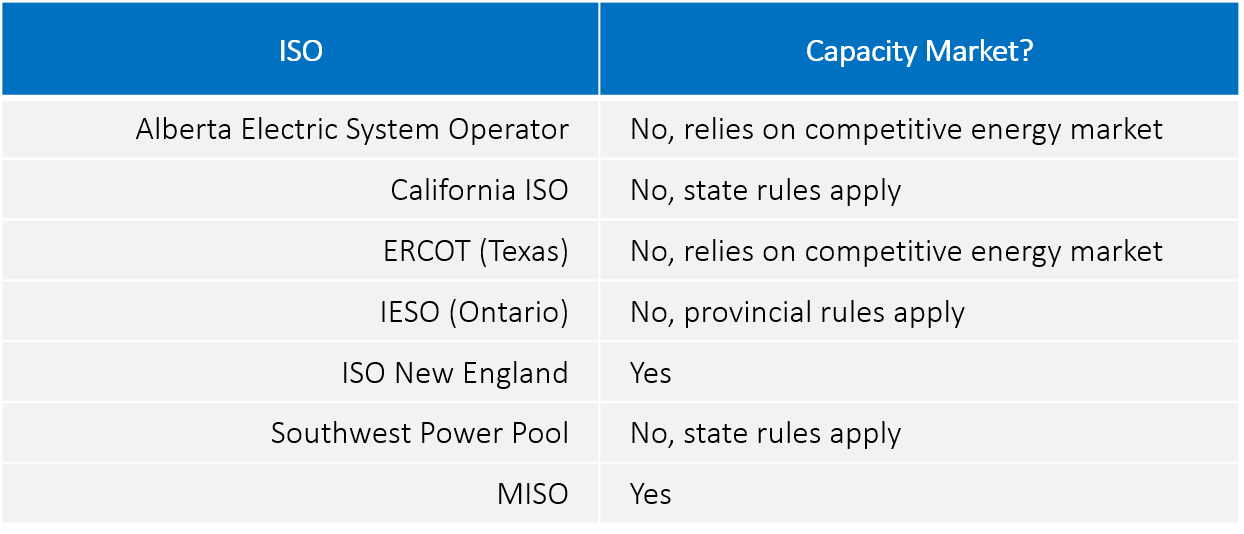
Allowing high energy prices during peak times has worked in markets such as Texas, but the concept often makes regulators and system operators uncomfortable since it may open the door to market manipulation opportunities and it fails to mandate a level of capacity that is available for reliability. Thus, many regions have chosen to implement a capacity market in which generators are paid monthly payments in return for having specified power plants available to the market throughout the year.

ISO capacity market chart


Issues with Capacity Markets

Clearly capacity markets create a revenue stream that helps get peaking generation built.  So why don’t all regions use them? There is a concern that capacity markets take more costs out of the competitive market and place them back into a regulatory construct that forces all market participants to jointly share the cost of power plants. To some this sounds a lot like the regulated days of utility rate base. And with all markets, there is concern that capacity markets are open to manipulation or other causes of excessive costs.

Indeed, in MISO where capacity costs have traditionally been very low, the recent auction resulted in prices in one region jumping from $16.75/MW-day to $150/MW-day.  This means households in Illinois will likely pay over $100 more annually for their electricity in coming years[1].  The debate about capacity markets shows how 20 years into electric deregulation, we still don’t have a consensus on how to manage the details.


Understanding details such as what a capacity market is and how prices can rise nine-fold in one year can be difficult for newcomers and those unfamiliar with details of ISO markets.  For a simple and easy-to-understand look at ISO markets and the services available in them, check out our ISO Market Basics class available in an online format. This course also is available as an instructor-led classroom seminar. Contact us at 866-765-5432 or info@enerdynamics.com for details. 


Footnotes

[1] See “Illinois AG accuses Dynegy of electricity market manipulation

Posted in Electricity | Tagged , , , , , , | Leave a comment

Why Would Consumers Want a Home Battery? Part II

by Bob Shively, Enerdynamics President and Lead Instructor

Our last post, Part I of Why Would Consumers Want a Home Battery?, we identified four “value adds” that homeowners may find compelling enough to buy and install a cool iStock_000063192597_Mediumnew battery system like the new Powerwall home battery system recently introduced by Tesla. These included:

  • reliability reasons if supply will be unavailable at a later time
  • economic arbitrage because power may be more expensive at a later time
  • avoiding specific utility charges associated with using the electric grid
  • making a roof-top solar system economical

We already examined the validity of the first two reasons (in Part I of this post). So this week we’re breaking down the reasoning at the final two potential motivators…

Using Batteries to Avoid Utility Charges 

So what about avoiding specific utility charges? This presents some possibilities.  A few utilities offer rates that encourage and reward electric customers for cutting usage at peak times.  Having a home battery could let a homeowner cut usage from the utility but still keep using certain appliances. Unfortunately, at least for now, the economic rewards are fairly minimal and it would take a number of years to pay for an outlay of $7,000 under these programs.

The one place where it could make good sense is for those customers building homes far from the existing electric grid. In this case, utilities often charge thousands of dollars extra to extend their distribution lines to a new home in a remote location.  In this case, a solar system coupled with Powerwall batteries could indeed be economic.

Using Batteries with a Solar System

This leads us to the last use, coupling home batteries with a home solar photovoltaic (PV) system. Most PV systems today are built on homes that remain interconnected to the utility system.  The systems generate electricity during the day, excess power flows back into the grid, and homeowners draw power back off the grid during the night and on cloudy days. Utilities use net metering for solar power, which means that any power you put onto the grid is credited against power you take from the grid at a later date. In effect, you are using the utility grid as a big battery and you don’t care what time of day your solar panels are generating power.

So again, unless you have time-of-use billing, there is no benefit to having a home battery.  But recently, utilities have started questioning net metering. Some have suggested that net metering payments should be reduced or, worse for those thinking of going solar, that the utility should charge monthly fixed fees as high as $50/month that would eat up most or all of the benefits of a solar system.

Here is where the home battery benefit could well come into play. If you have installed or are thinking of installing a home solar system, batteries are your insurance that the utility can’t wreck your economics. It’s an option that let’s the consumer say: “Want to make it too expensive to stay connected?  Fine, I’ll cut the cord and just use batteries to time shift my solar power.”

This also applies to situations in which utilities may limit the amount of solar power allowed on a specific circuit due to distribution design issues. In this case, the consumer can say “If you make it too hard for me to interconnect, I’ll cut the cord.”  Thus, in some regions of the country there may be a market for home batteries right away when they are included in a solar system. And most of the major solar installation companies active in the residential market such as SolarCity, Sungevity, and SunPower all have announced plans to offer their systems coupled with batteries.

solar output v home usage

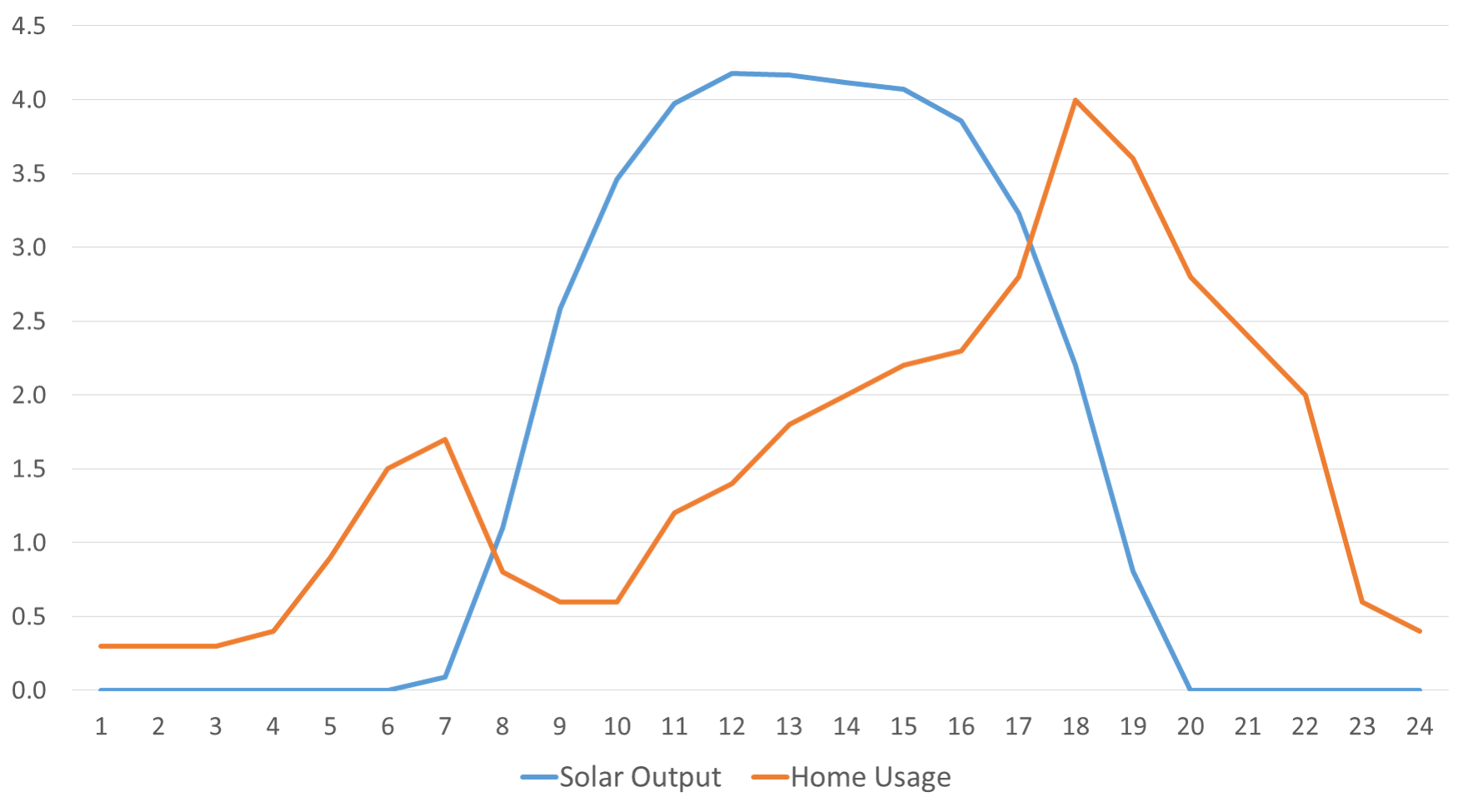
Solar output and home usage – storage to match solar supply to home usage can be supplied by utility system or by home battery

Home Batteries Put Utilities on Notice

Without solar, there really isn’t a compelling reason in today’s market to buy a home battery. And, unlike the Apple Watch, you probably won’t get too many “cool points” for having one. But as the home solar industry continues to evolve, and as utility companies try to respond to what many view as a threat to their historic profitable business model, lower-cost home batteries definitely change the equation.

Thus, the Powerwall battery announcement may have a lot to do with Tesla’s relationship to SolarCity as a warning to utilities to play nice. As a result, many utilities may decide to simply treat residential solar and home batteries as a future resource, design them into their distribution systems, and pay fair value for the benefits they provide. While these type of issues are playing out, batteries are more likely to make sense in commercial rather than the residential sector. We will explore that in a future post here on Energy Currents.

Posted in Electricity | Tagged , , , , , | Leave a comment