What is a Reasonable Rate of Return on Utility Infrastructure?

by Bob Shively, Enerdynamics President and CEO

“..the process of setting an allowed ROE has consistently proven to be the most contentious and subjective part of a rate case proceeding.”[1]

Much of the key natural gas and electricity infrastructure in the U.S. operates under the cost-of-service ratemaking. This is true for electric Investment-versus-return-concept-000069428007_Mediumtransmission and distribution, gas distribution, and most gas transmission lines. Cost-of-service ratemaking sets rates based on forecasted costs of providing service plus a “reasonable” rate of return on the equity invested by shareholders to build the capital facilities necessary to provide service. The return on equity (ROE) authorized by the regulator is not guaranteed since business results such as expenses and sales often impact the true return. Still, the authorized ROE is a key component of the expected level of earnings for a regulated utility.

Under ratemaking theory, the authorized return should balance the interests of ratepayers and shareholders: The rate should be just high enough to attract needed capital to maintain service reliability but no higher since anything above that level would provide shareholders with a profit level above what is necessary.

Rates of return are set by regulators after testimony by interested parties and analysis by regulatory staff. They vary based on the return on alternate investments such as bonds and other conservative business option, the amount of capital required, perceived risk associated with a specific company, and the regulatory climate in a specific locale.

Public Utilities Fortnightly has annually surveyed ROE authorized by state commissions since 1982. This year, authorized returns in the survey ranged from a low of 8.3% (ATCO electric and ATCO gas) to a high of 12.0% (Lockhart Power Company).  As shown in the graph below, most decisions clustered in the range of 9.0 to 10.3%.
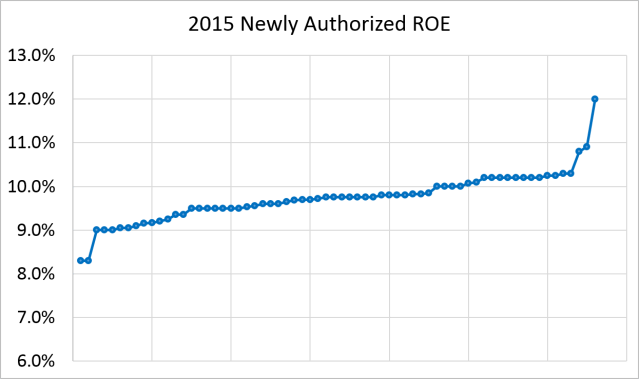
2015 ROE

In 2015, the median ROE was 9.8%. Since the economic downturn in 2008, ROE have dropped significantly as interest rates have fallen and investors have looked for lower risk inherent in most utility investment.
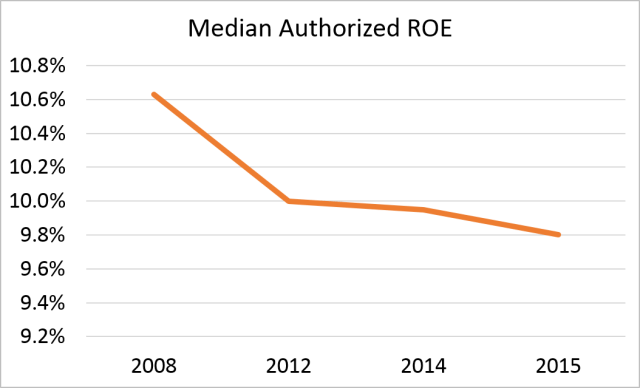
Median ROE

Given the size of many utilities’ ratebases, a small change in ROE can result in a change of authorized earnings of many millions of dollars.  And, of course, the flip side to that is that a small change can result in a change of rate levels paid by consumers.

So the next time your company goes in for a cost-of-capital case, you’ll realize just how much is riding on the percentage authorized by the regulator. And using the information from the Public Utilities Fortnightly annual study, you’ll be able to see how your company stacks up compared to other utilities.


Footnotes:

[1] “Equity Returns: ‘Allowed’ vs. Earned”, Phillip S. Cross, Public Utilities Fortnightly, November 2015

Posted in Electricity, Natural Gas | Tagged , , , , , , | 1 Comment

Will Entrepreneurs Save Us from Global Climate Change?

by Bob Shively, Enerdynamics President and CEO

“Producing large-scale, reliable, affordable, and carbon-free energy is one of concept_business.jpgthese key global problems. The swords that cut this Gordian Knot: breakthrough technologies built and deployed by entrepreneurial companies with global scope.” ~ Reid Hoffman, LinkedIn founder[1]
This week more than 150 world leaders are meeting in Paris to discuss action on climate change at the so-called COP21 (which stands for the 21st Conference of the Parties). The leaders are attempting to craft an agreement that will commit the various countries of the world to take action in addressing climate change. Some observers question whether politicians can truly come to agreement that will result in meaningful action before it is too late. As Microsoft founder Bill Gates notes: “It takes years to develop new sources of energy, and decades to make them a significant part of our energy mix.”[2]

Instead of waiting for regulatory initiatives, Gates and a number of other highly successful entrepreneurs including Jeff Bezos, Richard Branson, Vinod Khosla, George Soros, and Mark Zuckerberg have formed the “Breakthrough Energy Coalition”[3]. Reportedly the largest fund ever created to invest in clean energy development, the fund is intended to provide the capital needed to drive innovation from government labs to the market place. The need for such funding is outlined in the coalition’s investing principles:

“The private sector knows how to build companies, evaluate the potential for success, and take the risks that lead to taking innovative ideas and bringing them to the world. But in the current business environment, the risk-reward balance for early-stage investing in potentially transformative energy systems is unlikely to meet the market tests of traditional angel or VC investors – not until the underlying economics of the energy sector shift further towards clean energy.”[4]

The Breakthrough Coalition Concept:

blog infographic 12.2.15

Areas for investment include electricity generation and storage, transportation, industrial use, agriculture, and energy system efficiency. Investments will include new technologies as well as innovations that enable current technologies to become more efficient, scalable, or cheaper. For potential recipients of investment, “the key differentiating factor must be a credible pathway to rapid scaling – providing affordable energy to the greatest number of people without overburdening essential resources including land use.”[5]

What makes the new coalition different from other sources of capital?  Investors in the coalition state they are committed to long-term patient investment motivated not only by the desire to make money, but also to address the critical need to transition our energy systems. Will the result be the end to concerns over global climate change?  Of course there is no way to know, but there is room for optimism when some of the best business minds in the world are spending their money to try.


Footnotes:

[1] http://www.huffingtonpost.com/entry/green-technology_564f6d2fe4b0258edb315f71

[2] See Gates’ paper Energy Innovation available at http://www.gatesnotes.com/Energy/Investing-in-Energy-Innovation?WT.mc_id=11_30_2015_05_EnergyRD_BG-TW_&WT.tsrc=BGTW&linkId=19160797

[3] http://www.utilitydive.com/news/bill-gates-heads-largest-ever-public-private-partnership-to-fund-clean-ener/409994/

[4] http://www.breakthroughenergycoalition.com/assets/resources/breakthrough-energy-coalition-investment-principles.pdf

[5] ibid

Posted in Uncategorized | Leave a comment

Defining the Uses for Electricity Storage

by Bob Shively, Enerdynamics President and Lead Instructor

“Even without subsidies, certain storage technologies are already cost-competitive with certain conventional alternatives (for example, lithium-ion batteries for certain power grid support applications). Other storage technologies are close to being cost-competitive in other applications, and costs are expected to decline in coming years.

If industry projections materialize over the next five years, cost-effective energy storage technologies will have increasingly broad applications across the power grid, such as providing an alternative to conventional gas-fired peaking plants in certain areas.
– 2015 Press Release from Lazard

The holy grail of cost-effective electricity grid storage has been a dream for power engineers and system operators since the industry’s infancy.  While hydro pumped storage has proven economic for time-shifting supply from off-peak to peak periods when available, other forms of storage have failed to deliver on an economic basis.  This equation may be about to change as batteries and other forms of storage develop in performance and come down in price.

As utilities and other market participants consider storage as another tool to deliver reliable and cost-effective service, a key question is how to determine when investments in storage are justified. The difficulty is that the value is made up of multiple potential benefits to the grid. Valuing a power plant is fairly easy: The primary amount of its value is in energy and capacity provided, with a bit more value for various ancillary services.  Valuing a voltage regulator on the distribution system is similarly simple as one just has to determine the cost of voltage fluctuations the regulator will eliminate. But the value of storage can include multiple benefits that bridge from supply to distribution and vary by location of the storage device.

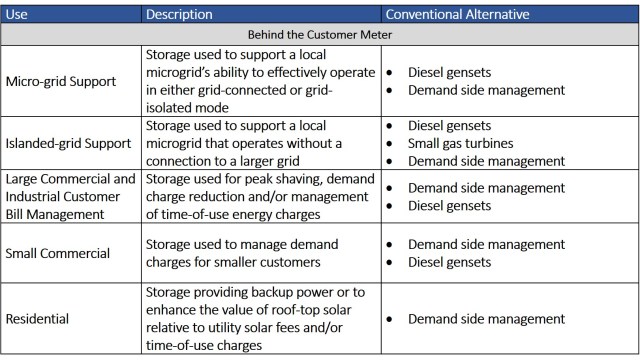
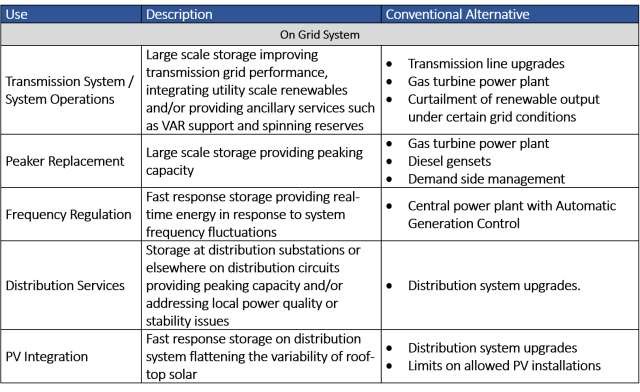
To help potential investors evaluate an investment, the financial advisory and asset management firm Lazard defines specific use cases. These are worth summarizing to help us visualize whether storage may make inroads into power systems and to understand with what other assets storage must compete. Following are the use cases outlined in Lazard’s Levelized Cost of Storage Analysis, with some adaption by Enerdynamics:

storage chart 1.jpg

storage chart 2

As market participants move forward with storage installations, the value of the various storage applications will be more apparent. This will allow potential investors to determine when and where storage has become economic.

Posted in Uncategorized | Leave a comment

Heat Rate: A Driving Force Behind Market Power Costs

by Bob Shively, Enerdynamics President and Lead Instructor

Participants in Enerdynamics’ seminars often wonder why market-based wholesale power costs fluctuate so much. Some say it is due to market control by generation owners who are manipulating prices to increase profits. In fact, that is rarely the case.  Most fluctuations in power prices can be explained by two factors – costs of fuel and marginal power plant heat rates. 

The Marginal Unit

To understand this, we must first understand the concept of the marginal unit.  The marginal unit is the last unit that must be used to serve customer loads during any period in time. Because power plants are usually dispatched based on least cost, the last unit turned on will be the unit with the highest variable operating cost. 

And, since generally no one wants to sell their power for less than the price of competitive alternatives (just like when you sell your house, you base it on comps of similar houses that recently sold, not a formula based on what you bought it for originally), the marginal unit sets the market price.

A representative dispatch stack showing the marginal cost of power at various times

A representative dispatch stack showing the marginal cost of power at various times

Heat Rate

So what determines which unit is the marginal unit?  In most cases, there are two key factors that go into the determination:

  1. The cost of the fuel used to power the unit
  2. The unit heat rate, which describes how efficiently the unit can convert the fuel to electricity.

In some cases other variable costs such as operating and maintenance (O&M) and emission allowance costs come in to play, but heat rate and fuel cost are most commonly the predominant variables. Heat rates are typically stated in units of Btu per kWh.  This tells us how many Btus of gas, coal, or oil are needed to generate one kWh of electricity. But since wholesale traders usually trade in units of MMBtu and MWh, heat rates are often described in units of MMBtu/MWh. 

Here are some typical heat rates for power plants:

Heat rate table


How Heat Rate Impacts Cost

Since the heat rate tells us how much fuel is needed to generation one unit of electricity, we can use the heat rate to calculate the variable fuel generation cost once we know the cost of fuel. 

heat rate illustration

Suppose gas costs $3/MMBtu. If a unit is a combined-cycle gas unit with a heat rate of 7 MMBtu/MWh, then the variable fuel cost of generation is:

$3/MMBtu x 7 MMBtu/MWh = $21/MWh

The unit will not run unless the market price of electricity is higher than $21. But if all the available combined-cycle units have been turned on and it is necessary to dispatch a single-cycle unit with a heat rate of 10 MMBtu/MWh, then the market rate will have to jump to at least $3/MMBtu x 10 = $30/MWh to get the single-cycle unit to run.  Thus, power prices can move quickly as the dispatch curve changes in response to changes in demand.

So, if you know the heat rates of the marginal units under various load conditions in a certain market and you know the market price of fuel, you are well on your way to understanding price behavior in that market. Fortunately, the market price of fuels is easily obtained. And, since there are only a handful of technologies out there and many units have revealed their heat rates in regulatory filings, it isn’t too hard to figure out marginal heat rates. Thus anyone willing to put in just a bit of work can gain this understanding of price movements.

Posted in Electricity | Tagged , , , , | Leave a comment

Helping Customers Make Sense of New Choices in a Distributed Energy World

by Matthew Rose, Director EMI Consulting and Enerdynamics Instructor

As the electric industry evolves to a more distributed model where end-use customers are directly involved in energy markets, new products will be required so that distribution and transmission system operators can effectively use distributed resources and give consumers the ability to manage their market participation. It is likely such products will be developed by entrepreneurial companies able to respond quickly to market needs. EnerNOC is one such company worth observing.

Boston-based energy software firm EnerNOC has successfully built a business around facilitating end-use customers’ participation in demand response (DR) programs. The company built its business by targeting customers able to manage their electric consumption and, in doing so, reap financial rewards offered by utilities and organized wholesale market organizations.

Over the past few years, however, changes within the demand response industry have impacted the extent and predictability of the financial rewards for demand reductions. Examples include:

  • The demand response business tends to be concentrated in the hotter summer months with limited activity and revenue in other months.
  • Regulatory issues affect the DR business including challenges to the calculations for determining incentives for reductions, customer baseline definitions, and rules for program participation.
  • Electricity demand has continued to decline across the U.S. (recognizing there are some regions seeing demand growth), resulting in greater access to capacity and reduced energy prices. These signals have prompted EnerNOC to rethink its offerings, expand its business reach, and offer a suite of more expansive products and services.

So how has EnerNOC responded to such industry changes?

EnerNOC has diversified from being a singularly focused demand response firm to a company offering broader energy intelligence software (EIS) that helps customers make sense of the new choices. Using its cash position, EnerNOC acquired several companies to advance offerings around facility enterprise management and thus facilitate customers’ energy-use optimization. This includes EnerNOC’s purchase of:

  • EnTech, which offered utility bill management software;
  • World Energy Solutions, an energy procurement software provider;
  • and Pulse Energy, a software solutions firm providing intelligence to commercial building customers to optimize consumption.

The integration of these pieces allows EnerNOC to approach customers with software solutions grounded on energy intelligence and actual building data[1]. The company also is advancing its offerings of emerging technologies primarily through strategic partnerships. For example:

  • EnerNOC announced a partnership with Tesla to promote and deploy energy storage projects.
  • EnerNOC negotiated partnership agreements with SunPower, a global provider of solar solutions and GridPoint, a data-driven energy management systems company.

EnerNOC’s plan is to assemble solutions supporting the full value chain of energy supply and consumption requirements for its customers. According to EnerNOC’s CEO, the decision to expand into energy intelligence software is based on the belief that “customers are looking for an energy platform to help them make sense of all the new choices they have.”


Footnotes:

[1] See for instance EnerNOC’s recent announcement that Walgreens is standardizing on the EnerNOC platform: http://investor.enernoc.com/releasedetail.cfm?ReleaseID=928753

Posted in Electricity | Tagged , , , | Leave a comment

Electric Utilities Preparing for Grid of the Future

by Bob Shively, Enerdynamics President and Lead Instructor

Distributed energy resources are among the biggest opportunities for utilities in coming years (see Utility Dive’s 2015 State of the Electric Utility survey).

Delivering on the opportunity requires utilities to rethink the traditional electric delivery system. Enerdynamics developed the following infographic to help explain the upcoming distributed grid (click on infographic to enlarge/download):

Enerdynamics Future Grid Infographic

Unlike today’s grid in which almost all power is generated from centralized resources and delivered through a one-way grid, the grid of the future will see power generated at both ends. Sources such as fuel cells, Combined Heat and Power (CHP), solar photovoltaics (PV), price responsive loads, and distributed storage will provide supply at the distribution level in competition with traditional centralized sources.

This paradigm will likely require a new entity called a Distributed System Operator (DSO) to facilitate local power markets in the same way that today’s Independent System Operators (ISOs) facilitate organized bulk power markets. DSOs will aggregate distributed resources and offer them into wholesale markets, thus allowing markets to select the most economic resource whether it is distributed or centralized. Distributed resources will compete not only to provide energy (kWh) but also will have the opportunity to provide capacity and ancillary services.

Electric utilities must reconfigure the distribution grid to make this vision a reality. Steps to such reconfiguration include:

  1. Install smart meters coupled with an advanced metering infrastructure (AMI) for all customers who wish to participate in markets. Many utilities are well into completing this step.
  2. Add distribution monitoring and automation so power flows from distributed resources can be managed without harming reliability and power quality. Many utilities are in the early stages of rolling out these technologies.
  3. Reconfigure or replace components as needed to provide for two-way flow. Distributed resources can put enough extra power onto the grid that electricity must sometimes flow backward through the distribution substation into the transmission system. Accommodating a two-way flow will provide the physical platform required to enable full utilization of distributed resources. Most utilities have only begun to think about how to achieve this last step, although a few have already done this for a few circuits.

Of course, none of this will be cheap. Utilities will need to focus on working with their consumers and regulators to find ways to cover costs while avoiding poor economic outcomes. That will be a topic for many future discussions.

Posted in Electricity | Tagged , , | Leave a comment

Gas Pipeline Proposals Abound in the European Market

by Christina Nagy-McKenna, Enerdynamics Instructor

Last April as Europe was reeling from the political instability of the Ukraine and annexation of Crimea to Russia, we wrote in a blog post that “gas pipeline projects are already responding to the events in the Ukraine: South Stream is dead. Shah Deniz lives. The EU [European Union] is strategizing to reduce its energy dependence on Russia while protecting all of its members from possible energy blackmail.”

Sixteen months later much has happened:

  • The relationship between the EU and Russia is layered with economic sanctions and mistrust.
  • Turkey is being courted by the East and West as the critical piece to pipeline projects that each side is championing.
  • An agreement between the U.S. and Iran may eventually bring Iran’s resources to the global market[1].
  • Lastly, there’s the matter of the EU’s $96 billion bailout plan to pull Greece’s economy off its tightrope and into safety. 

Each of these countries may play a role in the drama surrounding Europe’s energy security, Russia’s economic security, and the pipeline projects that factor into both.

Last year’s aggressive stance toward Ukraine resulted in the EU withdrawing support from the South Stream pipeline, a project that was going to bring Russian natural gas through the Black Sea and Bulgaria to Western Europe. Instead, the EU is pursuing another project in the southern corridor of Europe called the Trans-Adriatic Pipeline (TAP) to bring in gas from the Middle East and Central Asia, including the Shah Deniz reserve in Azerbaijan. 

 In December 2014 Russia officially cancelled the South Stream project and announced a new project, Turkish Stream, that pipes natural gas from Russia to Turkey and then on to Western Europe. Regardless of Russia’s strained relations with the EU, Europe remains an important market as 70% of Russia’s natural gas comes from Europe[2]. Whether all projects can be built is questionable as market demand is not robust enough. Perhaps for that reason, Russia is purportedly scaling back Turkish Stream and is quietly negotiating to expand its Nord Stream pipeline instead.

Read more about the politics surrounding these pipeline projects in the full-length version of this article in our Q3 2015 edition of Energy Insider


Footnotes:

[1] Note that Iran has the world’s largest amount of natural gas reserves.

[2] “The Energy Security Dilemma of Turkish Stream,” Natural Gas Europe, August 3, 2015.

Posted in Natural Gas | Tagged , , | Leave a comment

A Visual Look at the Electric and Natural Gas Delivery Systems

Natural gas and electricity take long and complex journeys from their original sources to their final end-use consumers. Understanding the various stages of each journey — commonly known as the delivery system — is important for those who work in the natural gas and/or electricity business.

Enerdynamics‘ latest series of infographics gives a visual representation of how electricity travels from generation to transmission to distribution and how natural gas goes from upstream to midstream to downstream.

These infographics are used in our industry basics seminars including Electric Industry Basics and Gas Industry Basics. We invite you to download and use these infographics in your own training so long as you attribute Enerdynamics as the source and include the Enerdynamics logo. Simply click on each infographic below to open and download the PDF file.


Posted in Electricity, Energy Training, Natural Gas | Tagged , , , , | Leave a comment

Who Do You Want to Provide Your Energy Services in the Future?

by Bob Shively, Enerdynamics President and Lead Instructor

“…our customers are the same people who dropped their landlines for cell phones, then switched wireless carriers to get the latest, greatest smart phones.  They cut their cable TV packages to the bare minimum and stopped renting DVDs from Blockbuster…”
~ Michael T. Burr, Editor-in-Chief of Public Utilities Fortnightly

In Enerdynamics’ seminar titled The Future of the Utility we explore scenarios on how
consumers may buy energy services in the future. Historically we think of buying our energy services from our local electric and gas utilities. That is, of course, if we even think about the commodity we buy as a service.

In some states, consumers have gained experience with energy retailers through deregulation of the commodity function, allowing service providers to sell gas or electricity directly to consumers[1]. Although consumers probably haven’t thought much about future energy services, many energy insiders envision a future world where energy services may become as diverse and numerous as services for your cell phone or multimedia delivered via your internet connection.

If this does occur, a key question is who will provide these services? Will utilities transform themselves into energy service providers, will new large energy retailers emerge, or will existing consumer-oriented companies move into the energy space? In our seminar, we ask the following question:

For electric services you might buy in the future, from whom do you want to buy them?

  • Your local electric utility
  • Apple
  • AT&T
  • Comcast
  • Ford
  • Google
  • An unregulated electric retailer
  • Someone else (who?)

Responses typically look like this:

Energy services provider poll answers

This suggests that utilities may fair best by finding ways to partner with consumer-oriented technology companies that are known and trusted by consumers. Who do you want to provide your future energy services? Share your thoughts in the comments section of this blog post!


Footnotes:

[1] See “Will a Gulf in Energy Services Become the Next Digital Divide?” at https://blog.enerdynamics.com/2015/01/22/will-a-gulf-in-energy-services-become-the-next-digital-divide/

Posted in Electricity, Energy Training | Tagged , , | 1 Comment

New Technologies That May Drive Our Energy Future

by Bob Shively, Enerdynamics President and Lead Instructor

“Technology is no silver bullet, yet it’s an essential part of the de-carbonization equation.” ~ April Reese, Discovermagazine.com

In recent years, the energy industry has made significant strides in moving toward technology that helps reduce greenhouse gas emissions including developments in wind, solar, biofuels, and electric vehicles. But as Dan Arvizu, Director of the U.S. National Renewable Energy Lab, recently stated at the IEEE Power and Energy Society conference, the technology that got us to the gigawatt scale in clean energy will not get us to the terawatt scale. And this matters in a world that in 2014 consumed more than 20,000 terawatt-hours of electricity.

So what new technologies might help society get to terawatt-hours of clean energy? Much research is being done by highly skilled and intelligent people, and, as Arivizu noted, progress in the lab is absolutely phenomenal. It is impossible to know what might become the technology of the future, but here are some interesting ones to ponder:

Solar satellites
Solar arrays in space are not hampered by many of the realities of land-based solar. Space arrays can receive sunlight almost all hours of the year and can take advantage of intense solar rays. It’s estimated that a photovoltaic (PV) cell in space can deliver up to 40 times more energy that the same cell would generate on earth. But how does the energy get back to earth? The energy would be converted to either laser beams or microwaves, sent to a receiving terminal on earth, and then converted back to electricity. Various entrepreneurial companies have attempted to develop a successful space energy business model, and ideas continue to be batted around in the world of venture capital.

satellite photo courtesy of NREL

satellite photo courtesy of NREL

Thermonuclear fusion
The same process that heats the sun might be harnessed as a high-powered source of energy. Fusion reactions occur when nuclei from two fuel atoms fuse under high temperature, resulting in a heavier nucleus. As the atoms fuse, high amounts of energy are released. The technology has been held back by the difficulties of containing the fuel plasma and making the process efficient enough given the large energy input required to start the reaction. But researchers in various countries continue development of viable concepts.

Small modular nuclear reactors (SMR)
Nuclear power is carbon free, but it has been held back in some countries due to safety concerns and the high initial cost of constructing nuclear reactors typically over 1,000 MW in size. Development work is now proceeding in multiple countries to adapt the nuclear fission process to smaller generators that can be manufactured in a factory and shipped to location in modules on the order of 200 MW.  These units could be designed for passive safety, meaning the nuclear fission would automatically shut down if safety issues occurred. Smaller units are attractive since they can fit demand needs more precisely and can be more viable for utilities to purchase.

Photoelectrocatalytic (PEC) water splitting
Clean hydrogen fuel has been created for years using water-splitting processes.  The problem? Energy input into the process is too high to create a viable industry. But certain metal alloys with semiconductor properties are capable of absorbing sunlight to separate charges that can be used to split water. In the lab, it has been shown that these materials can convert sunlight to hydrogen fuel. Researchers are now working on extending the concept to a workable technology.

These are just a few of many interesting concepts in R&D. Others include advanced biofuels, ocean thermal energy conservation (OTEC), green buildings that generate more power than they consume, and new generation PV materials. Will any of them come to fruition? All could be long shots, but so were many of the technologies we now take for granted.

Posted in Electricity, Energy Training, Renewables | Tagged , , , | Leave a comment